
What the day feels like
You arrive before breakfast light loosens over the Andean ridges and the road to Baños unfurls beneath a low cloud. The van slows at a lookout and the valley opens like a folded map—ribbons of road, the silver thread of the Pastaza River, and terraces that stair-step toward a green wall of cloud forest. By the time you reach town, steam is already rising from the natural baths; the air smells faintly of hot mineral water and cut grass. In Baños de Agua Santa, everything feels slightly exaggerated—the waterfalls thunder a little louder, the views are a touch more vertiginous, and the invitation to try something wild is nearly constant.
A full-day private tour from Quito compresses the best of Baños into a compact, high-energy loop: the thunder of Pailón del Diablo, the giddiness of Casa del Árbol and its famous swing, options for canopy, bungee and rafting, and the restorative soak of the thermal pools. The day moves fast but thoughtfully—there’s a rhythm here, an alternation of adrenaline and quiet that mirrors the landscape. A short hike brings you behind the spray of an enormous falls; a cable glider zips you across a gorge; the Pastaza river dares you to read its current. It’s an itinerary built for appetite—a hunger for views, for speed, and for simple, earthy pleasures like trout grilled over wood.
Geology and history give Baños its character. The town sits at roughly 1,820 meters (about 6,000 feet), where the eastern Andes begin to spill toward the Amazon basin; rivers cut deep, waterfalls cascade off volcanic rock, and the nearby Tungurahua volcano—an active cone that punctuates the skyline—reminds visitors that this is young, restless terrain. Local culture has long fused indigenous Andean traditions with Catholic practice; the town’s full name, Baños de Agua Santa, references a 17th‑century devotion to the Virgin of the Holy Water, whose shrine still draws pilgrims and neighbors alike.
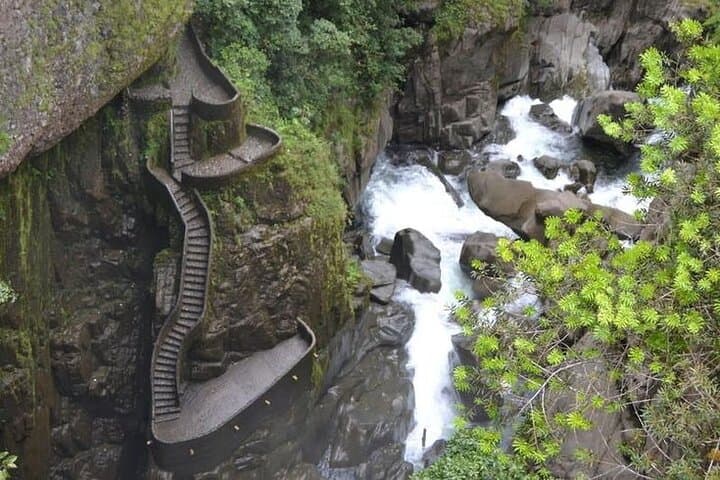
The trip’s centerpiece, Pailón del Diablo, is a study in water’s appetite for drama. A short, steep path threads through cloud forest and ends at a platform where the falls pour into a churning cauldron—mists cling to your jacket, and the roar rearranges conversation into whispers. Nearby, Casa del Árbol perches on a ridge facing Tungurahua; the swing—push your feet over a cliff and the world drops away—doesn’t so much let you fly as force you to negotiate between fear and joy.
Why book a private day out of Quito? Logistics are part of the appeal: pickup and drop-off remove the guesswork of mountain driving and altitude adjustment, and a private guide can time the route to avoid afternoon storms and to fit in optional activities—whitewater runs on the Pastaza, zip-line circuits through cloud forest, or a bungee jump from a hand-built platform. Practicalities matter: expect 6–8 hours on the road (the organized portion of this tour runs roughly 360–480 minutes), a scenic drive of about 3–4 hours one-way from Quito if you choose to self-drive, and an elevation change that can feel brisk if you’ve just come from high-altitude Quito.
There’s a practical engine beneath the drama. Footwear needs grip for wet walkways and river stone; a layer that sheds mist and light rain makes long photo stops comfortable; a reusable water bottle and electrolyte snacks help with the quick ups and downs of activity. Timing is everything—mornings are typically the clearest for volcano views; afternoons bring convective rain during the wet season.
Beyond the checklist, the human side of Baños is warming and immediate. Vendors thread the market with carved wood, smoked trout, and canelazo—a warm, spiced sugarcane-based drink that tastes like local hospitality. Guides and outfitters are small, local businesses for whom tourism is livelihood and stewardship. Respect the path, carry out what you bring, and consider a tip for a guide who knows the best vantage points or how to read the river’s moods.
End the day in quiet if you can: a soak in Termas de la Virgen, steam curling off the pools while the volcano smolders on the skyline, or a casual meal of trout and plantain at a riverside restaurante. If you leave Baños with plastered-grin photos of a swing mid-flight and the smell of wet forest in your jacket, you’ll have also collected something quieter—the sense that this valley rewards curiosity, and that the Andean edge is a place where playful risk and deep rest are braided together.
If you’re planning it: aim for a dry-month window (June–September) for clear vistas of Tungurahua, do a little acclimatization in Quito if you’re coming from sea level, and book a private transport to make the most of daylight. The day is a tidy package of kinetic joy and soft endings—exactly the kind of trip that leaves you wanting more.
Trail wisdom
Small choices, better day.
Expect Moisture
Trails near waterfalls are slick—wear grippy shoes and pack a lightweight waterproof layer.
Time Your Views
Mornings are clearest for volcano and valley sightlines; plan high viewpoints early to avoid afternoon cloudbuild.
Bring Local Cash
Small vendors, tipping, and some activity operators accept only cash—carry local currency.
Hydration & Altitude
Move at a steady pace, drink water and use electrolyte snacks—altitude and activity combine quickly.
Local knowledge
Read the place, not just the route.
Watch for native species including Hummingbirds (various Andean species), Howler monkeys and occasional toucans in the cloud forest.
Keep an eye out for wildlife during the transition between areas and habitats. Respect distance guidelines.
Trails and rivers near Baños are sensitive; stick to marked paths, avoid single-use plastics, and book licensed guides who support local stewardship.
Follow the guide's instructions on size limits, ethical handling, and leave-no-trace practices.
Ruta de las Cascadas viewpoints along the road to Puyo. Termas de la Virgen early-morning pool for fewer crowds
Locally recommended viewpoints and quiet spots known best to local operators.
Baños’ full name, Baños de Agua Santa, references a 17th‑century devotion to the Virgin of the Holy Water—her shrine remains an active cultural center.
Maritime roots and regional tradition shape the waterways and working coasts.
Seasonal guide
Four versions of the same landscape.
Spring
Best forLush cloud forest · Fewer tourists
ChallengesIntermittent rain · Slippery trails
Spring (Mar–May) brings abundant greenery and flowing falls; expect showers and pack accordingly.
Summer
Best forClear volcano views · Best window for photography
ChallengesHigher visitor numbers · Cool mornings
Summer (Jun–Aug) is the driest period—ideal for clear vistas of Tungurahua and outdoor adventures.
Fall
Best forGolden light at sunset · Comfortable daytime temps
ChallengesIncreasing rain late season · Variable river flow for rafting
Fall (Sep–Nov) can deliver crisp light and quieter afternoons, though storms return toward November.
Winter
Best forWarm thermal soaks · Lower-angle winter light
ChallengesFrequent rain and cloud · Possible activity closures
Winter (Dec–Feb) is wetter; plan for rain, and prioritize thermal pools and cultural stops.
Operator details
What the booking data adds.
Included
- ✓• Professional bilingual guide • Hotel/port pickup and drop-off • Private transportation
Not included
- —• Entrance fees
- —Lunch
- —• Tips
Good to know
- ✓Infants and small children can ride in a pram or stroller
- ✓Service animals allowed
- ✓Infants are required to sit on an adult’s lap
- ✓Not recommended for pregnant travelers
- ✓Not recommended for travelers with poor cardiovascular health
- ✓Travelers should have at least a moderate level of physical fitness
Pack with intention
What to bring.
Good to know
Common questions.
This private tour runs approximately 6 to 8 hours (360–480 minutes), including transport, viewpoints and activity time—exact length depends on chosen add-ons.
Plan the edges
The details that make the day easier.
Baños is named for a 17th-century devotion to the Virgin of the Holy Water (Nuestra Señora del Agua Santa); pilgrims still visit her shrine in town.
After the hike, eat grilled trout at a riverside comedor and warm up with canelazo in the town plaza; browse artisan stalls for wood carvings and textiles, then finish with a soak at Termas de la Virgen to unwind.
- Closest airport
- Quito (UIO). Typical drive: ~170 km
- 3–4 hours from Quito. Trailhead
- Baños town center. Cell service: Generally good in town, intermittent near some vantage points. Permits: No national permits required for this route; activity operators require waivers.
Baños’ rivers and trails are ecologically sensitive—pack out waste, use refillable water bottles, and choose local guides who invest in trail maintenance and community initiatives.
Explore by topic
Follow the threads.
Keep exploring
Make the story part of the trip.
In four hours you can move from shaded canyon ferns to wind-scoured coastal ridgelines, guided by someone who knows where the light—and the hidden views—live. This private half-day hike on the Monterey Peninsula or Big Sur is compact, curated, and perfect for travelers who want depth without a multiday commitment.
 Related story
Beneath a sky of shifting light, Skaftafell’s ice reads like a map of time. This three-hour guided glacier hike mixes technical instruction with geology and culture: compact, safe, and unforgettable.
 Related story
Lose the city for a few hours without leaving it: this 5-mile, 900-foot-gain Forest Park loop threads old-growth pockets, city viewpoints, and cultural landmarks for a compact taste of Portland’s wild side. Expect moss, roots, and stories.