
What the day feels like
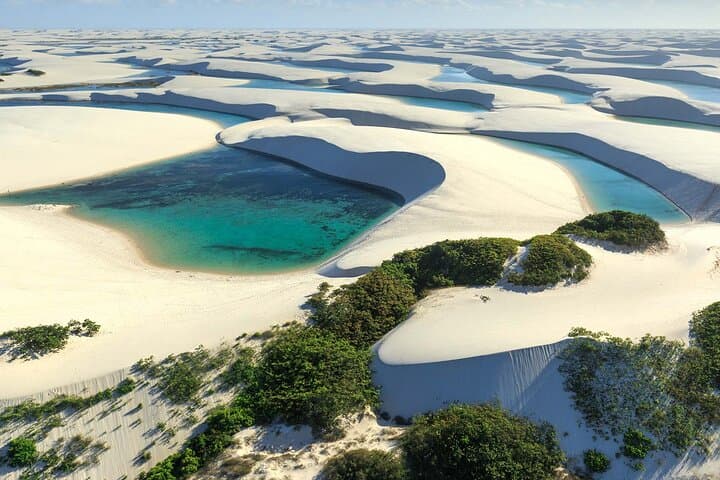
The Toyota's tires grunt and slide, a small orchestra of clattering metal and soft sand as we climb from a scrubby backroad into the open lobed forms of Lençóis Maranhenses. The dunes arrive unannounced, a white, rolling country that feels less like ground and more like a moving ocean halted mid-breath. Lagoons glint like eye-holes cut into that ocean — deep blue, green and impossibly clear — daring you to leave footprints on their rims. Our day starts before the sun cooks the sand; by 8:30 a.m. we’ve already left Barreirinhas behind and are threading a one-hour off-road trail toward Lagoa do Gavião, the first of many suspended pools that make this landscape a paradox: desert that cradles water.
What you notice first is the scale. The dunes are not cliffs but living slopes; wind sculpts them nightly, and the lagoons respond like memory — filling during the rainy season and slowly shrinking as the sun does its work. Geologically, Lençóis Maranhenses sits on a coastal plain where river sediments and Atlantic winds combine to pile sand into a slender park of ridges and basins. The result is a choreography of sand and rain. Local people call it a spectacle and a mood — and they’ve learned to time their lives around it. From June through September the lagoons flush with freshwater, an inland archipelago that invites swimmers and photographers alike.
The cultural thread here is as strong as the tides. Our route bends toward the sea at Canto do Atins, a hamlet where charcoal smoke from seaside kitchens announces the day’s catch. For decades the families here — including the famed restaurants of Mr. Antônio, Mrs. Luzia and Carminha (Ponta do Mangue) — have cooked simply: grilled shrimp, fish fresh from the surf, and carne-de-sol (sun-dried beef) done over coals. Lunch, served on a shaded patio, tastes like the coast: salt, smoke and citrus. People move slowly here; the day’s tempo is set by tide and wind.
After the heat of lunch, the tour winds to the village of Atins and the mouth of the Preguiças River, where river water and Atlantic current push and pull. The meeting point is theatrical: mangrove fingers splay into the estuary, and boats cut a silver line across reflections. Back on the dunes we stop again and again — at Lagoa das Sete Mulheres, Lagoa Tropical, Lagoa do Kaite — each pool a different shade, each rim a different angle for a photograph or a quiet moment to watch dragonflies skitter over glassy water. The return to Barreirinhas at around 5:30 p.m. feels like coming back from another world, a landscape whose scale you only appreciate after you’ve spent the day inside it.
Practical specifics: this is a full-day experience — plan on about nine hours from pickup to drop-off. Driving is predominantly by 4x4 over sand tracks; expect short walks from vehicle to viewpoint or lagoon rim, usually flat but involving soft sand that favors good ankle support. There’s no major elevation gain — the challenge is the heat, the sun and the sand itself. Bring hydration and a lightweight pack for swims, snacks and a camera.
Why go? Because Lençóis Maranhenses is an exercise in contrasts. You’ll walk on dunes that feel like snow at noon, swim in freshwater pools that seem impossibly pure, and eat a lunch cooked over local firewood while fishermen mend nets. It’s visceral, accessible and intimate: many visit independently, but a guided 4x4 tour unlocks the best lagoon stops in a single day and delivers local context — where to eat, where to stand for the best light, and how the rhythms of village life meet the rhythms of the sea.
Timing matters. Dawn and late afternoon offer softer light and cooler temperatures; between noon and 3 p.m. the sun is fierce. Plan for sun protection and circadian pacing: stop for brief swims to cool off, sip electrolytes, and don’t overdo the midday walks. Shoes: closed-toe trail shoes or sturdy sandals that resist sand are preferable. Photography: wide-angle lenses capture the scale; low sun makes every dune pop. For conservation, stick to existing tracks and minimize sunscreen run-off in the lagoons; local guides will point you to the least fragile routes.
End-of-day recommendations: sample grilled shrimp at Carminha or a cold cerveja in Atins while watching kitesailers launch (Atins is a small kitesurfing hub). If you have more time, base yourself in Barreirinhas for further exploration — boat rides on the Preguiças and night markets give another layer to the region.
This is a day for senses and logistics: bring water, respect the dunes, and let the landscape do the talking. The lagoons invite; the dunes dare. The only question is how long you’ll stay listening.
Trail wisdom
Small choices, better day.
Start early
Pickup is typically 8:30 a.m.; early starts avoid the worst midday heat and get you to lagoons when they’re clearest.
Hydrate and use electrolytes
Carry at least 2–3 liters per person and a sachet of electrolytes—heat plus sand walking dehydrates fast.
Footwear for sand
Choose closed-toe trail shoes or sturdy sandals that keep sand out and dry quickly after swims.
Respect lagoon ecology
Avoid using sunscreen or insect repellent right before swimming to reduce pollution; rinse on shore with biodegradable soap if needed.
Local knowledge
Read the place, not just the route.
Watch for native species including Herons and ibis around the estuary, Small freshwater fish in lagoons.
Keep an eye out for wildlife during the transition between areas and habitats. Respect distance guidelines.
This is a protected area—stick to established tracks, pack out trash and avoid contaminating lagoons with sunscreen or soaps.
Follow the guide's instructions on size limits, ethical handling, and leave-no-trace practices.
Walk the mangrove boardwalks at the Preguiças River mouth at low tide for birdwatching. Early-morning walk to smaller inland lagoons for tranquil reflections and fewer crowds
Locally recommended viewpoints and quiet spots known best to local operators.
Lençóis Maranhenses formed over millennia from river sediments and Atlantic winds; the region has long been home to fishing communities who adapted to seasonal changes in lagoon levels.
Maritime roots and regional tradition shape the waterways and working coasts.
Seasonal guide
Four versions of the same landscape.
Spring
Best forFewer visitors · Cooler mornings · Emerging lagoons
ChallengesIntermittent rain · Variable lagoon levels
Spring brings transition—some lagoons begin filling after rains; expect cooler mornings and occasional showers.
Summer
Best forWarm water swims · Clear blue skies · Extended daylight
ChallengesHigh heat and sun · Crowded weekends
Summer is hot and bright—ideal for swimming if lagoons are full, but bring strong sun protection and plan around midday heat.
Fall
Best forPeak lagoon levels · Stable weather · Photogenic light
ChallengesIncreased visitor numbers · Limited shade
Fall (July–September) is prime: lagoons are fullest and light is excellent for photography, though sites are busier.
Winter
Best forQuieter trails · Cooler temperatures · Off-peak pricing
ChallengesLower lagoon levels · Shorter daylight
Winter sees fewer visitors and cooler temps but some lagoons shrink—still dramatic, but less swimable in places.
Operator details
What the booking data adds.
Included
- ✓Transport in Toyota 4x4
- ✓Guide accompaniment
Not included
- —Lunch
Good to know
- ✓Public transportation options are available nearby
- ✓Infants are required to sit on an adult’s lap
- ✓Suitable for all physical fitness levels
- ✓Our tours do not include expenses for food, drinks and other extras;
- ✓Activity shared with other passengers.
- ✓Cancellations made at least 24 hours in advance will result in a full refund. On the day of the tour, there will be no refunds;
- ✓What to bring: Comfortable shoes and clothes, swimwear or a change of clothes to change into, towel, insect repellent, sunscreen and cash and/or credit or debit card to pay for extra expenses;
- ✓If the bilingual guide is not available on the day of your tour, don't worry: the guide will use a digital translator to ensure communication and the best possible experience.
- ✓Consumption of alcoholic beverages is prohibited in the Park and on the vehicles — subject to fine
- ✓The lagoons visited may vary depending on the time of year, as they are fed by rainfall. During periods of low rainfall, some may dry up and become inaccessible. Therefore, the itinerary is determined based on natural conditions on the day of the tour. Note: Some lagoons may disappear due to weather conditions.
- ✓As this is a group tour, the departure time may be subject to slight delays due to the boarding process and the route taken to pick up passengers from their accommodations.
Pack with intention
What to bring.
Good to know
Common questions.
The tour runs about 9 hours total with pickup around 8:30 a.m., returning to Barreirinhas by roughly 5:30 p.m.
Plan the edges
The details that make the day easier.
Lençóis Maranhenses National Park contains vast seasonal freshwater lagoons that fill during the rainy season—peaking between June and September—creating a unique landscape of dunes and clear pools.
Lunch in Atins is part of the trip: try grilled shrimp or peixe at Mr. Antônio, Mrs. Luzia or Carminha (Ponta do Mangue), then sip a cold cerveja while watching kitesurfers or locals repair nets.
- Closest airport
- São Luís (SLZ) — ~4–5 hours drive to Barreirinhas; Tour pickup: Barreirinhas; Driving: off-road 4x4 over sand tracks; Cell service: intermittent outside towns; Permits: park entrance fee and small environmental fees may apply at visitor centers.
Lençóis Maranhenses is a protected national park—stay on designated routes, avoid contaminating lagoons with chemicals, and support local businesses to benefit coastal communities.
Explore by topic
Follow the threads.
Keep exploring
Make the story part of the trip.
 Related story
Less than two hours from Nairobi, Kereita Forest pairs hands-on canopy adventure with quiet montane trails and a sobering colonial history—perfect for families, teams, and curious travelers seeking a full-day pulse of nature.
Set out from Bass Harbor for a private, customizable day on Blue Hill Bay — lighthouses, puffins, seals, and the chance to feel Acadia from the water. Small groups, local captains, unforgettable views.
In four hours you can move from shaded canyon ferns to wind-scoured coastal ridgelines, guided by someone who knows where the light—and the hidden views—live. This private half-day hike on the Monterey Peninsula or Big Sur is compact, curated, and perfect for travelers who want depth without a multiday commitment.