
What the day feels like
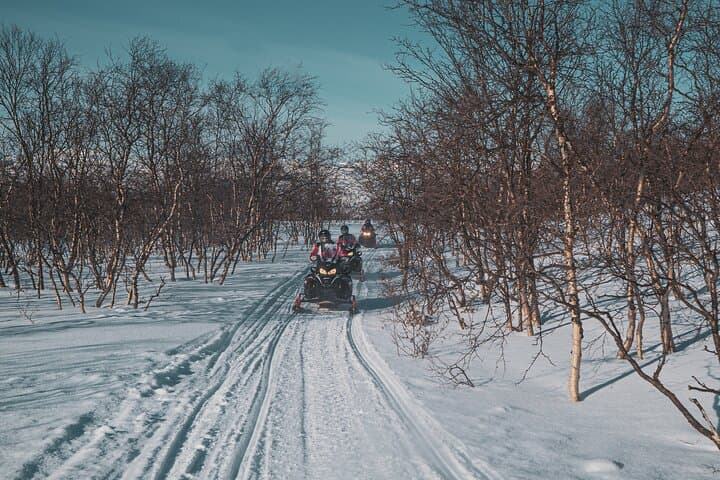
You climb out of the warmth of a 150-year-old mountain lodge into a world that has been pared down to essentials: cold, wind, and a sky so vast it makes the horizon feel like a promise. Gargia Valley is still, the lodge’s timbers creak with history, and a guide hands you a helmet and a steaming cup of coffee while sketching today’s route across the old postal road. What follows is four hours that pull you out of everyday scale — through snowbound forests, across the edge of a plateau, and onto Finnmarksvidda’s open, lean plains where only tracks and the sky mark direction.
This is not a joyride. It’s a short, charged apprenticeship in arctic movement. Your guide shows you how to handle the sled: throttle, lean, and how to read a surface that looks uniform from a distance but changes texture with every drift. For the first half hour you thread a lane of trees and frozen streams, the pines brushing flecks of snow off their needles as if sweeping your passage. Then the forest yields and you climb onto Beskades’ shoulder to meet Finnmarksvidda itself — an expanse of tundra where the air is large enough to carry a conversation across dozens of kilometers.
Finnmarksvidda is Norway’s high, rolling tundra plateau, shaped by ancient ice and grazed for centuries by Sámi reindeer herders. The route takes you along the old postal road — a ribbon of history linking remote settlements in winter — so the ride becomes both a landscape transit and a little lesson in regional life. Your stops are practical: to swap batteries, check runners, taste locally made snacks, and listen as the guide explains reindeer migration patterns, and how the seasons flip the land from a road network of packed snow in winter to an unbroken wilderness in summer.
There’s geology here that rewards a slow look. Up close, the plateau’s stones are pocked and striated by glacial scouring; up high the ground becomes a visual argument of white on white, where wind and snow create ridges and bowls that make this journey as much about reading the terrain as riding it. Cultural markers are quieter but persistent: occasional fenced corrals, the low profiles of winter shelters, and the sense that the Sámi relationship with the land runs parallel to — and sometimes overrides — the map you are following.
Practicalities are straightforward and pragmatic. This outing is fixed at four hours (roughly half riding and half immersive stops), equipment and instruction are provided, and the certified guide is charged with both your safety and your sense of adventure. The trip is ideal for people who want a concise but full-bodied arctic experience without the commitment of overnight expeditions. It’s also a photoable window into why northern Norway’s winter travel scene is an education in extremes: crisp light, deep silence, and — if you time it right — the aurora threading the night sky.
For planners: this is a winter-sports offering out of Alta with instant confirmation and a price that reflects its curated nature. Dress in layers: windproof outer shells and insulated mid-layers are non-negotiable. Bring good boots, clear goggles for bright days and low-vision lenses for flat light, and learn to let the sled do some of the steering; the plateau rewards calm, deliberate movement.
If you want to know more, local operators host a detailed itinerary online where you can learn about the lodge, the postal road, and the full logistics of the ride. Bookings and local expertise are consolidated here: <a href="https://app.advcollective.com/local-experts/explore-finnmarksvidda-4hr-snowmobile-journey-arctic-norway">Explore the Finnmarksvidda 4hr Snowmobile Journey</a>. That page also outlines how the guides tailor the day to wind, snow conditions and the group’s experience.
Why go? Because the trip compresses core northern Norwegian experience into a single, memorable half day — history, culture, and a competent, exciting way to move through wild country. It’s accessible to first-timers who want technical guidance and to seasoned riders who appreciate the plateau’s honest, uncompromising terrain. Travel here feels both intimate and elemental: the land doesn’t lean forward to meet you, it simply offers itself, and you choose to move through it.
After the ride there’s time for conversation back at the lodge: about reindeer herding schedules, the history of mail delivery across this plateau, and the practicalities of living in a latitude where seasons define livelihoods. If the sky is clear and night falls early, the aurora can punctuate an already full itinerary — a concluding reminder that in this part of the world, weather and light are as much part of the trip as the machines and the route.
For those building a winter itinerary in northern Norway, this four-hour ride is a useful building block. It’s short enough to fit into a multi-day trip that includes dog sledding, cross-country skiing, or an Alta Museum visit, and it’s intense enough to stand on its own as an arctic story you’ll tell for years. Learn more or reserve your place with local experts at <a href="https://app.advcollective.com/local-experts/explore-finnmarksvidda-4hr-snowmobile-journey-arctic-norway">Explore the Finnmarksvidda 4hr Snowmobile Journey</a> and plan to arrive with layers, a sense of curiosity, and enough patience to let the plain reveal itself on its own terms.
Trail wisdom
Small choices, better day.
Layer for Cold and Wind
Bring a windproof outer shell and an insulated midlayer; wind on the plateau can cut through single layers quickly.
Goggles and Clear Lenses
Carry both bright-light and low-light lenses to handle glare on clear days and flat white conditions.
Fuel and Time Management
The guide manages fuel but conserve throttle on open plains to keep your sled’s range; the trip is structured to avoid surprises.
Respect Herding Areas
Slow down near fenced areas and follow the guide’s instructions where reindeer may cross.
Local knowledge
Read the place, not just the route.
Watch for native species including Reindeer, Ptarmigan.
Keep an eye out for wildlife during the transition between areas and habitats. Respect distance guidelines.
Respect seasonal grazing routes and avoid driving off marked tracks to protect lichen and reindeer pasture, and follow leave-no-trace principles.
Follow the guide's instructions on size limits, ethical handling, and leave-no-trace practices.
A quiet fjord viewpoint near Alta for coastal photos. Early-morning breaks at the lodge with locally baked flatbread
Locally recommended viewpoints and quiet spots known best to local operators.
The old postal road used on this route was historically vital for winter communication between settlements and is a living reminder of how people adapted to the Arctic.
Maritime roots and regional tradition shape the waterways and working coasts.
Seasonal guide
Four versions of the same landscape.
Spring
Best forLonger daylight hours · Stable snowpacks · Aurora-chasing on clear nights
ChallengesMelting snow and slushy trails later in season · Variable temperatures
Late winter to early spring (February–April) often provides the best combination of daylight and reliable snow; expect firm surfaces in the morning and softer conditions in the afternoon.
Summer
Best forHiking and wildlife viewing · Midnight sun experiences
ChallengesNo snow — snowmobile tours are unavailable · Bugs in lowland areas
Summer shifts the region from motorized winter travel to hiking, fishing, and cultural visits; the Finnmarksvidda is a very different place without a snow blanket.
Fall
Best forAutumn color and migration watching · Fewer tourists
ChallengesEarly snow can be inconsistent · Shortening daylight
Fall is transitional: weather can be crisp and beautiful, but it’s a gamble for reliable sledding until solid snow arrives.
Winter
Best forSnowmobiling and cold-weather sports · Northern Lights viewing
ChallengesExtreme cold and wind chill · Short daylight hours in deep winter
Full winter is prime snowmobile season; tours operate on packed trails and the low light can create spectacular conditions for photography and aurora sightings.
Operator details
What the booking data adds.
Included
- ✓thermal suit, mittens, winter boots and helmet
- ✓Coffee and/or Tea
Good to know
- ✓Public transportation options are available nearby
- ✓Not recommended for pregnant travelers
- ✓Travelers should have at least a moderate level of physical fitness
- ✓Only the holders of a valid B class drivers license are allowed to drive a snowmobile in Norway. You are required to present your license for verification before taking part on the ride. Guests without a valid driving license are only allowed to be passengers.
- ✓You will share a snowmobile with another passenger, so each of you will get to drive half of the trip.
Pack with intention
What to bring.
Good to know
Common questions.
No — the trip includes instruction from a certified guide and is designed for novices and experienced riders alike.
Plan the edges
The details that make the day easier.
Finnmarksvidda is Norway’s largest plateau — covering roughly 22,000 square kilometers — and is a central grazing area for Sámi reindeer herding, a practice that continues today.
After the ride, return to Alta for hearty Arctic fare: try reindeer preparations or Arctic char at a local restaurant and visit the Alta Museum to connect the day to the region’s rock carvings and Sámi history.
- trailhead
- Alta Airport (ALF); Driving distance from Alta: approximately 30–60 minutes to the Gargia valley lodge (varies by operator); Cell service: spotty on Finnmarksvidda; Permits
- passes
- none required for guided tours, but always follow guide instructions.
Stay on designated tracks to protect delicate tundra vegetation and reindeer pastures; pack out garbage and avoid disturbing wildlife or herding areas.
Explore by topic
Follow the threads.
Keep exploring
Make the story part of the trip.
Set out from Bass Harbor for a private, customizable day on Blue Hill Bay — lighthouses, puffins, seals, and the chance to feel Acadia from the water. Small groups, local captains, unforgettable views.
In four hours you can move from shaded canyon ferns to wind-scoured coastal ridgelines, guided by someone who knows where the light—and the hidden views—live. This private half-day hike on the Monterey Peninsula or Big Sur is compact, curated, and perfect for travelers who want depth without a multiday commitment.
 Related story
Beneath a sky of shifting light, Skaftafell’s ice reads like a map of time. This three-hour guided glacier hike mixes technical instruction with geology and culture: compact, safe, and unforgettable.