
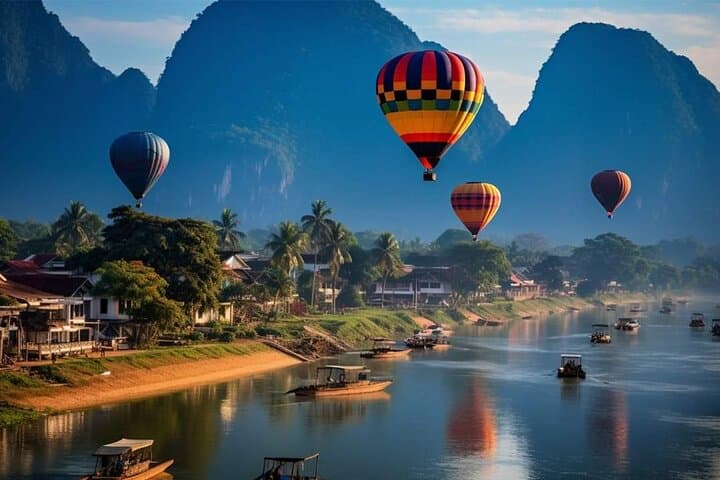
What the day feels like
You step into the cool pre-dawn air as the crew unfurls a balloon the size of a small cathedral. The burner hisses to life and the night’s chill peels away; fabric breathes and the basket shivers under your feet. As the balloon lifts, Vang Vieng stretches out beneath you like a relief map come alive—rice paddies quilted in shades of jade, the Nam Song River coiling like a green ribbon, and a scatter of villages clinging to the bases of steep karst towers. For sixty minutes the world contracts to the panorama at your feet: limestone teeth, cave mouths, pagodas glinting in the first light. The pilot angles the basket and the valleys roll past in an uninterrupted, cinematic sweep.
Vang Vieng’s appeal has always been twofold: its landscape is dramatic, and its pace is forgiving. Once a backpacker’s rite of passage for river tubing and nightlife, the town has quietly shifted toward outdoor pursuits that respect the limestone country that defines it. Geologically, the region is a karst playground—limestone that water has sculpted into needle-like peaks, hidden caverns, and underground streams over millions of years. From the balloon, the scale of that slow work becomes obvious; you can see faults and strata, old river terraces, and the way human agriculture knits itself around natural contours.
Culturally, you’re rising over a rural slice of Laos where life follows the rhythm of rice seasons and river levels. Villages cluster on slightly higher ground; morning markets already glow with wok steam and Lao coffee. Pagodas punctuate hilltops, their gilded stupa tops catching the sun first. The Nam Song River, whose valley the balloon follows at times, has been central to local life for generations—transport, irrigation, and, more recently, tourism.
A hot air balloon here is less stunt than slow-motion anthropology. The pilot is your interpreter between sky and ground, pointing out a cave entrance, a flock of egrets spiraling up from a paddy, or a farmer guiding water buffalo down a track. Balloon landings are deliberate negotiations—pilots seek clear paddocks and the goodwill of landowners—and when you touch down, the quiet connection to place feels earned.
Why book it? For one, perspective: the karst country of Vang Vieng is best read from above. Photographers get a 360-degree stage for the golden hour; non-photographers get the rare luxury of moving without engines, of being able to look and hold that view. For travelers who want an easy, low-exertion way to experience Vang Vieng’s landscape, a balloon ride is logistical simplicity—minimal hiking, maximum pay-off.
Practical side: flights run around sunrise and late afternoon (5:30 and 16:30 are typical departures), with most companies offering hotel pickup—useful because pre-dawn transfers are part of the rhythm. The advertised flight time here is 60 minutes; factor an hour or two for prep and transport. The price listed from the operator is about USD 172; availability can be limited around peak season (dry months), so book in advance if you have a specific morning in mind.
What to expect on the day: arrive layered—mornings can be cool before sunrise but warm quickly. Bring a camera with a mid-length zoom (24–70mm or 24–105mm), fast shutter speeds for capturing burn bursts, and a polarizing filter if you plan to shoot landscapes. The burner’s heat is intermittent; stand back when it cycles. Motion is gentle but wind-driven; if you’re prone to vertigo, sit near the basket edge and focus on the horizon—vertical motion feels less pronounced than you’d think.
Safety and sustainability: pilots will brief you on landing positions and weight distribution. Good operators plan for landowner permissions and avoid high-impact landings in rice fields; pick a company that reclaims sites respectfully and compensates owners if needed. Weather governs everything—balloons don’t fly in strong winds or rain—so have a flexible morning on your itinerary.
Beyond the flight there’s a day of options. Return to town for Lao coffee and a plate of laap (the region’s signature minced meat salad) or follow the Nam Song downstream to explore caves like Tham Phu Kham and its turquoise pools. If you have time, rent a bicycle and thread the backroads to small hamlets and roadside temples; the landscape that looks cinematic from above is equally rewarding close-up.
For those planning, the essentials are straightforward: book around the dry season for clear skies, confirm pickup and cancellation terms, and be ready for early mornings. A balloon flight over Vang Vieng is not a dare; it’s a slow, precise invitation to see a karst country on its own terms—quiet, patient, and better appreciated from a place where the world opens beneath your feet.
Trail wisdom
Small choices, better day.
Book the sunrise slot
Morning flights offer softer light and calmer winds—aim for the 5:30 departure for the best visibility.
Dress in layers
Early mornings are cool but warm fast when the sun hits the valley—light layers allow quick adjustments.
Bring a mid-range zoom
A 24–105mm lens captures wide panoramas and tighter village details without changing lenses mid-flight.
Confirm pickup and landing plans
Operators typically include hotel pickup; verify landing area procedures and whether there’s a short walk post-landing.
Local knowledge
Read the place, not just the route.
Watch for native species including White-breasted waterhen, Purple heron and other wading birds.
Keep an eye out for wildlife during the transition between areas and habitats. Respect distance guidelines.
Operators and local groups increasingly prioritize low-impact landings and community compensation—choose companies that engage with landowners and avoid agricultural damage.
Follow the guide's instructions on size limits, ethical handling, and leave-no-trace practices.
Tham Phu Kham Blue Lagoon—swim under a cave entrance. Clifftop viewpoints along Highway 13 for close-up karst views
Locally recommended viewpoints and quiet spots known best to local operators.
Vang Vieng grew from a rural riverside village into a tourist hub during the 1990s; the surrounding karst has shaped settlement and transport for centuries.
Maritime roots and regional tradition shape the waterways and working coasts.
Seasonal guide
Four versions of the same landscape.
Spring
Best forClear skies · Fewer tourists · Green rice terraces
ChallengesVariable early-morning temperatures · Occasional haze from regional burning
Spring (Mar–Apr) brings lush paddies and fewer crowds, but monitor regional burn seasons which can affect visibility.
Summer
Best forDramatic cloudscapes · Lush green landscapes · Afternoon light shows
ChallengesRainy season storms · Higher humidity · Limited flight windows
Summer monsoon (May–Oct) brings intense green but more cancelled flights—book buffer days.
Fall
Best forCrisp mornings · Stable winds · Harvest-time colors
ChallengesCooler pre-dawn temps · Increased demand in dry months
Fall (Oct–Nov) is transition to the dry season with improving flying conditions and clear skies.
Winter
Best forBlue-sky visibility · Calm winds · Comfortable daytime temps
ChallengesEarly cold snaps pre-sunrise · Peak tourist demand
The dry season (Nov–Feb) is optimal for ballooning—clear, calm mornings and reliable launches.
Operator details
What the booking data adds.
Included
- ✓Hotel pickup and drop-off in Vang Vieng city area
- ✓Hot air balloon flight certificate.
- ✓Experienced balloon pilot
- ✓30-minute hot air balloon flight(sunrise or sunset flight Choose 1)
Not included
- —Tips and all expenses not mentioned above
Good to know
- ✓Public transportation options are available nearby
- ✓Infants are required to sit on an adult’s lap
- ✓Not recommended for pregnant travelers
- ✓Not recommended for travelers with poor cardiovascular health
- ✓Suitable for all physical fitness levels
Pack with intention
What to bring.
Good to know
Common questions.
The advertised airborne time is about 60 minutes; allow additional time for pickup, setup, and return—plan for 1.5–2 hours overall.
Plan the edges
The details that make the day easier.
Vang Vieng is surrounded by karst limestone formations formed over millions of years—these rocks contain caves and underground systems that are central to the region’s hydrology and cultural sites.
After your flight, head to a riverside café for Lao coffee and laap, sample sticky rice with mango at a market stall, and wind down with a cold BeerLao while watching karst silhouettes at sunset.
- Closest airport
- Wattay International Airport (Vientiane) ~3–4 hours drive to Vang Vieng; Driving distance from Vientiane: ~150 km; Cell service: generally available in town, spotty in remote valleys; Permits: none required for tourist balloon flights—confirm with operator.
Choose operators that coordinate landowner permissions and avoid landings in active paddies; pack out all waste and minimize disturbance to wildlife and farming routines.
Explore by topic
Follow the threads.
Keep exploring
Make the story part of the trip.
Set out from Bass Harbor for a private, customizable day on Blue Hill Bay — lighthouses, puffins, seals, and the chance to feel Acadia from the water. Small groups, local captains, unforgettable views.
In four hours you can move from shaded canyon ferns to wind-scoured coastal ridgelines, guided by someone who knows where the light—and the hidden views—live. This private half-day hike on the Monterey Peninsula or Big Sur is compact, curated, and perfect for travelers who want depth without a multiday commitment.
 Related story
Beneath a sky of shifting light, Skaftafell’s ice reads like a map of time. This three-hour guided glacier hike mixes technical instruction with geology and culture: compact, safe, and unforgettable.