
What the day feels like
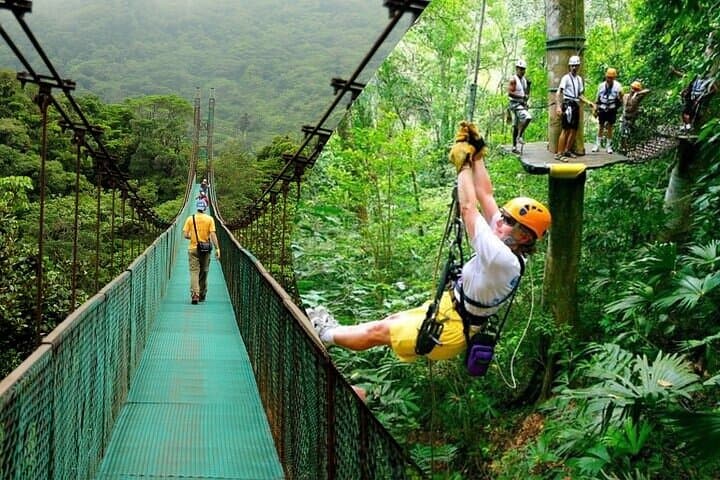
You step off the platform and the jungle breathes beneath your feet — not a passive backdrop but an organism with its own lungs, gulping and exhaling humidity and bird calls. The first zipline hums; a harness tightens, the guide gives a clipped thumbs-up, and then the forest takes you. You fly low over a braided tangle of lianas and palm crowns, the canopy opening like a theater curtain to reveal flashes of color: a toucan tail, the lazy blink of a three-fingered sloth. The cables here don't only carry you across space, they carry you through time — through layers of life stacked on top of life.
This Rainforest Skywalk & Zipline Adventure is one of those day-long trips that flips between two speeds: the electric speed of ziplines across the treetops and the slow, calibrated pace of the hanging bridges, where silence is its own reward. It takes 5–6 hours, fits well into a travel day from Puerto Viejo de Talamanca, and is built for people who want both a hit of adrenaline and a genuine nature immersion without needing technical climbing skills.
Geology and ecology are the stage. Limón province's lowland rainforest sits on soil weathered from volcanic uplifts and coastal plains, a humid lattice where epiphytes and strangler figs anchor themselves into older trees. That verticality is why canopy tours work: the forest is a stacked world, and zipline cables are the fastest way to traverse its strata. Cultural beats pulse alongside nature; the Afro-Caribbean heritage of the southern Caribbean coast — in food, language, and rhythms — means the day ends as much with a taste of rice and beans and coconut flavors as with the memory of wind on your face.
History is close by but quiet. Much of this coastline was once little-visited compared with the Pacific side, and that relative isolation helped protect both community culture and intact tracts of forest. Modern canopy tourism here grew in the 1990s as operators realized that a living canopy could be both a classroom for biodiversity and an economic lifeline for local guides.
Why take this tour? For one, it's efficient: in a single morning and afternoon you get multiple ziplines, trained guides, and a network of suspension bridges where you can pause and watch the forest in detail. For another, it's accessible: no technical climbing experience required, and operators equip you with harnesses and helmets. Finally, the wildlife — howler monkeys, toucans, sloths, and bright butterflies — is surprisingly visible from the elevated vantage points, where animals tend to feel less threatened than they would on the forest floor.
Practical edge: expect mud, humidity, and quick weather shifts. Wear sturdy closed-toe shoes with good grip; bring a light rain shell, insect repellent, a reusable water bottle or hydration bladder, and a small waterproof bag for your camera or phone. Operators typically provide gloves, harnesses, and helmets, but confirm ahead of time. Plan for about 5–6 hours total including transport from Puerto Viejo, a short safety orientation, eight to twelve cable runs depending on the operator, and time on three or four hanging bridges.
Safety and sustainability matter. Guides run safety briefings and will clip you into redundant systems; still, listen closely, keep your limbs in as instructed, and avoid loose gear. Choose operators that follow canopy ethics: minimized canopy tree attachment, staff training in wildlife spotting without disturbance, and equitable pay for local guides. If you see monkeys or sloths, observe quietly; the thrill of a photo isn't worth the stress you might cause the animal.
Timing is everything. The dry season (December–April) gives you the clearest views and the least mud, but early mornings and late afternoons in the wet season can be lush and nearly empty of other visitors. Morning tours often produce the most bird activity. If you're prone to motion sensitivity, pick the slower skywalk portions first to settle in.
On a larger scale, this is a trip that connects: to a living ecosystem, to community-run tourism that channels revenue to coastal towns, and to a landscape that rewards observation. At the end of the day, you step down onto the trail, hear the ocean notch the horizon somewhere beyond the trees, and feel you've had a true cross-section of Costa Rica's southern Caribbean — fast, slow, loud, and quietly abundant.
If you go: confirm pickup logistics and what the operator covers, bring a soft bag for any wet clothing, and allocate time after the tour to sample local flavors in Puerto Viejo — the day is best closed with something cool, salty, and coconut-sweet.
Trail wisdom
Small choices, better day.
Wear Grippy Shoes
Closed-toe hiking shoes with good tread keep you steady on muddy approaches and bridge planks.
Bring a Small Dry Bag
Protect your phone and wallet during ziplines and sudden tropical showers.
Hydrate Early
Start with a full water bottle—tropical humidity and adrenaline both dehydrate quickly.
Stick to Guide Instructions
Guides use specific clipping and braking protocols—follow them exactly for safety.
Local knowledge
Read the place, not just the route.
Watch for native species including Three-fingered sloth, Keel-billed toucan.
Keep an eye out for wildlife during the transition between areas and habitats. Respect distance guidelines.
Choose operators that practice low-impact canopy access and contribute to local conservation or community projects; avoid tours that disturb wildlife or over-attach equipment to living trees.
Follow the guide's instructions on size limits, ethical handling, and leave-no-trace practices.
Early-morning bridge walks for birdwatching when guides are quiet. Small roadside 'sodas' in Puerto Viejo for authentic Caribbean-Costa Rican plates
Locally recommended viewpoints and quiet spots known best to local operators.
The Caribbean coast has been shaped by Afro-Caribbean and indigenous Bribri influences; many modern tour guides are local and blend natural history with cultural stories.
Maritime roots and regional tradition shape the waterways and working coasts.
Seasonal guide
Four versions of the same landscape.
Spring
Best forFoliage regeneration · Fewer crowds · Early migratory birds
ChallengesAfternoon showers · Muddy trails
March–May moves into the wet transition; mornings are often clear and the forest starts to flush green with new growth.
Summer
Best forLush rainforest views · Butterflies and amphibians · Lower visitor numbers
ChallengesHeavy rain in afternoons · slippery trails
June–August brings frequent rains and the forest at its most verdant; pack rain protection and expect wet conditions.
Fall
Best forPeak biodiversity · Waterfall fullness · Quiet trails
ChallengesMore persistent rain · shorter windows of dry weather
September–November is the wettest stretch; wildlife is abundant but plan for weather-related adjustments.
Winter
Best forDry trails · Clear views · Reliable weather
ChallengesHigher visitor numbers · warmer midday temps
December–February is the dry season and the easiest time for drier trails and consistent scheduling.
Operator details
What the booking data adds.
Included
- ✓All income
- ✓Bottled water
- ✓WiFi on board
- ✓All Fees and Taxes
- ✓Air-conditioned vehicle
- ✓Port pickup and drop-off
- ✓Bilingual tour guide
Not included
- —Food and drinks
Good to know
- ✓Not recommended for travelers with spinal injuries
- ✓Not recommended for pregnant travelers
- ✓Not recommended for travelers with poor cardiovascular health
- ✓Travelers should have at least a moderate level of physical fitness
Pack with intention
What to bring.
Good to know
Common questions.
No — guides provide full safety instruction and progressive lines allow first-timers to build confidence.
Plan the edges
The details that make the day easier.
Costa Rica contains nearly 5% of the world’s biodiversity despite covering around 0.03% of Earth’s land area.
After the tour, head back into Puerto Viejo for Caribbean-influenced fare—look for local 'sodas' serving rice and beans in coconut sauce, fresh ceviche, and a cold Imperial beer; many visitors finish with a roadside fruit shake or a slice of freshly baked coconut bread.
- Closest major airport
- Juan Santamaría Intl. (SJO) in San José (approx. 4–5 hours by road); Local airport: Limón (LIO) has limited service; Driving distance from Puerto Viejo: 15–40 minutes depending on operator location; Cell service: patchy in canopy areas; Permits: none typically required — operator handles permissions.
Support operators that minimize tree attachments, follow wildlife-viewing ethics, use locally hired guides, and encourage bring-your-own-water policies to reduce single-use plastics.
Explore by topic
Follow the threads.
Keep exploring
Make the story part of the trip.
In four hours you can move from shaded canyon ferns to wind-scoured coastal ridgelines, guided by someone who knows where the light—and the hidden views—live. This private half-day hike on the Monterey Peninsula or Big Sur is compact, curated, and perfect for travelers who want depth without a multiday commitment.
 Related story
Beneath a sky of shifting light, Skaftafell’s ice reads like a map of time. This three-hour guided glacier hike mixes technical instruction with geology and culture: compact, safe, and unforgettable.
 Related story
Lose the city for a few hours without leaving it: this 5-mile, 900-foot-gain Forest Park loop threads old-growth pockets, city viewpoints, and cultural landmarks for a compact taste of Portland’s wild side. Expect moss, roots, and stories.