THE ADVENTURE COLLECTIVE® · Independent discovery and booking for outdoor travel

A five-hour private walk through Oneroa's galleries, studios and sculpture park on Waiheke Island. Meet artists, visit a shoemaker and enjoy lunch at a painter's home while learning how the island’s light shapes local work.
A five-hour private walk through Oneroa's galleries, studios and sculpture park on Waiheke Island. Meet artists, visit a shoemaker and enjoy lunch at a painter's home while learning how the island’s light shapes local work.
You step off the ferry and the harbor exhales: salt-stung wind, gulls carving the wake, and a guide holding a sign on the left as promised. The lane up from Matiatia climbs past pohutukawa and tidy cottages, then opens onto Oneroa — a compact village where paint-streaked doors, gallery signs, and the scent of coffee make a convincing case that creativity here is an industry. The Private Art Walk on Waiheke Island unfolds at a deliberate pace: five hours of small-group, curated encounters with painters, sculptors, and makers whose work seems to have grown out of the light and landscape itself.
Verified experiences and guided adventures in the surrounding area.
Operated by Terra & Tide · Oneroa, Auckland
You step off the ferry and the harbor exhales: salt-stung wind, gulls carving the wake, and a guide holding a sign on the left as promised. The lane up from Matiatia climbs past pohutukawa and tidy cottages, then opens onto Oneroa — a compact village where paint-streaked doors, gallery signs, and the scent of coffee make a convincing case that creativity here is an industry. The Private Art Walk on Waiheke Island unfolds at a deliberate pace: five hours of small-group, curated encounters with painters, sculptors, and makers whose work seems to have grown out of the light and landscape itself.
Waiheke sits on Miocene rock and sand-rich soils lifted by tectonic action; the island’s low ridges and sheltered bays have long attracted settlers, first Māori and later European viticulturists and artists who found the climate and isolation generative. Oneroa’s Community Art Gallery has become a cultural hub, rotating contemporary New Zealand work and island artists. The tour adds intimacy to that institutional energy — you’ll meet Gabriella Lewenz in her home studio, hear a sculptor explain the way bronze and form respond to coastal light, and step into a shoemaker’s workshop where craft is both utility and expression.
The sculpture park, set into coastal bush, asks more of you than a typical gallery: sculptures vie with pohutukawa and wild scrub, and the wind seems to rearrange the work’s relationship to the sea. Conversation moves between material and place — pigment choices, the island’s palette, and how salt air accelerates patina. Lunch is served at an artist’s house, a pause that turns critique into casual exchange — questions about process, provenance, and the price of shipping ceramics to the mainland.
Practical details are straightforward. The walk is accessible for most fitness levels with short hills and paved streets; total on-foot distance depends on the custom route but expect light walking between clustered locations in Oneroa. The meeting point option gives you flexibility: meet at Matiatia Wharf if you arrive by the 9:00 ferry from Auckland, or start at Waiheke Community Art Gallery at 10:00 if you’re already island-based. Bring cash or a card for any impulse purchases, and a compact daypack for water and a rain layer — the island weather can shift quickly.
For travelers who like context with aesthetics, this private tour is part gallery crawl, part studio visit, part local economy primer. It hands you the language of a place that makes things by hand and invites you to see how art is rooted in the soil and the shore.
easy.
5 hours.
Suitable for a range of fitness levels; expect short paved climbs and standing during gallery talks
If coming from Auckland, take the full-speed ferry to Matiatia Wharf; the guide will be waiting on the left. If already on Waiheke, you may meet at the Waiheke Community Art Gallery at 10:00.
Yes — the pace is leisurely and content can be adjusted, but younger children may tire after several studio visits.
Yes — gallery admissions and lunch at the artist's home are included in the tour price.
This is a private tour for 2–8 people and can be designed around your specific interests and requirements.
The tour operates in all weather; guides will adapt the route to prioritize indoor studios and galleries if required.
Absolutely — the tour encourages direct purchases from artists. Bring payment options and consider transport for larger items.
Waiheke has long been occupied by Tāmaki Māori and later attracted European settlers for orchards and vineyards; over the last 50 years it has developed a dense creative community.
Visitors are urged to take litter and purchases away from fragile coastal bush; many galleries work with local conservation groups to minimize shipping and packaging waste.
Terra & Tide operates guided outdoor trips and adventures with an emphasis on safety, stewardship, and memorable experiences.
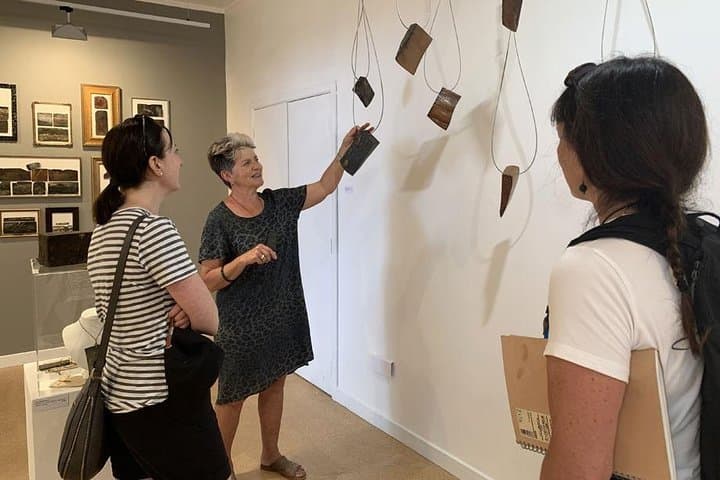


You step off the ferry and the harbor exhales: salt-stung wind, gulls carving the wake, and a guide holding a sign on the left as promised. The lane up from Matiatia climbs past pohutukawa and tidy cottages, then opens onto Oneroa — a compact village where paint-streaked doors, gallery signs, and the scent of coffee make a convincing case that creativity here is an industry. The Private Art Walk on Waiheke Island unfolds at a deliberate pace: five hours of small-group, curated encounters with painters, sculptors, and makers whose work seems to have grown out of the light and landscape itself.
You step off the ferry and the harbor exhales: salt-stung wind, gulls carving the wake, and a guide holding a sign on the left as promised. The lane up from Matiatia climbs past pohutukawa and tidy cottages, then opens onto Oneroa — a compact village where paint-streaked doors, gallery signs, and the scent of coffee make a convincing case that creativity here is an industry. The Private Art Walk on Waiheke Island unfolds at a deliberate pace: five hours of small-group, curated encounters with painters, sculptors, and makers whose work seems to have grown out of the light and landscape itself.
Waiheke sits on Miocene rock and sand-rich soils lifted by tectonic action; the island’s low ridges and sheltered bays have long attracted settlers, first Māori and later European viticulturists and artists who found the climate and isolation generative. Oneroa’s Community Art Gallery has become a cultural hub, rotating contemporary New Zealand work and island artists. The tour adds intimacy to that institutional energy — you’ll meet Gabriella Lewenz in her home studio, hear a sculptor explain the way bronze and form respond to coastal light, and step into a shoemaker’s workshop where craft is both utility and expression.
The sculpture park, set into coastal bush, asks more of you than a typical gallery: sculptures vie with pohutukawa and wild scrub, and the wind seems to rearrange the work’s relationship to the sea. Conversation moves between material and place — pigment choices, the island’s palette, and how salt air accelerates patina. Lunch is served at an artist’s house, a pause that turns critique into casual exchange — questions about process, provenance, and the price of shipping ceramics to the mainland.
Practical details are straightforward. The walk is accessible for most fitness levels with short hills and paved streets; total on-foot distance depends on the custom route but expect light walking between clustered locations in Oneroa. The meeting point option gives you flexibility: meet at Matiatia Wharf if you arrive by the 9:00 ferry from Auckland, or start at Waiheke Community Art Gallery at 10:00 if you’re already island-based. Bring cash or a card for any impulse purchases, and a compact daypack for water and a rain layer — the island weather can shift quickly.
For travelers who like context with aesthetics, this private tour is part gallery crawl, part studio visit, part local economy primer. It hands you the language of a place that makes things by hand and invites you to see how art is rooted in the soil and the shore.