THE ADVENTURE COLLECTIVE® · Independent discovery and booking for outdoor travel

A nine-day loop from Hanoi through Ninh Binh, Nam Dinh and Cat Ba that pairs village encounters with karst climbs and a Lan Ha Bay cruise. Expect boat passages, a 500-step viewpoint climb, easy-to-moderate cycling, and immersive local culture.
A nine-day loop from Hanoi through Ninh Binh, Nam Dinh and Cat Ba that pairs village encounters with karst climbs and a Lan Ha Bay cruise. Expect boat passages, a 500-step viewpoint climb, easy-to-moderate cycling, and immersive local culture.
You step out of Hanoi’s humid morning into a van threaded with green rice paddies and suddenly the city’s buzz recedes.
By midday the limestone towers of Trang An rise like stern guardians, their steep faces pulling clouds down to rest; the river dares you to follow its slow, reflective bends through caves. Over the next nine days the trip alternates between human-scale villages and marine-scale karst: a slow Tam Coc boat ride (about 2 hours) past rice fields; a climb up Mua Mountain’s near-500 steps to a compact summit altar; bicycle loops through Tho Ha and Dong Bien (roughly 5–15 km daily); and a forested ascent to Navi Peak on Cat Ba for panoramic views of Lan Ha Bay’s emerald channels.
History and culture thread through the route — Trang An’s karst was inscribed as a UNESCO site for its Pleistocene geomorphology, while Nam Dinh’s six-generation water-puppet tradition keeps riverside ritual alive. Geologically the region is classic tropical karst: soluble limestone sculpted into cliffs and grottoes, where stalactites drip slow time into caves like Galaxy Grotto.
Practical guidance: pack a good pair of walking shoes for uneven stone steps, a lightweight rain shell for sudden tropical downpours, and a refillable water bottle — tap water isn’t potable. Plan for several short boat transfers and one overnight cruise; basic paddling skills help if you intend to kayak. Allow time for slow mornings in villages — cultural exchanges are often the most memorable part of this itinerary.
This trip blends active, moderate hiking and cycling with calm water travel and community-led experiences — prepare to move deliberately and listen to the landscape.
Verified experiences and guided adventures in the surrounding area.
Operated by Realistic Asia · Hanoi, Hanoi
You step out of Hanoi’s humid morning into a van threaded with green rice paddies and suddenly the city’s buzz recedes.
By midday the limestone towers of Trang An rise like stern guardians, their steep faces pulling clouds down to rest; the river dares you to follow its slow, reflective bends through caves. Over the next nine days the trip alternates between human-scale villages and marine-scale karst: a slow Tam Coc boat ride (about 2 hours) past rice fields; a climb up Mua Mountain’s near-500 steps to a compact summit altar; bicycle loops through Tho Ha and Dong Bien (roughly 5–15 km daily); and a forested ascent to Navi Peak on Cat Ba for panoramic views of Lan Ha Bay’s emerald channels.
History and culture thread through the route — Trang An’s karst was inscribed as a UNESCO site for its Pleistocene geomorphology, while Nam Dinh’s six-generation water-puppet tradition keeps riverside ritual alive. Geologically the region is classic tropical karst: soluble limestone sculpted into cliffs and grottoes, where stalactites drip slow time into caves like Galaxy Grotto.
Practical guidance: pack a good pair of walking shoes for uneven stone steps, a lightweight rain shell for sudden tropical downpours, and a refillable water bottle — tap water isn’t potable. Plan for several short boat transfers and one overnight cruise; basic paddling skills help if you intend to kayak. Allow time for slow mornings in villages — cultural exchanges are often the most memorable part of this itinerary.
This trip blends active, moderate hiking and cycling with calm water travel and community-led experiences — prepare to move deliberately and listen to the landscape.
moderate.
9 days.
Suitable for travelers who can walk 3–6 hours a day on mixed terrain, handle climbs of several hundred steps, and ride 5–15 km on gentle country roads.
Most travelers require a visa or e-visa—confirm requirements for your nationality well before travel; the operator can provide invitation letters but visa approval is your responsibility.
Hikes are generally moderate (steps, uneven karst trails); cycling sections are village-level roads of 5–15 km on mostly flat terrain—basic fitness is sufficient.
Cruise cabins are shared by default on this itinerary; they are mid-range (4-star equivalent) with basic private facilities—check single-cabin needs in advance.
Bring binoculars, a small guidebook or app for birds, neutral-colored clothing, and patience—Xuan Thuy and Lan Ha host shorebirds and forest species best seen early or late in the day.
The Red River Delta has long been a cultural crossroads—Nam Dinh is an important center for northern water puppetry, and Ninh Binh preserves millennia of rice-cultivation carved into karst terrain.
Karst and mangrove habitats are fragile; avoid walking on rice bunds, minimise plastic use, and support local-run homestays and community conservation projects.
Realistic Asia operates guided outdoor trips and adventures with an emphasis on safety, stewardship, and memorable experiences.



You step out of Hanoi’s humid morning into a van threaded with green rice paddies and suddenly the city’s buzz recedes.
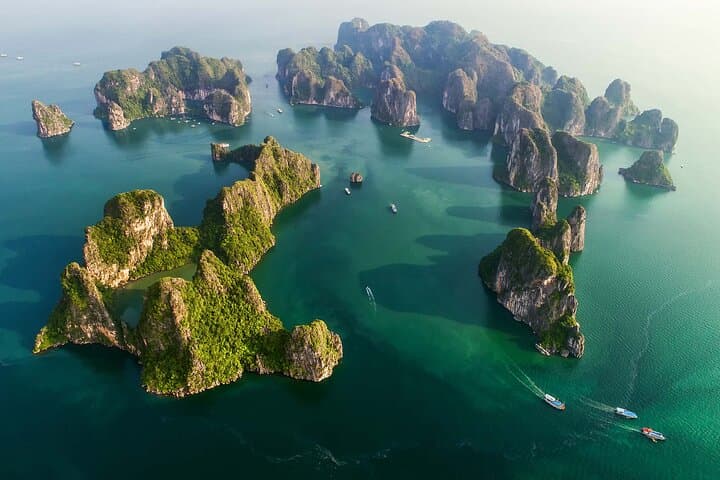
By midday the limestone towers of Trang An rise like stern guardians, their steep faces pulling clouds down to rest; the river dares you to follow its slow, reflective bends through caves. Over the next nine days the trip alternates between human-scale villages and marine-scale karst: a slow Tam Coc boat ride (about 2 hours) past rice fields; a climb up Mua Mountain’s near-500 steps to a compact summit altar; bicycle loops through Tho Ha and Dong Bien (roughly 5–15 km daily); and a forested ascent to Navi Peak on Cat Ba for panoramic views of Lan Ha Bay’s emerald channels.
History and culture thread through the route — Trang An’s karst was inscribed as a UNESCO site for its Pleistocene geomorphology, while Nam Dinh’s six-generation water-puppet tradition keeps riverside ritual alive. Geologically the region is classic tropical karst: soluble limestone sculpted into cliffs and grottoes, where stalactites drip slow time into caves like Galaxy Grotto.
Practical guidance: pack a good pair of walking shoes for uneven stone steps, a lightweight rain shell for sudden tropical downpours, and a refillable water bottle — tap water isn’t potable. Plan for several short boat transfers and one overnight cruise; basic paddling skills help if you intend to kayak. Allow time for slow mornings in villages — cultural exchanges are often the most memorable part of this itinerary.
This trip blends active, moderate hiking and cycling with calm water travel and community-led experiences — prepare to move deliberately and listen to the landscape.
You step out of Hanoi’s humid morning into a van threaded with green rice paddies and suddenly the city’s buzz recedes.
By midday the limestone towers of Trang An rise like stern guardians, their steep faces pulling clouds down to rest; the river dares you to follow its slow, reflective bends through caves. Over the next nine days the trip alternates between human-scale villages and marine-scale karst: a slow Tam Coc boat ride (about 2 hours) past rice fields; a climb up Mua Mountain’s near-500 steps to a compact summit altar; bicycle loops through Tho Ha and Dong Bien (roughly 5–15 km daily); and a forested ascent to Navi Peak on Cat Ba for panoramic views of Lan Ha Bay’s emerald channels.
History and culture thread through the route — Trang An’s karst was inscribed as a UNESCO site for its Pleistocene geomorphology, while Nam Dinh’s six-generation water-puppet tradition keeps riverside ritual alive. Geologically the region is classic tropical karst: soluble limestone sculpted into cliffs and grottoes, where stalactites drip slow time into caves like Galaxy Grotto.
Practical guidance: pack a good pair of walking shoes for uneven stone steps, a lightweight rain shell for sudden tropical downpours, and a refillable water bottle — tap water isn’t potable. Plan for several short boat transfers and one overnight cruise; basic paddling skills help if you intend to kayak. Allow time for slow mornings in villages — cultural exchanges are often the most memorable part of this itinerary.
This trip blends active, moderate hiking and cycling with calm water travel and community-led experiences — prepare to move deliberately and listen to the landscape.