THE ADVENTURE COLLECTIVE® · Independent discovery and booking for outdoor travel

Spend an afternoon ascending Table Mountain by cableway and sweeping through Cape Town’s historic streets. This compact half-day tour pairs summit views with cultural stops at the Malay Quarter, Company Gardens and the V&A Waterfront.
Spend an afternoon ascending Table Mountain by cableway and sweeping through Cape Town’s historic streets. This compact half-day tour pairs summit views with cultural stops at the Malay Quarter, Company Gardens and the V&A Waterfront.
You step off the van at the Table Mountain cableway station and the city widens beneath you — streets unspool toward the waterfront while the Atlantic pins the horizon. The afternoon light slants across the plateau and, if the wind allows, the cable cabins begin their slow, vertiginous climb. The rock above seems to breathe; clouds will sometimes sweep over the rim like a restless ocean, daring you to keep your balance between sea and sky.
Verified experiences and guided adventures in the surrounding area.
You step off the van at the Table Mountain cableway station and the city widens beneath you — streets unspool toward the waterfront while the Atlantic pins the horizon. The afternoon light slants across the plateau and, if the wind allows, the cable cabins begin their slow, vertiginous climb. The rock above seems to breathe; clouds will sometimes sweep over the rim like a restless ocean, daring you to keep your balance between sea and sky.
This half-day tour stitches two distinct faces of Cape Town together: the geological drama of Table Mountain and the layered human history of the city below. Table Mountain is a slab of Cape granite and sandstone whose flat crown sits at about 1,086 meters above sea level; its steep flanks are carved by ancient stream channels and wind-sculpted ridges. From the cableway summit platform, you'll see the V&A Waterfront and Robben Island to the northwest, while the Atlantic coast slides away to the west — a reminder of how geology shaped settlement and trade here.
On the descent into town the guide traces Cape Town’s early days: the Company Gardens, planted by Dutch settlers in the 17th century to supply ships, the Malay Quarter with its colorful row houses and Cape Muslim heritage, and the Castle of Good Hope, a compact star-shaped fort that marks the city's colonial past. The tour also pauses for a shoreline overview at the Atlantic seafront and a quick stop at the V&A Waterfront shops if time allows.
Practicalities are straightforward. The tour runs about four hours and is best taken in the afternoon when the cableway often has lighter crowds and the light slants for photos. Cableway tickets are not included and summit access is weather dependent — strong winds or low cloud can close the lift without notice, so bring flexibility in your schedule. Expect short, mostly paved walks around the city and the summit viewing areas; you won’t need technical gear but steady footwear is advised for damp or windy conditions.
Timing matters: arrive with layered clothing for temperature swings of 10–15°C between sea level and summit; bring a windproof shell, sun protection, and a water bottle. If you want photos, aim for late afternoon for warm side-light and dynamic cloudscapes. The route is compact but rich — a brisk introduction to Cape Town’s natural backbone and civic story, perfect for travelers who want the mountain, the history, and the sea in a single, manageable slice of time.
easy.
4 hours.
Light fitness; comfortable with short walks and standing for viewpoints
No. The cableway ticket is not included in the tour price and must be purchased separately; rides are weather dependent.
If the cableway is closed due to wind or fog, guides will provide alternate viewpoints around the base or expand city stops when possible.
Expect short, mostly paved walks at the summit and several brief city strolls — nothing strenuous, suitable for most fitness levels.
Yes — public restrooms are available at the cableway station, Table Mountain summit, and at several city stops including the V&A Waterfront.
Children are welcome but keep in mind wind on the summit; strollers may be difficult on some uneven sidewalks and at viewing areas.
There is usually a quick stop at the V&A Waterfront and a chance to visit a shop like Diamond Works, but extended shopping time may be limited.
Table Mountain's flat summit and Cape Town’s harbor shaped centuries of trade and colonial history; the Company Gardens were originally farm plots planted by the Dutch East India Company in the 1600s.
Table Mountain National Park is managed to protect fynbos vegetation and endemic species; stay on paths and avoid picking plants to reduce impact.
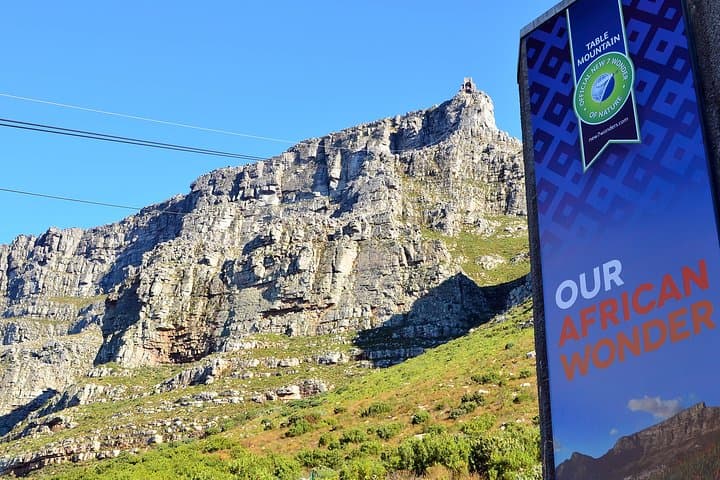
You step off the van at the Table Mountain cableway station and the city widens beneath you — streets unspool toward the waterfront while the Atlantic pins the horizon. The afternoon light slants across the plateau and, if the wind allows, the cable cabins begin their slow, vertiginous climb. The rock above seems to breathe; clouds will sometimes sweep over the rim like a restless ocean, daring you to keep your balance between sea and sky.
You step off the van at the Table Mountain cableway station and the city widens beneath you — streets unspool toward the waterfront while the Atlantic pins the horizon. The afternoon light slants across the plateau and, if the wind allows, the cable cabins begin their slow, vertiginous climb. The rock above seems to breathe; clouds will sometimes sweep over the rim like a restless ocean, daring you to keep your balance between sea and sky.
This half-day tour stitches two distinct faces of Cape Town together: the geological drama of Table Mountain and the layered human history of the city below. Table Mountain is a slab of Cape granite and sandstone whose flat crown sits at about 1,086 meters above sea level; its steep flanks are carved by ancient stream channels and wind-sculpted ridges. From the cableway summit platform, you'll see the V&A Waterfront and Robben Island to the northwest, while the Atlantic coast slides away to the west — a reminder of how geology shaped settlement and trade here.
On the descent into town the guide traces Cape Town’s early days: the Company Gardens, planted by Dutch settlers in the 17th century to supply ships, the Malay Quarter with its colorful row houses and Cape Muslim heritage, and the Castle of Good Hope, a compact star-shaped fort that marks the city's colonial past. The tour also pauses for a shoreline overview at the Atlantic seafront and a quick stop at the V&A Waterfront shops if time allows.
Practicalities are straightforward. The tour runs about four hours and is best taken in the afternoon when the cableway often has lighter crowds and the light slants for photos. Cableway tickets are not included and summit access is weather dependent — strong winds or low cloud can close the lift without notice, so bring flexibility in your schedule. Expect short, mostly paved walks around the city and the summit viewing areas; you won’t need technical gear but steady footwear is advised for damp or windy conditions.
Timing matters: arrive with layered clothing for temperature swings of 10–15°C between sea level and summit; bring a windproof shell, sun protection, and a water bottle. If you want photos, aim for late afternoon for warm side-light and dynamic cloudscapes. The route is compact but rich — a brisk introduction to Cape Town’s natural backbone and civic story, perfect for travelers who want the mountain, the history, and the sea in a single, manageable slice of time.