THE ADVENTURE COLLECTIVE® · Independent discovery and booking for outdoor travel

Climb an active cone and look into one of the world’s rare lava-filled craters on a full-day mountaineering trip from Pucón. This guided ascent blends technical snow travel with sweeping Andean views and a playful snow-sled descent.
Climb an active cone and look into one of the world’s rare lava-filled craters on a full-day mountaineering trip from Pucón. This guided ascent blends technical snow travel with sweeping Andean views and a playful snow-sled descent.
The morning air in Pucón bites clean and cold; the town still hums with espresso machines and the last cigarette of a traveler. Buses pull away from Arauco Street and the asphalt gives way to scrub and black pumice. By the time the guides unload packs at the park gate, the cone of Villarrica has already loomed above the clouds like a living machine—steaming, symmetrical, breathing. Climbers tighten crampons and listen to a short briefing: routes, signals, and the weather window that will decide whether the summit is possible.
Verified experiences and guided adventures in the surrounding area.
Operated by Turismo Montañas del Sur · Pucón, Araucanía
The morning air in Pucón bites clean and cold; the town still hums with espresso machines and the last cigarette of a traveler. Buses pull away from Arauco Street and the asphalt gives way to scrub and black pumice. By the time the guides unload packs at the park gate, the cone of Villarrica has already loomed above the clouds like a living machine—steaming, symmetrical, breathing. Climbers tighten crampons and listen to a short briefing: routes, signals, and the weather window that will decide whether the summit is possible.
Villarrica is one of South America's most active volcanoes and one of the handful worldwide with an open, observable lava-filled crater. It rises to about 2,860 meters above sea level, shaped by repeated eruptions and the relentless subduction of the Nazca Plate beneath South America. For the Mapuche people who live in the shadow of the cone, Villarrica—Rucapillán in Mapudungun—has long been a place of spiritual significance; today it is also a magnet for mountaineers chasing that raw mixture of heat and ice.
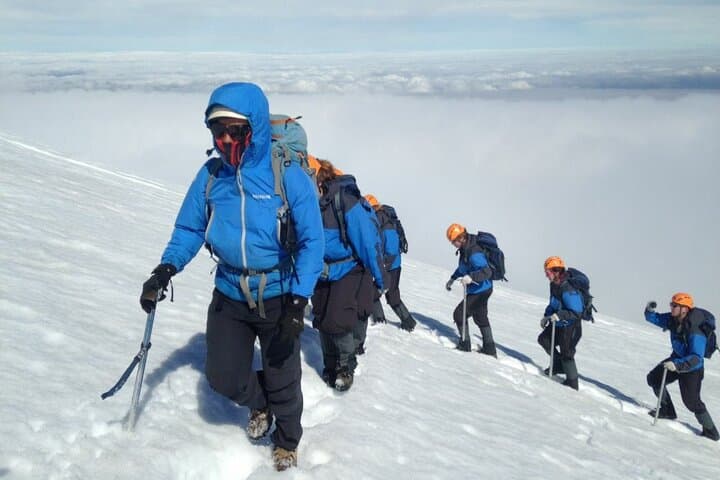
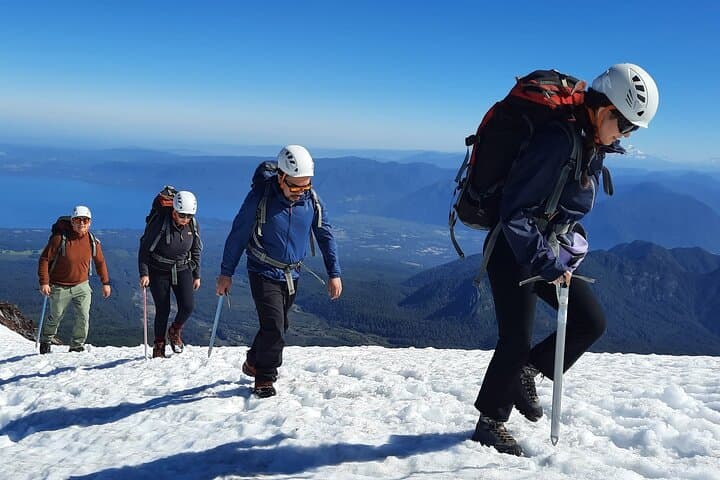
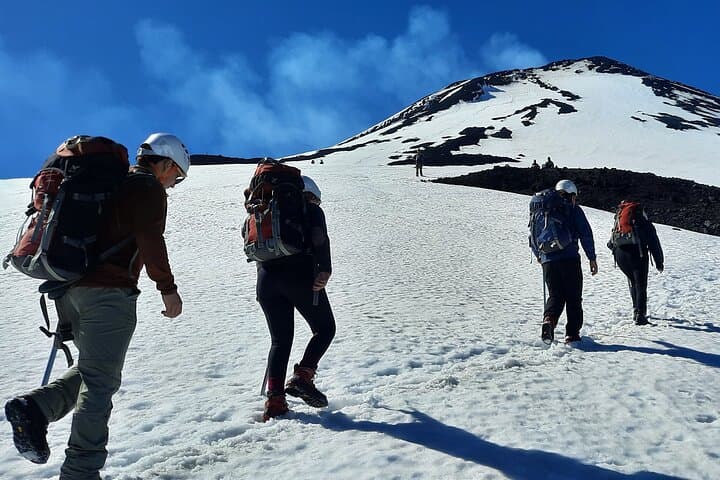
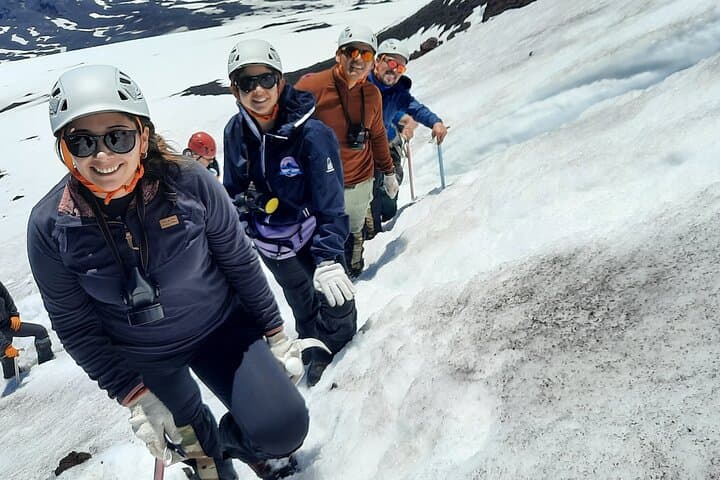
The route is straightforward but demanding: a mix of rock, loose scree, and steep snow slopes that require crampons and an ice axe. Guides break the ascent into rhythm—step, breathe, step—so the mountain keeps pace with the group, and the group keeps pace with the mountain. On clear days the summit rewards with 360-degree exposure: Lake Villarrica glints to the west, the Andes stitch the horizon, and you can see the ski runs and forests that frame the lake towns below.
The descent is a different kind of fun. After the summit, participants slide down packed snow in long, childlike runs—an adrenaline cleanse that undoes some of the vertical grind. Practicalities matter: this is a full-day outing (roughly nine hours), with significant elevation gain (about 1,200–1,600 meters depending on the starting point). Guides provide helmets, crampons, ice axes, and park tickets; they also read weather and volcanic conditions, which are the deciding factor for safety.
If you go, plan for sun and wind. Layers that handle both cold and exertion, sturdy mountaineering boots, and a hydration system make a big difference. Expect early pickups in Pucón, a briefing at the agency on Arauco, and a return to town late afternoon—mud-streaked, sunburned, and likely grinning. For anyone with moderate fitness and a taste for serious day hikes, Villarrica delivers a compact, elemental climb: the push of altitude, the hiss of steam, and the cheap, perfect joy of sliding back down on snow.
challenging.
9 hours (full day).
Good aerobic fitness and leg strength; comfortable walking 6–10 hours with sustained uphill sections
No technical climbing experience is required; guides teach crampon and ice-axe technique on the way up, but you should be comfortable with steep, sustained uphill hiking.
Operators monitor volcanic activity and weather closely; tours go only when guides and park authorities deem conditions safe—be prepared for last-minute cancellations.
Expect roughly 1,200–1,600 meters of elevation gain depending on the pick-up point and trailhead used by the operator.
This tour is not recommended for pregnant travelers or those with significant heart or spinal conditions due to the physical demands and altitude.
Eat a carb-rich meal with some protein 2–3 hours before departure and carry 1.5–2 liters of water; energy bars and electrolytes are useful during the ascent.
No pets; climbs are guided and solo ascents are not supported by this tour—guided groups are required for safety and park access.
Villarrica’s eruptions shaped local settlement and trade routes; Mapuche communities long regarded the volcano as a sacred presence and the modern ski town of Pucón grew with tourism in the 20th century.
Visitors enter Villarrica National Park; stick to established routes, pack out waste, and follow guide instructions to protect fragile high-altitude soils and reduce disturbance to local ecosystems.
Turismo Montañas del Sur operates guided outdoor trips and adventures with an emphasis on safety, stewardship, and memorable experiences.
The morning air in Pucón bites clean and cold; the town still hums with espresso machines and the last cigarette of a traveler. Buses pull away from Arauco Street and the asphalt gives way to scrub and black pumice. By the time the guides unload packs at the park gate, the cone of Villarrica has already loomed above the clouds like a living machine—steaming, symmetrical, breathing. Climbers tighten crampons and listen to a short briefing: routes, signals, and the weather window that will decide whether the summit is possible.
The morning air in Pucón bites clean and cold; the town still hums with espresso machines and the last cigarette of a traveler. Buses pull away from Arauco Street and the asphalt gives way to scrub and black pumice. By the time the guides unload packs at the park gate, the cone of Villarrica has already loomed above the clouds like a living machine—steaming, symmetrical, breathing. Climbers tighten crampons and listen to a short briefing: routes, signals, and the weather window that will decide whether the summit is possible.
Villarrica is one of South America's most active volcanoes and one of the handful worldwide with an open, observable lava-filled crater. It rises to about 2,860 meters above sea level, shaped by repeated eruptions and the relentless subduction of the Nazca Plate beneath South America. For the Mapuche people who live in the shadow of the cone, Villarrica—Rucapillán in Mapudungun—has long been a place of spiritual significance; today it is also a magnet for mountaineers chasing that raw mixture of heat and ice.
The route is straightforward but demanding: a mix of rock, loose scree, and steep snow slopes that require crampons and an ice axe. Guides break the ascent into rhythm—step, breathe, step—so the mountain keeps pace with the group, and the group keeps pace with the mountain. On clear days the summit rewards with 360-degree exposure: Lake Villarrica glints to the west, the Andes stitch the horizon, and you can see the ski runs and forests that frame the lake towns below.
The descent is a different kind of fun. After the summit, participants slide down packed snow in long, childlike runs—an adrenaline cleanse that undoes some of the vertical grind. Practicalities matter: this is a full-day outing (roughly nine hours), with significant elevation gain (about 1,200–1,600 meters depending on the starting point). Guides provide helmets, crampons, ice axes, and park tickets; they also read weather and volcanic conditions, which are the deciding factor for safety.
If you go, plan for sun and wind. Layers that handle both cold and exertion, sturdy mountaineering boots, and a hydration system make a big difference. Expect early pickups in Pucón, a briefing at the agency on Arauco, and a return to town late afternoon—mud-streaked, sunburned, and likely grinning. For anyone with moderate fitness and a taste for serious day hikes, Villarrica delivers a compact, elemental climb: the push of altitude, the hiss of steam, and the cheap, perfect joy of sliding back down on snow.