THE ADVENTURE COLLECTIVE® · Independent discovery and booking for outdoor travel

Skip the lines and climb Lion Rock with a guide who brings the 5th‑century palace to life. This skip‑the‑line entrance ticket and guided tour covers Sigiriya’s water gardens, frescoes, Mirror Wall, and the dramatic summit views—ideal for a focused two‑hour visit.
Skip the lines and climb Lion Rock with a guide who brings the 5th‑century palace to life. This skip‑the‑line entrance ticket and guided tour covers Sigiriya’s water gardens, frescoes, Mirror Wall, and the dramatic summit views—ideal for a focused two‑hour visit.
The path to Sigiriya begins in the humid stillness of Sri Lanka’s Cultural Triangle: a low plain suddenly interrupted by a sheer, rust‑red dome rising 200 meters above rice paddies. You step away from the parking area and into a sequence of engineered landscapes—moated gardens, terraces cut into bedrock, and a flight of metal stairs that climbs past frescoes and the scarred Mirror Wall. The guide points out the painted ladies, traces the king’s story, and times the ascent so the crowd thins as you break onto the lion’s platform.
Verified experiences and guided adventures in the surrounding area.
The path to Sigiriya begins in the humid stillness of Sri Lanka’s Cultural Triangle: a low plain suddenly interrupted by a sheer, rust‑red dome rising 200 meters above rice paddies. You step away from the parking area and into a sequence of engineered landscapes—moated gardens, terraces cut into bedrock, and a flight of metal stairs that climbs past frescoes and the scarred Mirror Wall. The guide points out the painted ladies, traces the king’s story, and times the ascent so the crowd thins as you break onto the lion’s platform.
Built in the late 5th century by King Kasyapa, Sigiriya is both palace and monument, a royal citadel anchored to an igneous outcrop. Its water gardens were hydraulic achievements long before modern pumps—channels and pools that still reflect the rock at low sun. Geologically the fortress sits on an exposed core of ancient rock; erosion left the harder plug standing while softer sedimentaries washed away, creating the abrupt skyline that dominates the region.
Culturally, Sigiriya served as a royal center and later as a Buddhist monastery; visitors today move between those layers—stone ramparts, fresco galleries, and monastic ruins. Local villages around Habarana and Dambulla still farm the floodplain, and the approach passes sleeping bulls and roadside stalls selling tender coconut.
Practical reality is part of the experience. The guided, skip‑the‑line ticket removes the long morning queue and gives you two hours to cover the core circuit: lower gardens, the fresco gallery, Mirror Wall, and the lion’s paws viewpoint. Expect 1,000–1,200 steps in total and exposed metal stairways on the upper sections—steep but manageable for most fit travelers. Climb early to avoid heat; the site is typically open from about 07:00 to 17:30.
Respect the frescoes and restricted areas: carry water, wear closed shoes with grip, and stow loose items—monkeys are opportunistic. If you have mobility concerns, note the ascent includes narrow flights and one section of steep metal staircases where assistance is difficult.
A guided visit doesn’t just save time: it adds context, pointing out inscriptions, hydraulic remnants, and the story of Kasyapa’s dramatic fall that turned this palace into a ruin. Finish with a walk through the gardens where the rock reflects in still pools—a good place to catch breath and let the scale of the place sink in before heading back to Habarana or onward to Dambulla’s cave temples.
moderate.
2 hours.
Moderately fit—able to climb steep stairs and handle short bursts of exertion.
This instant confirmation ticket includes skip‑the‑line entrance to Sigiriya Rock Fortress and a guided tour covering the gardens, frescoes, Mirror Wall, and summit viewpoints.
The ascent involves roughly 1,000–1,200 steps with exposed metal stairways near the top; it’s moderate but involves continuous stair climbing for 20–40 minutes depending on pace.
Certain fresco areas and sections of the summit are restricted for conservation and safety; your guide will direct you around closed zones.
Children can climb but supervision is required; strollers are not practical due to stairs—consider a baby carrier for infants.
Shade is limited above the lower terraces; water and basic facilities are available near the entrance but carry your own supply for the climb.
Early morning offers softer light, fewer people, and cooler temperatures; late afternoon can be hazy but Pidurangala provides a strong sunset alternative.
Sigiriya was converted into an elaborate royal citadel by King Kasyapa in the late 5th century and later served as a Buddhist monastery for several centuries.
As a UNESCO site, Sigiriya enforces visitor limits and restricted areas to protect frescoes and hydraulic features—stay on designated paths and avoid flash photography where posted.
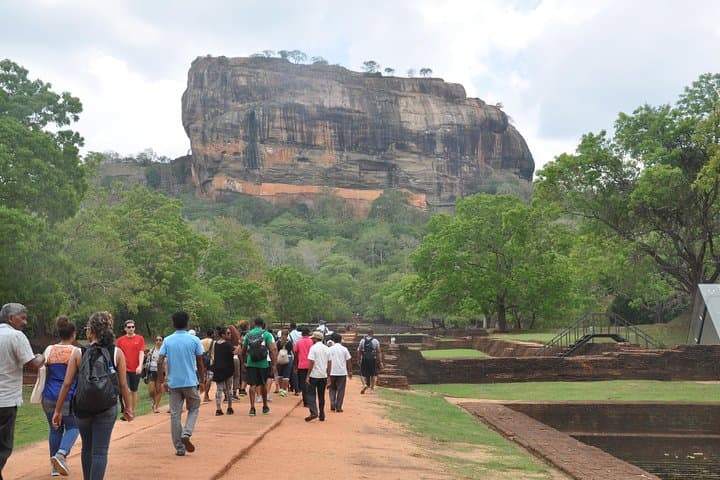
The path to Sigiriya begins in the humid stillness of Sri Lanka’s Cultural Triangle: a low plain suddenly interrupted by a sheer, rust‑red dome rising 200 meters above rice paddies. You step away from the parking area and into a sequence of engineered landscapes—moated gardens, terraces cut into bedrock, and a flight of metal stairs that climbs past frescoes and the scarred Mirror Wall. The guide points out the painted ladies, traces the king’s story, and times the ascent so the crowd thins as you break onto the lion’s platform.
The path to Sigiriya begins in the humid stillness of Sri Lanka’s Cultural Triangle: a low plain suddenly interrupted by a sheer, rust‑red dome rising 200 meters above rice paddies. You step away from the parking area and into a sequence of engineered landscapes—moated gardens, terraces cut into bedrock, and a flight of metal stairs that climbs past frescoes and the scarred Mirror Wall. The guide points out the painted ladies, traces the king’s story, and times the ascent so the crowd thins as you break onto the lion’s platform.
Built in the late 5th century by King Kasyapa, Sigiriya is both palace and monument, a royal citadel anchored to an igneous outcrop. Its water gardens were hydraulic achievements long before modern pumps—channels and pools that still reflect the rock at low sun. Geologically the fortress sits on an exposed core of ancient rock; erosion left the harder plug standing while softer sedimentaries washed away, creating the abrupt skyline that dominates the region.
Culturally, Sigiriya served as a royal center and later as a Buddhist monastery; visitors today move between those layers—stone ramparts, fresco galleries, and monastic ruins. Local villages around Habarana and Dambulla still farm the floodplain, and the approach passes sleeping bulls and roadside stalls selling tender coconut.
Practical reality is part of the experience. The guided, skip‑the‑line ticket removes the long morning queue and gives you two hours to cover the core circuit: lower gardens, the fresco gallery, Mirror Wall, and the lion’s paws viewpoint. Expect 1,000–1,200 steps in total and exposed metal stairways on the upper sections—steep but manageable for most fit travelers. Climb early to avoid heat; the site is typically open from about 07:00 to 17:30.
Respect the frescoes and restricted areas: carry water, wear closed shoes with grip, and stow loose items—monkeys are opportunistic. If you have mobility concerns, note the ascent includes narrow flights and one section of steep metal staircases where assistance is difficult.
A guided visit doesn’t just save time: it adds context, pointing out inscriptions, hydraulic remnants, and the story of Kasyapa’s dramatic fall that turned this palace into a ruin. Finish with a walk through the gardens where the rock reflects in still pools—a good place to catch breath and let the scale of the place sink in before heading back to Habarana or onward to Dambulla’s cave temples.