THE ADVENTURE COLLECTIVE® · Independent discovery and booking for outdoor travel

Walk the Seven Hanging Valleys Trail—6 km of cliff-top panoramas, secret coves and limestone arches along Portugal’s Algarve. This guided tour includes water, fruit, return transfer and 4K photos, making it ideal for hikers who want dramatic views without logistical fuss.
Walk the Seven Hanging Valleys Trail—6 km of cliff-top panoramas, secret coves and limestone arches along Portugal’s Algarve. This guided tour includes water, fruit, return transfer and 4K photos, making it ideal for hikers who want dramatic views without logistical fuss.
You step onto sun-warmed limestone and the Atlantic speaks first: a low, constant rumble, the waves clapping at the feet of sea stacks that have been shaved into impossible shapes. The trail begins at Praia de Vale Centeanes with an immediate reminder that this is a route shaped by water and wind—the cliffs lean out over the ocean, daring you to look down. Over roughly 6 km the path threads between headlands, drops to secret coves, climbs stairways carved into rock and finishes at the postcard curve of Praia da Marinha.
Verified experiences and guided adventures in the surrounding area.
You step onto sun-warmed limestone and the Atlantic speaks first: a low, constant rumble, the waves clapping at the feet of sea stacks that have been shaved into impossible shapes. The trail begins at Praia de Vale Centeanes with an immediate reminder that this is a route shaped by water and wind—the cliffs lean out over the ocean, daring you to look down. Over roughly 6 km the path threads between headlands, drops to secret coves, climbs stairways carved into rock and finishes at the postcard curve of Praia da Marinha.
The coastline here records millions of years of change. Shelled layers of limestone and marl, laid down during the Miocene, now form vertical faces pierced by arches and caves where the sea has found weakness. People have read these cliffs for centuries; fishermen used natural coves to shelter boats, and local stonework still traces that maritime economy in nearby villages. Today the Algarve’s cultural life mixes surf-and-seafood rhythms with a growing outdoor-tourism scene that prizes low-impact access to dramatic views.
On the trail you’ll meet scrubby coastal vegetation—rockrose, juniper and resilient grasses that bind fragile soil—and a colony of seabirds that claim the ledges. Dolphin pods are routine offshore; look for flat dark backs breaking the horizon. The cliffs are theatrical but fragile. Stick to marked paths and avoid edging too close: erosion works faster than hikers.
Practical details: expect 3–4 hours on the guided tour, with a total distance of about 6 km one-way and modest cumulative elevation (roughly 150–250 m of up-and-down across headlands). Terrain alternates packed dirt, limestone slabs and stairs—good traction matters. The tour includes water, fruit, a return transfer to Vale Centeanes or nearby hotels, and 4K photos taken along the route so you don’t miss the light while framing shots.
Timing is everything. Mornings and late afternoons wash the cliffs in warm side light; midday flattens the relief and raises temperatures in summer. If you plan to swim at a cove, check local conditions—rip currents can be strong and some coves are reachable only at low tide.
Bring sturdy shoes, sun protection and a small daypack with water and a light layer. Move deliberately over exposed sections, pause at viewpoints for photos and for the simple work of breathing near an ocean that insists on being noticed.
This hike is an accessible way to read the Algarve’s geology and seascape in one coherent sentence: bold, eroded, and alive. It rewards steady walkers with beaches that feel discovered rather than visited, and with a coastline that keeps revealing its edges.
moderate.
3–4 hours.
Moderate fitness—able to handle uneven terrain, stairs and short climbs over several hours.
The guided route covers about 6 km (one-way) and the tour runs roughly 3–4 hours including stops and photo sessions.
Yes—the tour includes return transfers to Vale Centeanes Beach or local hotels as noted in the booking.
Yes—professional 4K photos taken along the hike are included and shared after the tour.
Some coves are accessible for swimming at low tide, but currents can be strong—only enter the water where locals advise and avoid isolated caves without supervision.
Dogs are typically allowed if kept on a leash, but check the tour operator’s policy before booking and bring water and waste bags.
Children and older hikers can do the trail if comfortable with uneven paths and stairs; consider pace, breaks and sun exposure when planning.
Fishermen once used these coves as seasonal shelters and local stonework in nearby towns reflects a long relationship with the sea.
The cliffs’ vegetation and trails are fragile—stick to paths, pack out trash and support local operators who follow low-impact practices.
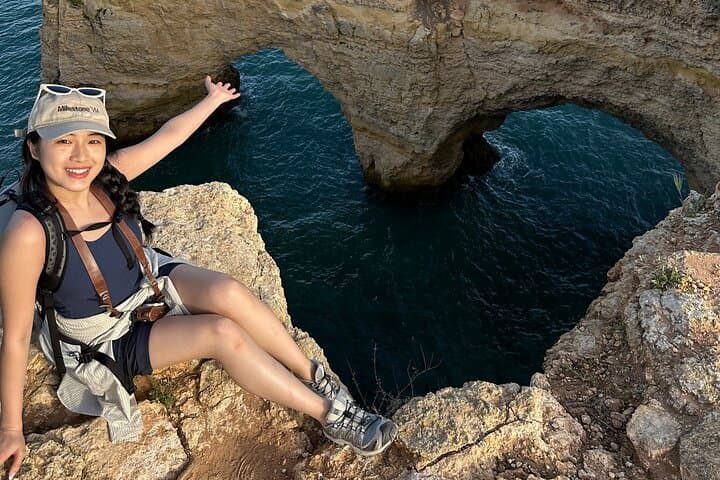
You step onto sun-warmed limestone and the Atlantic speaks first: a low, constant rumble, the waves clapping at the feet of sea stacks that have been shaved into impossible shapes. The trail begins at Praia de Vale Centeanes with an immediate reminder that this is a route shaped by water and wind—the cliffs lean out over the ocean, daring you to look down. Over roughly 6 km the path threads between headlands, drops to secret coves, climbs stairways carved into rock and finishes at the postcard curve of Praia da Marinha.
You step onto sun-warmed limestone and the Atlantic speaks first: a low, constant rumble, the waves clapping at the feet of sea stacks that have been shaved into impossible shapes. The trail begins at Praia de Vale Centeanes with an immediate reminder that this is a route shaped by water and wind—the cliffs lean out over the ocean, daring you to look down. Over roughly 6 km the path threads between headlands, drops to secret coves, climbs stairways carved into rock and finishes at the postcard curve of Praia da Marinha.
The coastline here records millions of years of change. Shelled layers of limestone and marl, laid down during the Miocene, now form vertical faces pierced by arches and caves where the sea has found weakness. People have read these cliffs for centuries; fishermen used natural coves to shelter boats, and local stonework still traces that maritime economy in nearby villages. Today the Algarve’s cultural life mixes surf-and-seafood rhythms with a growing outdoor-tourism scene that prizes low-impact access to dramatic views.
On the trail you’ll meet scrubby coastal vegetation—rockrose, juniper and resilient grasses that bind fragile soil—and a colony of seabirds that claim the ledges. Dolphin pods are routine offshore; look for flat dark backs breaking the horizon. The cliffs are theatrical but fragile. Stick to marked paths and avoid edging too close: erosion works faster than hikers.
Practical details: expect 3–4 hours on the guided tour, with a total distance of about 6 km one-way and modest cumulative elevation (roughly 150–250 m of up-and-down across headlands). Terrain alternates packed dirt, limestone slabs and stairs—good traction matters. The tour includes water, fruit, a return transfer to Vale Centeanes or nearby hotels, and 4K photos taken along the route so you don’t miss the light while framing shots.
Timing is everything. Mornings and late afternoons wash the cliffs in warm side light; midday flattens the relief and raises temperatures in summer. If you plan to swim at a cove, check local conditions—rip currents can be strong and some coves are reachable only at low tide.
Bring sturdy shoes, sun protection and a small daypack with water and a light layer. Move deliberately over exposed sections, pause at viewpoints for photos and for the simple work of breathing near an ocean that insists on being noticed.
This hike is an accessible way to read the Algarve’s geology and seascape in one coherent sentence: bold, eroded, and alive. It rewards steady walkers with beaches that feel discovered rather than visited, and with a coastline that keeps revealing its edges.