THE ADVENTURE COLLECTIVE® · Independent discovery and booking for outdoor travel

Board a private launch from Samaná and spend an eight-hour day trading city streets for whale-sprayed ocean and the postcard beach of Cayo Levantado. Expect focused whale-watching in season, mangrove geology at Los Haitises, and a relaxed island lunch.
Board a private launch from Samaná and spend an eight-hour day trading city streets for whale-sprayed ocean and the postcard beach of Cayo Levantado. Expect focused whale-watching in season, mangrove geology at Los Haitises, and a relaxed island lunch.
The engine hushes and the bay opens. White breakers lace the hull as the boat pushes away from Avenida Marina and the low coastline of Samaná dissolves into blue. On clear days Cayo Levantado appears like a coin of sand with palms—three miles (about 5 km) from shore—its white beach catching the sun. Before the island, the boat slips into deeper water and the sea takes the lead: humpback whales, sometimes breaching within yards, announce themselves with sprays and tails, daring the human spectators to keep pace.
Verified experiences and guided adventures in the surrounding area.
Operated by MamaJuana Travel · Samaná, Samaná Province
The engine hushes and the bay opens. White breakers lace the hull as the boat pushes away from Avenida Marina and the low coastline of Samaná dissolves into blue. On clear days Cayo Levantado appears like a coin of sand with palms—three miles (about 5 km) from shore—its white beach catching the sun. Before the island, the boat slips into deeper water and the sea takes the lead: humpback whales, sometimes breaching within yards, announce themselves with sprays and tails, daring the human spectators to keep pace.
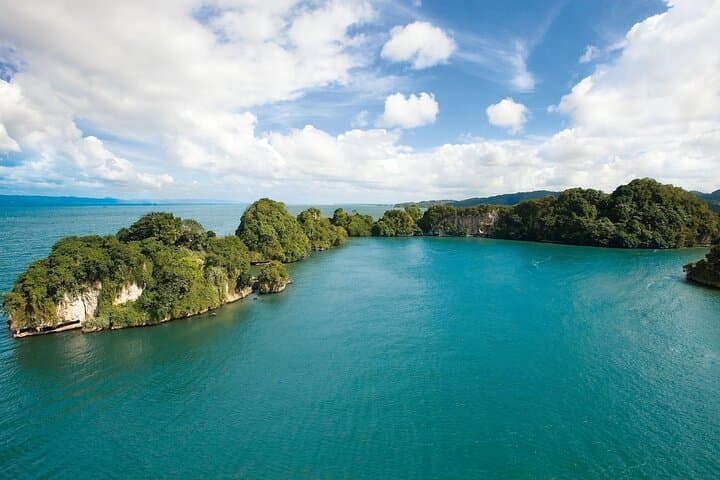
This is a day of two landscapes. Offshore, the Dominican Republic’s humpback population gathers for breeding between January and March; guides time departures to maximize sightings, but the animals decide the choreography. Inland and along the coast, Los Haitises National Park offers a contrast — low limestone karsts, mangrove channels, and caves once used by the Taíno people for ceremonial art. Spanish colonial logs reference the Samana Bay as a sheltered harbor and, more recently, a film crew in the 1970s put Cayo Levantado on the map as “Bacardi Island.” The geology here is Pleistocene limestone, gouged by rain and sea into the rounded mogotes and sinkholes that give Los Haitises its sculpted profile.
Culturally, the Samaná peninsula blends Afro-Caribbean traditions with fishing-village rhythms: markets sell fried fish and casabe, and small boats still shuttle locals between cays. Conservation rules—especially strict whale-watching approaches and reef protections—govern interactions; captains maintain respectful distances and use lifebelts and binoculars to improve the experience rather than crowd the animals.
Practical guidance: the full excursion runs about eight hours. Expect roughly two hours allocated to whale watching on the water and about three hours on Cayo Levantado for swimming and lunch; transfers and viewing add the rest. Bring reef-safe sunscreen, a brimmed hat, light layers for morning ocean spray, and water shoes for the island’s rocky approach. Hydration and seasickness precautions are sensible—boats provide bottled water and lifebelts, and an air-conditioned transfer option is usually included when booking from Santo Domingo.
Timing matters: plan the trip in whale season (January–March) for the best chance of sightings; outside that window the trip focuses on birdlife, mangroves, and beach time. Photographers will want early-morning light for whale blows and late-afternoon warmth on the sand. Cash helps for small purchases on Cayo Levantado. Finally, respect the ecosystems—leave no trace on fragile dunes and follow guides’ instructions around wildlife. With simple preparation, the day balances spectacle and ease: close encounters with giants, then a slow afternoon under palms to let the ocean remind you how big the world still is.
easy.
8 hours.
Suitable for most fitness levels; involves brief walking on sand and boarding small boats—basic mobility required.
Humpbacks are most reliably seen from early January through the end of March during mating season.
Cayo Levantado sits about 3 miles (5 km) from Samaná; boat transfers are typically 20–40 minutes depending on conditions.
Yes—beaches have shallow entry points, and life vests are provided for boat travel; supervise any water activities.
Lunch and bottled water are included; soda or additional snacks may be available on the island for purchase.
No—whale watching depends on wildlife behavior. Operators maximize opportunities but sightings are not contractually guaranteed.
Yes—pickup options from Santo Domingo and many hotels are commonly offered, often with an extra charge for locations outside standard zones.
Los Haitises contains Taíno cave art and karst formations that sheltered indigenous communities; Cayo Levantado gained pop culture fame after a 1970s commercial.
Operators follow distance rules for whales and emphasize reef-safe products; visitors are asked to avoid disturbing nesting dunes and to pack out waste.
MamaJuana Travel operates guided outdoor trips and adventures with an emphasis on safety, stewardship, and memorable experiences.
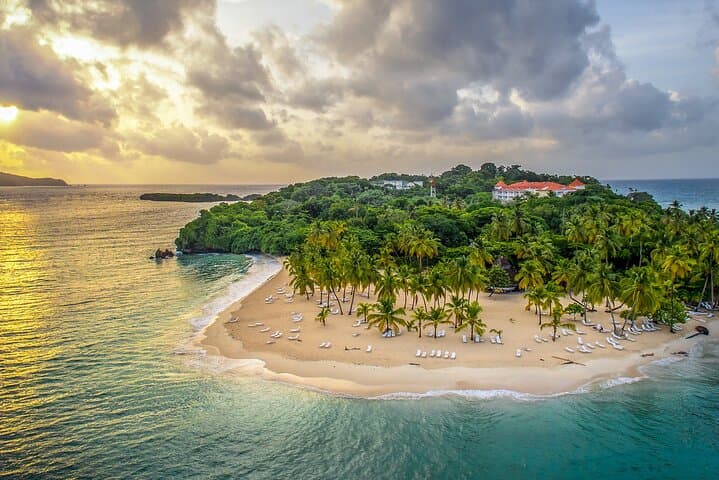
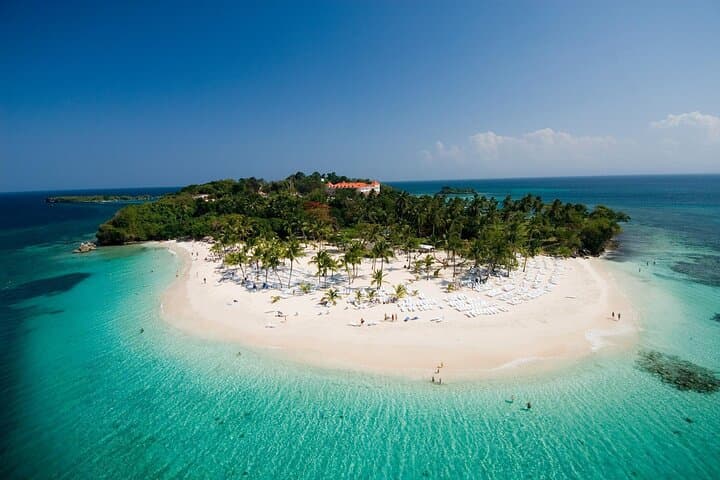
The engine hushes and the bay opens. White breakers lace the hull as the boat pushes away from Avenida Marina and the low coastline of Samaná dissolves into blue. On clear days Cayo Levantado appears like a coin of sand with palms—three miles (about 5 km) from shore—its white beach catching the sun. Before the island, the boat slips into deeper water and the sea takes the lead: humpback whales, sometimes breaching within yards, announce themselves with sprays and tails, daring the human spectators to keep pace.
The engine hushes and the bay opens. White breakers lace the hull as the boat pushes away from Avenida Marina and the low coastline of Samaná dissolves into blue. On clear days Cayo Levantado appears like a coin of sand with palms—three miles (about 5 km) from shore—its white beach catching the sun. Before the island, the boat slips into deeper water and the sea takes the lead: humpback whales, sometimes breaching within yards, announce themselves with sprays and tails, daring the human spectators to keep pace.
This is a day of two landscapes. Offshore, the Dominican Republic’s humpback population gathers for breeding between January and March; guides time departures to maximize sightings, but the animals decide the choreography. Inland and along the coast, Los Haitises National Park offers a contrast — low limestone karsts, mangrove channels, and caves once used by the Taíno people for ceremonial art. Spanish colonial logs reference the Samana Bay as a sheltered harbor and, more recently, a film crew in the 1970s put Cayo Levantado on the map as “Bacardi Island.” The geology here is Pleistocene limestone, gouged by rain and sea into the rounded mogotes and sinkholes that give Los Haitises its sculpted profile.
Culturally, the Samaná peninsula blends Afro-Caribbean traditions with fishing-village rhythms: markets sell fried fish and casabe, and small boats still shuttle locals between cays. Conservation rules—especially strict whale-watching approaches and reef protections—govern interactions; captains maintain respectful distances and use lifebelts and binoculars to improve the experience rather than crowd the animals.
Practical guidance: the full excursion runs about eight hours. Expect roughly two hours allocated to whale watching on the water and about three hours on Cayo Levantado for swimming and lunch; transfers and viewing add the rest. Bring reef-safe sunscreen, a brimmed hat, light layers for morning ocean spray, and water shoes for the island’s rocky approach. Hydration and seasickness precautions are sensible—boats provide bottled water and lifebelts, and an air-conditioned transfer option is usually included when booking from Santo Domingo.
Timing matters: plan the trip in whale season (January–March) for the best chance of sightings; outside that window the trip focuses on birdlife, mangroves, and beach time. Photographers will want early-morning light for whale blows and late-afternoon warmth on the sand. Cash helps for small purchases on Cayo Levantado. Finally, respect the ecosystems—leave no trace on fragile dunes and follow guides’ instructions around wildlife. With simple preparation, the day balances spectacle and ease: close encounters with giants, then a slow afternoon under palms to let the ocean remind you how big the world still is.