THE ADVENTURE COLLECTIVE® · Independent discovery and booking for outdoor travel

Cross the channel to Robben Island with a former-political-prisoner guide, then rise above Cape Town on the Table Mountain cableway—an eight-hour blend of recent history, geology and colorful local neighborhoods.
Cross the channel to Robben Island with a former-political-prisoner guide, then rise above Cape Town on the Table Mountain cableway—an eight-hour blend of recent history, geology and colorful local neighborhoods.
The ferry slips away from the V&A Waterfront with Cape Town’s skyline folding open behind you — a low, flat city wrapped in ocean and a ridgeline that will define the day: Table Mountain. Salt air stings briefly and gulls wheel as the boat crosses toward Robben Island, where sunlight catches on whitewashed buildings and the island’s stony profile holds the memory of one of South Africa’s most consequential chapters.
Verified experiences and guided adventures in the surrounding area.
Operated by Aim Cape Tours. · Cape Town, Western Cape
The ferry slips away from the V&A Waterfront with Cape Town’s skyline folding open behind you — a low, flat city wrapped in ocean and a ridgeline that will define the day: Table Mountain. Salt air stings briefly and gulls wheel as the boat crosses toward Robben Island, where sunlight catches on whitewashed buildings and the island’s stony profile holds the memory of one of South Africa’s most consequential chapters.
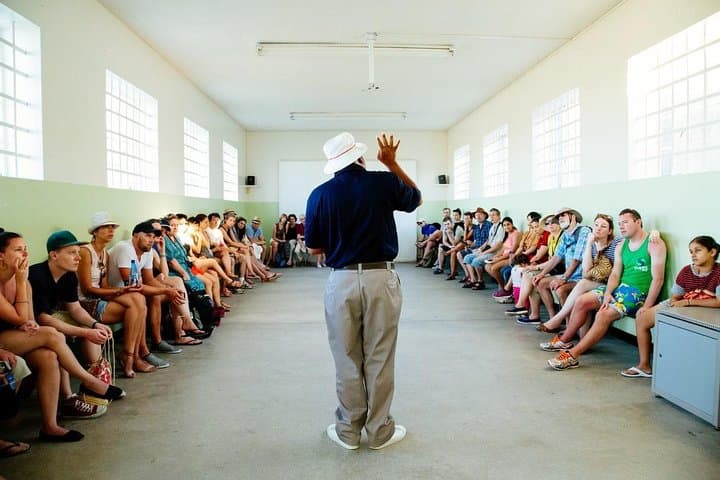
On Robben Island the pace changes. Voices fall into a measured cadence as former political prisoners guide groups past the limestone quarry, the cramped courthouse and the cell that held Nelson Mandela. The island’s scrub and seagulls feel indifferent to human drama; rocks and wind keep their own counsel. Guides don’t just recite facts — they place you in the sequence of events, describing work detail, hunger, and the small human rituals that sustained resistance.
Return to the mainland and the tour pivots from memory to panorama. You move from the flat lines of the waterfront into the ascent of Table Mountain — by cable car if weather allows — to stand above the city at roughly 1,086 meters at Maclear’s Beacon. The geology is ancient sandstone atop a granite base; the mountain’s flat crown cuts a clean horizon and hosts a unique fynbos flora found nowhere else on Earth.
Between those bookends are quick stops through Cape Town’s living neighborhoods: the rainbow-painted streets of Bo-Kaap, where Cape Malay history, mosques and spice-scented kitchens pulse with community life; the Company’s Garden, a colonial-era green that was once provisioning ground for passing ships and today shelters museums and squirrels with equal vigor; and St. George’s Cathedral and Groote Kerk, architectural markers of a city shaped by empire and struggle.
Practicalities matter: the full excursion is about eight hours and includes ferry transport, a guided Robben Island tour (led by ex-political prisoners), vehicle transfers and several short walks. Weather dictates parts of the trip — Robben Island ferries and Table Mountain cable cars close in strong wind or swell. Book Robben Island in advance; tours sell out.
Wear layers for wind and sun, sturdy closed shoes for uneven terrain, and bring water and a hat. Plan for early pickup options around Cape Town and allow flexibility if weather halts the cableway; the itinerary continues in that case and refunds follow provider policy. For those who want history and high views in one day, this loop delivers: the island’s quiet endurance and the mountain’s broad-eyed sweep combine into a deeply human, plainly beautiful Cape Town day.
moderate.
8 hours.
Suitable for travelers comfortable with short walks, standing during ferry crossings and boarding/disembarking; minimal climbing required if using cableway.
Only if you choose the 'All tickets included' option; otherwise purchase on site or advise the operator in advance.
Yes — ferries cancel in high wind or rough seas. If canceled, operators typically offer refunds or rescheduling per policy.
Tours are conducted by former political prisoners and museum staff who provide firsthand accounts and historical context.
Accessibility is limited: ferries and island terrain present challenges; contact the supplier for specific accommodations before booking.
Lunch is not included; the itinerary stops at the V&A Waterfront where your driver can recommend nearby restaurants.
Shared pickup is offered within a radius of the city centre (traveler-set pickup points within ~10 km); there is also a central meeting point at the Nelson Mandela Gateway.
Robben Island was used as a prison for political prisoners during apartheid; Table Mountain is part of the Cape Floral Kingdom, one of the world’s biodiversity hotspots.
The mountain’s fynbos is fragile; stick to trails and respect closure notices. Robben Island Museum operates conservation and heritage programs to preserve the site’s history.
Aim Cape Tours. operates guided outdoor trips and adventures with an emphasis on safety, stewardship, and memorable experiences.



The ferry slips away from the V&A Waterfront with Cape Town’s skyline folding open behind you — a low, flat city wrapped in ocean and a ridgeline that will define the day: Table Mountain. Salt air stings briefly and gulls wheel as the boat crosses toward Robben Island, where sunlight catches on whitewashed buildings and the island’s stony profile holds the memory of one of South Africa’s most consequential chapters.
The ferry slips away from the V&A Waterfront with Cape Town’s skyline folding open behind you — a low, flat city wrapped in ocean and a ridgeline that will define the day: Table Mountain. Salt air stings briefly and gulls wheel as the boat crosses toward Robben Island, where sunlight catches on whitewashed buildings and the island’s stony profile holds the memory of one of South Africa’s most consequential chapters.
On Robben Island the pace changes. Voices fall into a measured cadence as former political prisoners guide groups past the limestone quarry, the cramped courthouse and the cell that held Nelson Mandela. The island’s scrub and seagulls feel indifferent to human drama; rocks and wind keep their own counsel. Guides don’t just recite facts — they place you in the sequence of events, describing work detail, hunger, and the small human rituals that sustained resistance.
Return to the mainland and the tour pivots from memory to panorama. You move from the flat lines of the waterfront into the ascent of Table Mountain — by cable car if weather allows — to stand above the city at roughly 1,086 meters at Maclear’s Beacon. The geology is ancient sandstone atop a granite base; the mountain’s flat crown cuts a clean horizon and hosts a unique fynbos flora found nowhere else on Earth.
Between those bookends are quick stops through Cape Town’s living neighborhoods: the rainbow-painted streets of Bo-Kaap, where Cape Malay history, mosques and spice-scented kitchens pulse with community life; the Company’s Garden, a colonial-era green that was once provisioning ground for passing ships and today shelters museums and squirrels with equal vigor; and St. George’s Cathedral and Groote Kerk, architectural markers of a city shaped by empire and struggle.
Practicalities matter: the full excursion is about eight hours and includes ferry transport, a guided Robben Island tour (led by ex-political prisoners), vehicle transfers and several short walks. Weather dictates parts of the trip — Robben Island ferries and Table Mountain cable cars close in strong wind or swell. Book Robben Island in advance; tours sell out.
Wear layers for wind and sun, sturdy closed shoes for uneven terrain, and bring water and a hat. Plan for early pickup options around Cape Town and allow flexibility if weather halts the cableway; the itinerary continues in that case and refunds follow provider policy. For those who want history and high views in one day, this loop delivers: the island’s quiet endurance and the mountain’s broad-eyed sweep combine into a deeply human, plainly beautiful Cape Town day.