THE ADVENTURE COLLECTIVE® · Independent discovery and booking for outdoor travel

In four hours you can stand on Table Mountain’s wind-swept summit and then trace Cape Town’s layered history through the Malay Quarter, Company Gardens, and the V&A Waterfront. This private half-day tour pairs big panoramas with local color—and practical flexibility when weather intervenes.
In four hours you can stand on Table Mountain’s wind-swept summit and then trace Cape Town’s layered history through the Malay Quarter, Company Gardens, and the V&A Waterfront. This private half-day tour pairs big panoramas with local color—and practical flexibility when weather intervenes.
You step out of the car to Atlantic wind that seems to push the city into clearer focus—the harbor spread below, a swath of blue hurtling toward Robben Island, and the broad, flat crown of Table Mountain rising like a weathered roof above it all. On this half-day private tour the ascent is efficient: a short ride to the lower cableway station and, weather permitting, a glass-walled lift to the summit where the city contracts into streets and ships.
Verified experiences and guided adventures in the surrounding area.
You step out of the car to Atlantic wind that seems to push the city into clearer focus—the harbor spread below, a swath of blue hurtling toward Robben Island, and the broad, flat crown of Table Mountain rising like a weathered roof above it all. On this half-day private tour the ascent is efficient: a short ride to the lower cableway station and, weather permitting, a glass-walled lift to the summit where the city contracts into streets and ships.
Table Mountain’s plateau is only 1,086 meters above sea level, but the views are expansive enough to reframe Cape Town’s history. The flat top is made of hard, quartzitic sandstone laid down some 300 million years ago and lifted by tectonic drama. Long before colonists arrived the indigenous Khoikhoi and San peoples navigated these slopes. Later, the Dutch built the Castle of Good Hope in the city below; the tour often pauses there or in the Company Gardens, giving a quick, tangible survey of Cape Town’s layered past.
The route combines natural spectacle with city culture. From the summit you can watch Atlantic swell batter the coastline; Signal Hill and the Twelve Apostles buttress the skyline to the west. Back in town the tour winds through the Malay Quarter—Bo‑Kaap—where brightly painted houses and spiced aromas recall Cape Malay communities and the legacy of the slave trade. A quick stop at the V&A Waterfront offers a contrast: polished promenades, Diamond Works shops, and the constant movement of ferries.
Practically speaking, this is a four-hour experience best started in the morning when the Atlantic breeze has not yet whipped the mountain into capricious fog. Cableway tickets are typically not included and summit access is weather dependent—staff will rebook if winds or cloud make the lift unsafe. Wear sturdy walking shoes for the rocky, uneven summit paths and bring sun protection (the sun at elevation is blunt). Hydrate before you go; there are cafes at the top but service can be slow when the viewing decks are busy.
Expect short, gentle walks on paved paths and exposed rock sections that reward modest effort with sweeping panoramas. The private format means stops can be tailored—ask your guide about Bo‑Kaap photo spots, a quick look at the Castle of Good Hope, or which coastal outlook gives the best shot of Table Bay.
For first-time visitors this half-day is a compact primer: geology and urban history in one loop, with the summit ceremony of cableway glass and wind at the top. If the mountain refuses visitors, the city tour still delivers vivid neighborhoods, colonial architecture, and shoreline viewpoints—Cape Town’s character is as present at street level as it is from the plateau above.
moderate.
4 hours.
Light to moderate fitness; able to walk short distances on uneven ground and climb steps.
Usually not—confirm with the operator and book tickets in advance when possible; access is also weather dependent.
Most operators will rebook or offer an extended city tour alternative; confirm cancellation and rebooking policies when you book.
Yes—it's a gentle itinerary with short walks; the cableway provides easy access to the summit, but assess mobility for those with balance or heart concerns.
Expect short, mostly easy walks on paved sections and some uneven rock at viewpoints—nothing technical or long-distance.
Policies vary—ask beforehand; cableway tickets, museum entrance fees, and tips for your guide are often additional.
Yes. This is a private tour and guides typically tailor stops—request more time in Bo‑Kaap, the Castle, or additional viewpoints.
Table Mountain has long been a landmark for indigenous Khoikhoi and later colonial navigators; the Castle of Good Hope below dates to 17th-century Dutch settlement.
Table Mountain National Park manages the plateau; stick to paths to reduce erosion and avoid feeding wildlife—fynbos and endemic species are sensitive to disturbance.
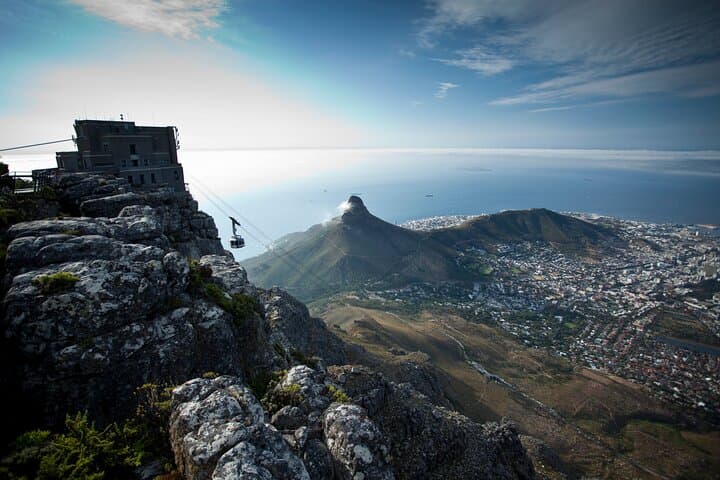
You step out of the car to Atlantic wind that seems to push the city into clearer focus—the harbor spread below, a swath of blue hurtling toward Robben Island, and the broad, flat crown of Table Mountain rising like a weathered roof above it all. On this half-day private tour the ascent is efficient: a short ride to the lower cableway station and, weather permitting, a glass-walled lift to the summit where the city contracts into streets and ships.
You step out of the car to Atlantic wind that seems to push the city into clearer focus—the harbor spread below, a swath of blue hurtling toward Robben Island, and the broad, flat crown of Table Mountain rising like a weathered roof above it all. On this half-day private tour the ascent is efficient: a short ride to the lower cableway station and, weather permitting, a glass-walled lift to the summit where the city contracts into streets and ships.
Table Mountain’s plateau is only 1,086 meters above sea level, but the views are expansive enough to reframe Cape Town’s history. The flat top is made of hard, quartzitic sandstone laid down some 300 million years ago and lifted by tectonic drama. Long before colonists arrived the indigenous Khoikhoi and San peoples navigated these slopes. Later, the Dutch built the Castle of Good Hope in the city below; the tour often pauses there or in the Company Gardens, giving a quick, tangible survey of Cape Town’s layered past.
The route combines natural spectacle with city culture. From the summit you can watch Atlantic swell batter the coastline; Signal Hill and the Twelve Apostles buttress the skyline to the west. Back in town the tour winds through the Malay Quarter—Bo‑Kaap—where brightly painted houses and spiced aromas recall Cape Malay communities and the legacy of the slave trade. A quick stop at the V&A Waterfront offers a contrast: polished promenades, Diamond Works shops, and the constant movement of ferries.
Practically speaking, this is a four-hour experience best started in the morning when the Atlantic breeze has not yet whipped the mountain into capricious fog. Cableway tickets are typically not included and summit access is weather dependent—staff will rebook if winds or cloud make the lift unsafe. Wear sturdy walking shoes for the rocky, uneven summit paths and bring sun protection (the sun at elevation is blunt). Hydrate before you go; there are cafes at the top but service can be slow when the viewing decks are busy.
Expect short, gentle walks on paved paths and exposed rock sections that reward modest effort with sweeping panoramas. The private format means stops can be tailored—ask your guide about Bo‑Kaap photo spots, a quick look at the Castle of Good Hope, or which coastal outlook gives the best shot of Table Bay.
For first-time visitors this half-day is a compact primer: geology and urban history in one loop, with the summit ceremony of cableway glass and wind at the top. If the mountain refuses visitors, the city tour still delivers vivid neighborhoods, colonial architecture, and shoreline viewpoints—Cape Town’s character is as present at street level as it is from the plateau above.