THE ADVENTURE COLLECTIVE® · Independent discovery and booking for outdoor travel

Turn a transfer between Zagreb and Zadar into an immersive visit to Plitvice Lakes National Park. This private guided tour pairs door-to-door transport with a focused walk across the park’s boardwalks, waterfalls and mirror-flat lakes.
Turn a transfer between Zagreb and Zadar into an immersive visit to Plitvice Lakes National Park. This private guided tour pairs door-to-door transport with a focused walk across the park’s boardwalks, waterfalls and mirror-flat lakes.
You step off the minivan onto a wooden boardwalk that hums with the same cool breath as the lakes themselves. Mist clings to the water in thin veils; a distant cascade announces itself with a steady, honest roar. For travelers breaking a drive between Zagreb and Zadar, this private guided stop at Plitvice Lakes National Park turns transit time into a concentrated dose of karst spectacle.
Verified experiences and guided adventures in the surrounding area.
Operated by hotelski prijevoz · Plitvička Jezera, Lika-Senj County
You step off the minivan onto a wooden boardwalk that hums with the same cool breath as the lakes themselves. Mist clings to the water in thin veils; a distant cascade announces itself with a steady, honest roar. For travelers breaking a drive between Zagreb and Zadar, this private guided stop at Plitvice Lakes National Park turns transit time into a concentrated dose of karst spectacle.
Plitvice’s sixteen terraced lakes are heavy with history and geology. Over millennia, mineral-rich water built travertine dams—soft rock that the park still grows today—forcing lakes to pool, spill and carve the stepped channels you walk across now. The park became a protected area in 1949 and a UNESCO World Heritage Site in 1979, a recognition of both its ecological value and the surprising fragility of living limestone.
Culturally, this is rural Lika—small villages, pastoral rhythms, and a food ethos that favors smoked cheese, freshwater fish, and simple stews. Your guide will stitch in local context while steering you to the park’s signature features: the lower lakes’ lacework of boardwalks, the panoramic prospect toward Veliki Slap (the Big Waterfall), and the quiet span of Kozjak Lake where the boat crossing reframes the landscape.
Practicalities matter here. The supplier recommends buying entrance tickets online at least three days before arrival—Entrance 1 at 11:00 is a suggested sweet spot—and you’ll transfer door-to-door from Zagreb with a private drop-off in Zadar. Expect roughly a 2–2.5 hour drive from Zagreb to Plitvice and about 1.5–2 hours onward to Zadar, depending on traffic. The guided walking component typically runs 2–3 hours: plan on 3–6 km of mostly flat walking on boardwalks and paths, with some stairs and short climbs; cumulative elevation change is modest (under ~200 m), so the route is accessible to most walkers.
Gear and timing make the day. Wear sturdy, water-resistant walking shoes—the boardwalks can be wet and slippery—and bring a light rain layer year-round. Summer fills the park early; aim for off-peak hours in shoulder seasons for mist and color. Respect park rules: stay on boardwalks, don’t swim, and carry out any trash. Your guide will handle commentary and logistics, but buying your park ticket in advance and bringing small change for the boat or café smooths the visit.
At its best, this stop turns what could be a windowed drive into an elemental walk through water, stone and forest—a compact immersion in one of Croatia’s most elemental landscapes before the Adriatic waits in Zadar.
moderate.
9 hours (including transfers); 2–3 hours walking in park.
Suitable for most travelers who can walk 3–6 km on uneven boardwalks and climb short flights of stairs.
No—tickets must be purchased separately on the Plitvice Lakes official website; the operator recommends buying at least 3 days in advance.
Guided time inside the park is typically 2–3 hours covering 3–6 km along boardwalks and paths.
Yes—this private transfer offers hotel pickup in Zagreb and drop-off in Zadar; confirm your pickup location when booking.
Some lower-lake boardwalks are relatively level, but uneven planks and steps make full wheelchair accessibility limited—check with the supplier for specifics.
No—swimming is prohibited to protect the travertine formations and local ecosystem.
The tour runs in most weather; cancellations follow the supplier’s policy—check with them for options and safety updates.
Plitvice’s lakes formed through ongoing travertine deposition; the park was protected in 1949 and added to UNESCO’s list in 1979.
Stay on boardwalks and follow park rules—travertine is living rock and easily damaged. Buying tickets ahead helps manage visitor flow and reduce pressure on trails.
hotelski prijevoz operates guided outdoor trips and adventures with an emphasis on safety, stewardship, and memorable experiences.

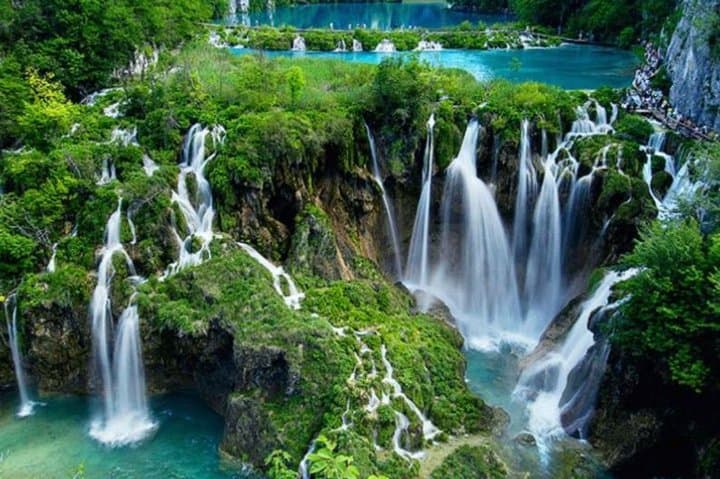
You step off the minivan onto a wooden boardwalk that hums with the same cool breath as the lakes themselves. Mist clings to the water in thin veils; a distant cascade announces itself with a steady, honest roar. For travelers breaking a drive between Zagreb and Zadar, this private guided stop at Plitvice Lakes National Park turns transit time into a concentrated dose of karst spectacle.
You step off the minivan onto a wooden boardwalk that hums with the same cool breath as the lakes themselves. Mist clings to the water in thin veils; a distant cascade announces itself with a steady, honest roar. For travelers breaking a drive between Zagreb and Zadar, this private guided stop at Plitvice Lakes National Park turns transit time into a concentrated dose of karst spectacle.
Plitvice’s sixteen terraced lakes are heavy with history and geology. Over millennia, mineral-rich water built travertine dams—soft rock that the park still grows today—forcing lakes to pool, spill and carve the stepped channels you walk across now. The park became a protected area in 1949 and a UNESCO World Heritage Site in 1979, a recognition of both its ecological value and the surprising fragility of living limestone.
Culturally, this is rural Lika—small villages, pastoral rhythms, and a food ethos that favors smoked cheese, freshwater fish, and simple stews. Your guide will stitch in local context while steering you to the park’s signature features: the lower lakes’ lacework of boardwalks, the panoramic prospect toward Veliki Slap (the Big Waterfall), and the quiet span of Kozjak Lake where the boat crossing reframes the landscape.
Practicalities matter here. The supplier recommends buying entrance tickets online at least three days before arrival—Entrance 1 at 11:00 is a suggested sweet spot—and you’ll transfer door-to-door from Zagreb with a private drop-off in Zadar. Expect roughly a 2–2.5 hour drive from Zagreb to Plitvice and about 1.5–2 hours onward to Zadar, depending on traffic. The guided walking component typically runs 2–3 hours: plan on 3–6 km of mostly flat walking on boardwalks and paths, with some stairs and short climbs; cumulative elevation change is modest (under ~200 m), so the route is accessible to most walkers.
Gear and timing make the day. Wear sturdy, water-resistant walking shoes—the boardwalks can be wet and slippery—and bring a light rain layer year-round. Summer fills the park early; aim for off-peak hours in shoulder seasons for mist and color. Respect park rules: stay on boardwalks, don’t swim, and carry out any trash. Your guide will handle commentary and logistics, but buying your park ticket in advance and bringing small change for the boat or café smooths the visit.
At its best, this stop turns what could be a windowed drive into an elemental walk through water, stone and forest—a compact immersion in one of Croatia’s most elemental landscapes before the Adriatic waits in Zadar.