THE ADVENTURE COLLECTIVE® · Independent discovery and booking for outdoor travel

In under ten minutes the Harder Kulm funicular lifts you above Interlaken to a 1,322 m viewing platform with direct views of the Eiger, Mönch and Jungfrau and both Lake Thun and Lake Brienz. This practical guide explains what to expect, when to go, and how to make the most of the summit in a short visit.
In under ten minutes the Harder Kulm funicular lifts you above Interlaken to a 1,322 m viewing platform with direct views of the Eiger, Mönch and Jungfrau and both Lake Thun and Lake Brienz. This practical guide explains what to expect, when to go, and how to make the most of the summit in a short visit.
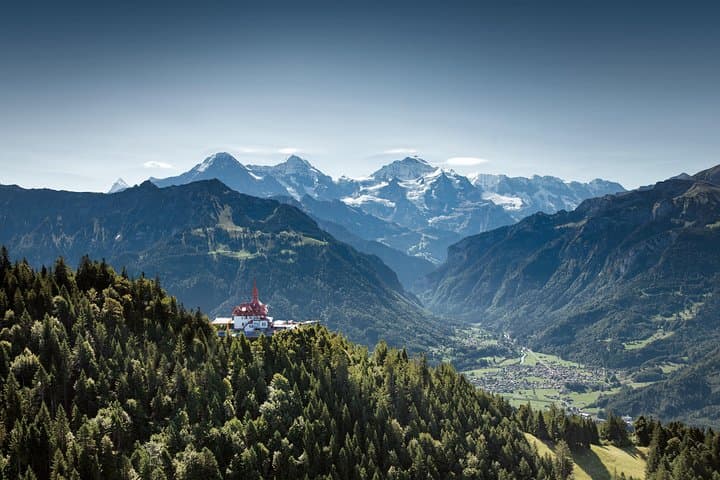
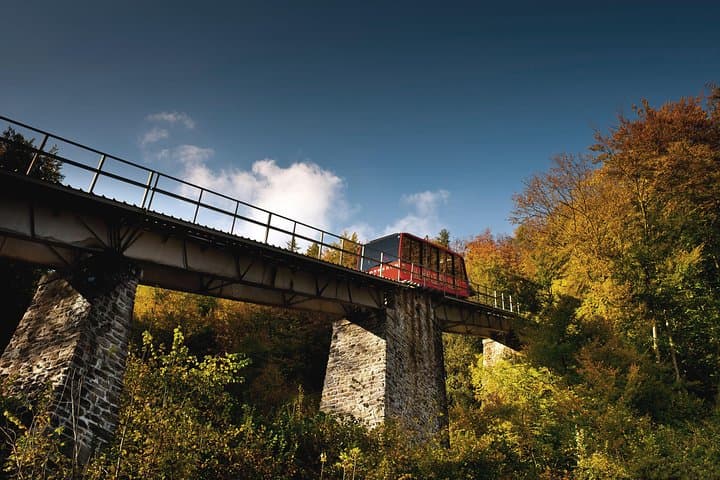
You step onto the funicular in Interlaken Ost and the town shrinks quickly—roofs, steeples and the twin lakes fold beneath you as the track rockets into a fir forest. In under ten minutes the carriage exhales at 1,322 metres, and the first thing you notice is how the air reorders perspective: the Eiger, Mönch and Jungfrau align like sculpture across the northern horizon while Lake Thun and Lake Brienz gleam on opposite sides of the valley.
Verified experiences and guided adventures in the surrounding area.
Operated by Harder Kulm - Top of Interlaken · Interlaken, Bern
You step onto the funicular in Interlaken Ost and the town shrinks quickly—roofs, steeples and the twin lakes fold beneath you as the track rockets into a fir forest. In under ten minutes the carriage exhales at 1,322 metres, and the first thing you notice is how the air reorders perspective: the Eiger, Mönch and Jungfrau align like sculpture across the northern horizon while Lake Thun and Lake Brienz gleam on opposite sides of the valley.
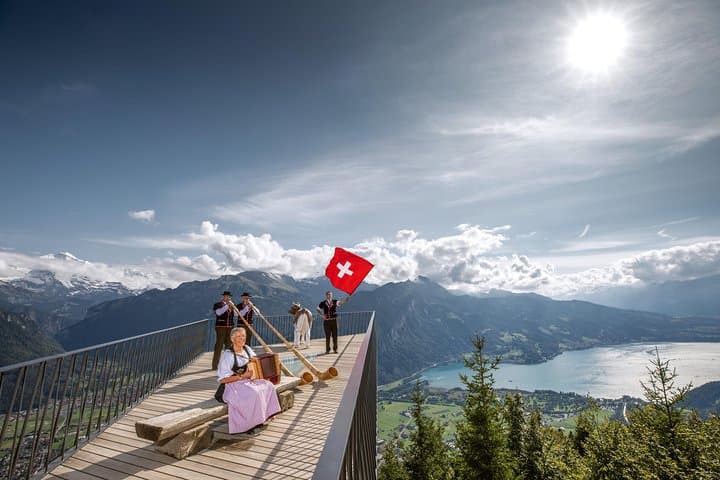
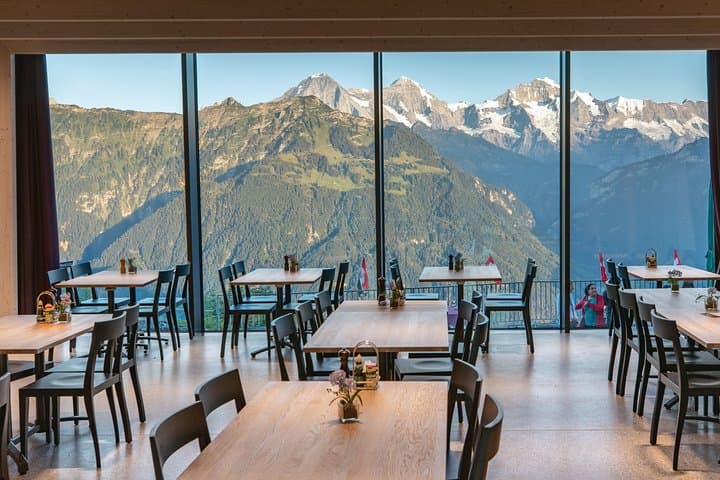
The ascent is brief but dramatic. The Harder Kulm funicular opened in the early 20th century to ferry locals and visitors up from the town below; the route passes a small wildlife park and a wooded slope that still hums with local birdlife. At the summit a fairy-tale restaurant—its turrets visible from a distance—perches beside the viewing platform and the Two-Lakes-Bridge, a narrow walkway with a glass section that dares you to look straight down at the blue water miles below.
Geology here is obvious and immediate: the valley is carved by ancient glaciers whose work left a flat basin, then steepened walls and maternal ridgelines. From Harder Kulm you can read that story at a glance—glacial spillways, moraine-formed lake basins, and the raw north faces of the higher Bernese Alps.
Culturally, Harder Kulm has long been Interlaken’s public lookout, a place for summer promenades, winter snowboots and Swiss photo postcards. Locals use the funicular for quick dinners above town, visitors for sunrise panoramas and hikers as a launch point for trails that fan into higher ridges.
Practical side: the ticket covers the roundtrip funicular ride. The trip is unguided—board by scanning a QR code at the gate—and you’ll find clear signage and a short network of paved and gravel paths at the top. Expect crowds mid-afternoon in summer; sunrise or late afternoon light gives clearer air and softer shadows for photos. The viewing platform is exposed to wind—bring a windbreaker. The restaurant is open late and offers a terrace when weather allows.
Plan for simple, quick logistics: allow 1–4 hours depending on whether you linger for a meal, take photos, or continue on foot along the ridge. Accessibility is good—the funicular handles strollers and pets—and the experience suits almost any fitness level. Respect marked trails and seasonal closures; alpine weather can change fast and the summit sits well above town temperatures.
Harder Kulm rewards short attention with big views: it’s less a hike than a doorway into the Bernese Oberland, a compact, high-altitude viewpoint that makes the scale of the Alps readable in a single, unforgettably wide frame.
easy.
1–4 hours.
Suitable for most fitness levels—no sustained climbing required if using the funicular; short walking on paved or gravel paths at the top is typical.
The funicular ascent takes under ten minutes each way, but plan 1–4 hours for the full visit depending on dining and photography time.
Yes—pets and service animals are permitted on the funicular and at the summit, but keep dogs leashed and pack out waste.
The funicular and main summit area are accessible; however, some viewpoints and the glass section may require short steps or ramps—check onsite for specifics.
Yes—the castle-style restaurant and terrace serve meals and drinks; service can be busy during peak hours, so expect a wait.
The funicular typically operates in poor weather, but visibility can be limited—check forecasts and bring warm layers; refunds follow the operator's 24-hour cancellation policy.
Yes—there are hiking routes to Harder Kulm from Interlaken and nearby trails, but they require more time and elevation gain than the funicular ride.
The Harder Kulm funicular opened in the early 20th century as a quick link between Interlaken and its panoramic summit; the summit restaurant has been a social landmark since that era.
Stay on marked paths to protect fragile alpine grasses and avoid flying drones near the platform to minimize disturbance to wildlife and other visitors.
Harder Kulm - Top of Interlaken operates guided outdoor trips and adventures with an emphasis on safety, stewardship, and memorable experiences.
You step onto the funicular in Interlaken Ost and the town shrinks quickly—roofs, steeples and the twin lakes fold beneath you as the track rockets into a fir forest. In under ten minutes the carriage exhales at 1,322 metres, and the first thing you notice is how the air reorders perspective: the Eiger, Mönch and Jungfrau align like sculpture across the northern horizon while Lake Thun and Lake Brienz gleam on opposite sides of the valley.
You step onto the funicular in Interlaken Ost and the town shrinks quickly—roofs, steeples and the twin lakes fold beneath you as the track rockets into a fir forest. In under ten minutes the carriage exhales at 1,322 metres, and the first thing you notice is how the air reorders perspective: the Eiger, Mönch and Jungfrau align like sculpture across the northern horizon while Lake Thun and Lake Brienz gleam on opposite sides of the valley.
The ascent is brief but dramatic. The Harder Kulm funicular opened in the early 20th century to ferry locals and visitors up from the town below; the route passes a small wildlife park and a wooded slope that still hums with local birdlife. At the summit a fairy-tale restaurant—its turrets visible from a distance—perches beside the viewing platform and the Two-Lakes-Bridge, a narrow walkway with a glass section that dares you to look straight down at the blue water miles below.
Geology here is obvious and immediate: the valley is carved by ancient glaciers whose work left a flat basin, then steepened walls and maternal ridgelines. From Harder Kulm you can read that story at a glance—glacial spillways, moraine-formed lake basins, and the raw north faces of the higher Bernese Alps.
Culturally, Harder Kulm has long been Interlaken’s public lookout, a place for summer promenades, winter snowboots and Swiss photo postcards. Locals use the funicular for quick dinners above town, visitors for sunrise panoramas and hikers as a launch point for trails that fan into higher ridges.
Practical side: the ticket covers the roundtrip funicular ride. The trip is unguided—board by scanning a QR code at the gate—and you’ll find clear signage and a short network of paved and gravel paths at the top. Expect crowds mid-afternoon in summer; sunrise or late afternoon light gives clearer air and softer shadows for photos. The viewing platform is exposed to wind—bring a windbreaker. The restaurant is open late and offers a terrace when weather allows.
Plan for simple, quick logistics: allow 1–4 hours depending on whether you linger for a meal, take photos, or continue on foot along the ridge. Accessibility is good—the funicular handles strollers and pets—and the experience suits almost any fitness level. Respect marked trails and seasonal closures; alpine weather can change fast and the summit sits well above town temperatures.
Harder Kulm rewards short attention with big views: it’s less a hike than a doorway into the Bernese Oberland, a compact, high-altitude viewpoint that makes the scale of the Alps readable in a single, unforgettably wide frame.