THE ADVENTURE COLLECTIVE® · Independent discovery and booking for outdoor travel

Spend a day crossing eras—Roman theater, Hellenistic streets, and a cool waterfall—on an easy guided loop from Side. This 7–8 hour tour pairs archaeology with a nature finish, ideal for travelers who want history and a refreshing finale in one outing.
Spend a day crossing eras—Roman theater, Hellenistic streets, and a cool waterfall—on an easy guided loop from Side. This 7–8 hour tour pairs archaeology with a nature finish, ideal for travelers who want history and a refreshing finale in one outing.
You step onto the air-conditioned coach in Side before sunrise, and the Mediterranean light has already warmed the limestone hills. By the time the bus threads out of the resort strip, stories start to gather—of gladiators and orators, of stone that has been rearranged into temples, and a river that keeps cutting its own quiet passages through the land.
Verified experiences and guided adventures in the surrounding area.
Operated by Seven Tours · Side, Antalya Province
You step onto the air-conditioned coach in Side before sunrise, and the Mediterranean light has already warmed the limestone hills. By the time the bus threads out of the resort strip, stories start to gather—of gladiators and orators, of stone that has been rearranged into temples, and a river that keeps cutting its own quiet passages through the land.
The day's rhythm is deliberate: first Aspendos, where a Roman stage still holds an audience of sky. Walk the slope of the theater and you feel how the design shapes sound; a whisper on the stage carries to the top row. Beyond the seats, the Eurymedon River sculpts the floodplain below, and the nearby Roman bridge arches like a line of punctuation across the water.
Perge follows with a different cadence. Its colonnaded avenue, flanked by weather-polished blocks and mosaic fragments, reads like a street plan from another era. The Hellenistic foundations and later Roman remakings layer across one another: agora, stadium, baths. A guide translates the stones into civic life—traders, ceremonies, the steady advance of empire—so the ruins stop being inert and start feeling like a paused city.
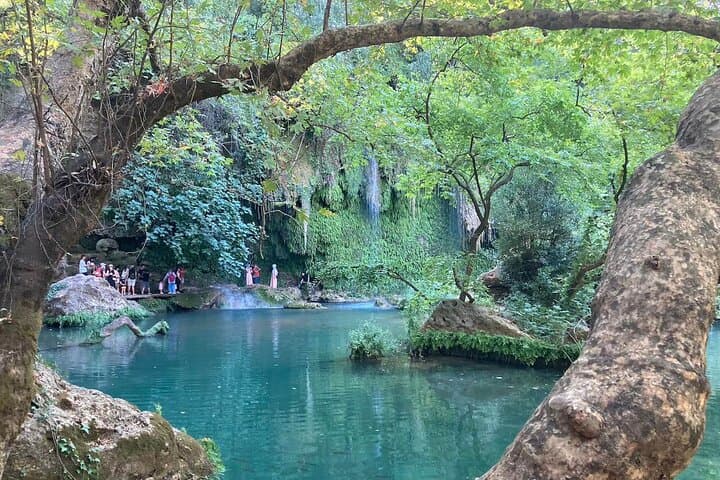
The final act is Kurşunlu Waterfall, a switch in tempo. Pine and plane trees lean over pools where emerald water tumbles and collects; the cascade gestures at you, urging a slower pace. Moss-covered steps can be slippery, and the sound of water rearranges the day's dust and heat into cool hush.
Geologically the region is a mix of Miocene limestone and alluvial terraces. Human hands have quarried and repurposed that stone for millennia, so the same rock that forms the theater’s risers also shapes local farm walls. Culturally, this corridor between Side and Antalya has been a crossroads from Pamphylia to Pisidia, with layers of Greek, Roman, Byzantine and Ottoman influence.
Practical details: expect a 7–8 hour outing with hotel pickup across Side and Manavgat, transport in an air-conditioned coach, bilingual guiding, and a included lunch. Wear sturdy walking shoes for uneven marble and packed-earth paths; bring sun protection and a small towel if you plan a dip at Kurşunlu. Admissions to Aspendos and Perge are typically paid on-site; the waterfall's entrance is included on this tour. Mobility limitations are noted: some sites require steps and short uneven walks.
Timing matters: mornings make Aspendos' acoustics feel haunted and Perge bright and photo-ready; mid-afternoon cools best at the waterfall. Respect site rules—no climbing on fragile ruins—and keep water and waste off the trails so the river and pools keep daring future visitors to pause and listen.
easy.
7–8 hours.
Suitable for most fitness levels; involves several hours of walking on uneven ground and steps.
The tour runs approximately 7–8 hours, including hotel pickup, transit, lunch, and time at each site.
Admission to Kurşunlu Waterfall is included on this tour; entrance fees for Aspendos and Perge are typically paid on-site.
Yes—lunch is included and usually served at a local restaurant between site visits.
Yes—it's rated easy, but expect uneven ground and steps; guests with limited mobility may find some areas challenging.
Guides are bilingual; the tour description notes bilingual guiding, often Turkish and English.
Short dips in designated pool areas are common, but follow guide instructions and watch for posted safety signs.
Perge and Aspendos were major centers in ancient Pamphylia; Aspendos’ theater dates to the 2nd century CE and is famed for its acoustics, while Perge preserves Hellenistic street planning later overlaid by Roman public buildings.
Kurşunlu is a protected area; visitors should stay on marked paths and pack out waste to protect streams and nesting birds.
Seven Tours operates guided outdoor trips and adventures with an emphasis on safety, stewardship, and memorable experiences.



You step onto the air-conditioned coach in Side before sunrise, and the Mediterranean light has already warmed the limestone hills. By the time the bus threads out of the resort strip, stories start to gather—of gladiators and orators, of stone that has been rearranged into temples, and a river that keeps cutting its own quiet passages through the land.
You step onto the air-conditioned coach in Side before sunrise, and the Mediterranean light has already warmed the limestone hills. By the time the bus threads out of the resort strip, stories start to gather—of gladiators and orators, of stone that has been rearranged into temples, and a river that keeps cutting its own quiet passages through the land.
The day's rhythm is deliberate: first Aspendos, where a Roman stage still holds an audience of sky. Walk the slope of the theater and you feel how the design shapes sound; a whisper on the stage carries to the top row. Beyond the seats, the Eurymedon River sculpts the floodplain below, and the nearby Roman bridge arches like a line of punctuation across the water.
Perge follows with a different cadence. Its colonnaded avenue, flanked by weather-polished blocks and mosaic fragments, reads like a street plan from another era. The Hellenistic foundations and later Roman remakings layer across one another: agora, stadium, baths. A guide translates the stones into civic life—traders, ceremonies, the steady advance of empire—so the ruins stop being inert and start feeling like a paused city.
The final act is Kurşunlu Waterfall, a switch in tempo. Pine and plane trees lean over pools where emerald water tumbles and collects; the cascade gestures at you, urging a slower pace. Moss-covered steps can be slippery, and the sound of water rearranges the day's dust and heat into cool hush.
Geologically the region is a mix of Miocene limestone and alluvial terraces. Human hands have quarried and repurposed that stone for millennia, so the same rock that forms the theater’s risers also shapes local farm walls. Culturally, this corridor between Side and Antalya has been a crossroads from Pamphylia to Pisidia, with layers of Greek, Roman, Byzantine and Ottoman influence.
Practical details: expect a 7–8 hour outing with hotel pickup across Side and Manavgat, transport in an air-conditioned coach, bilingual guiding, and a included lunch. Wear sturdy walking shoes for uneven marble and packed-earth paths; bring sun protection and a small towel if you plan a dip at Kurşunlu. Admissions to Aspendos and Perge are typically paid on-site; the waterfall's entrance is included on this tour. Mobility limitations are noted: some sites require steps and short uneven walks.
Timing matters: mornings make Aspendos' acoustics feel haunted and Perge bright and photo-ready; mid-afternoon cools best at the waterfall. Respect site rules—no climbing on fragile ruins—and keep water and waste off the trails so the river and pools keep daring future visitors to pause and listen.