THE ADVENTURE COLLECTIVE® · Independent discovery and booking for outdoor travel

A compact, three-day journey from Ulaanbaatar that pairs ger-stays with horse and camel rides across dunes and a search for the wild Takhi in Hustai National Park. Expect hands-on cultural encounters, varied terrain and intimate wildlife viewing.
A compact, three-day journey from Ulaanbaatar that pairs ger-stays with horse and camel rides across dunes and a search for the wild Takhi in Hustai National Park. Expect hands-on cultural encounters, varied terrain and intimate wildlife viewing.
The first morning light in the steppe arrives without fanfare: a wide, cool sky lifting off the edges of a low, grass-scarred ridge. On Essence of Mongolia’s three-day loop you exchange city concrete for a landscape that moves at the pace of grazing herds and the slow creak of a ger door. By midmorning the vehicle has left Ulaanbaatar behind and the road opens to rolling hills, the air picking up a mineral tang that hints at dunes and mountain dust ahead.
Verified experiences and guided adventures in the surrounding area.
Operated by Tour Mongolia · Ulaanbaatar, N/A
The first morning light in the steppe arrives without fanfare: a wide, cool sky lifting off the edges of a low, grass-scarred ridge. On Essence of Mongolia’s three-day loop you exchange city concrete for a landscape that moves at the pace of grazing herds and the slow creak of a ger door. By midmorning the vehicle has left Ulaanbaatar behind and the road opens to rolling hills, the air picking up a mineral tang that hints at dunes and mountain dust ahead.
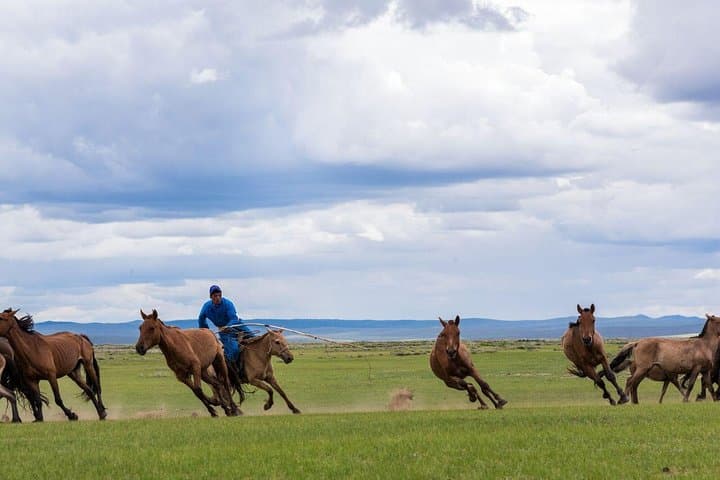
Day one begins in Gurvanbulag, where guests stay in a family ger and are welcomed with milk tea and fresh curds. The riding here is practical, not polo—the horses are stocky steppe mounts accustomed to short bursts and long walks. In the afternoon a short ride or walk carries you toward wind-sculpted dunes; riders are provided helmets and shin protectors, and guides keep the pace patient for newcomers.
On day two you move to Khogno Khan and the Elsen Tasarkhai dunes. Geologically, Khogno Khan is an outcrop of older volcanic and metamorphic rock rising from loess and alluvial deposits, and the ruined temples of Uvgun Khiid cling to those exposed slopes. The hike to the old temple is a steady 45-minute climb over loose rock and grassy ledges with 150–250 m of elevation change—worth it for the panoramic sweep that follows.
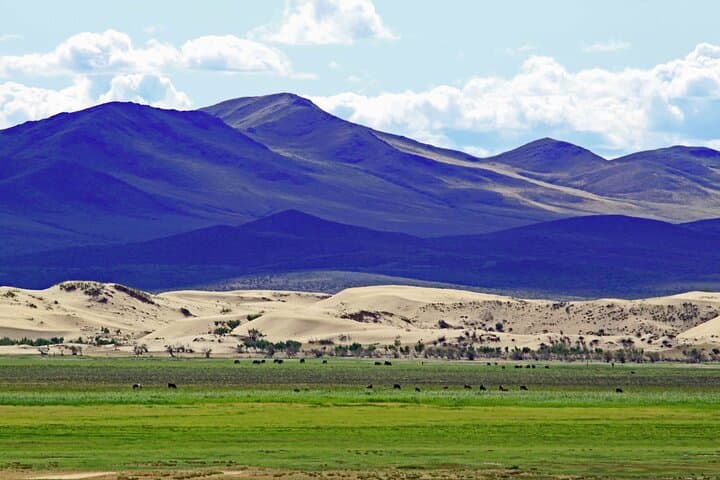
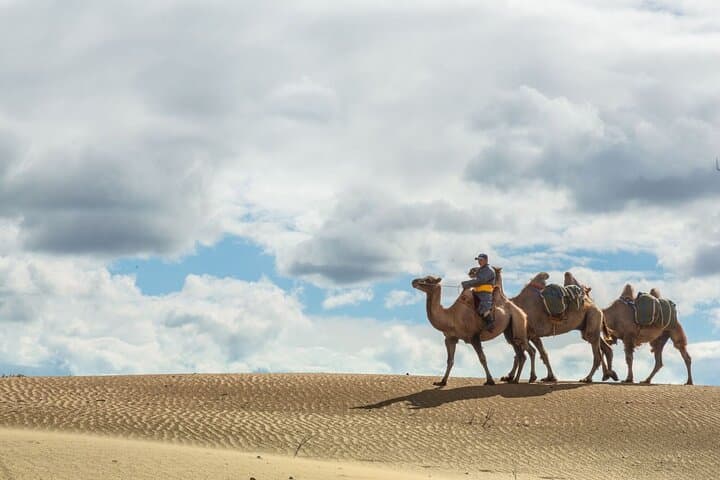
The dunes at Elsen Tasarkhai feel improbably desert-like: sand ridges that push and fold against a greener horizon. Here Bactrian camels take over, carrying riders in single-file across a compact dune system where light changes fast and shadows sharpen contours.
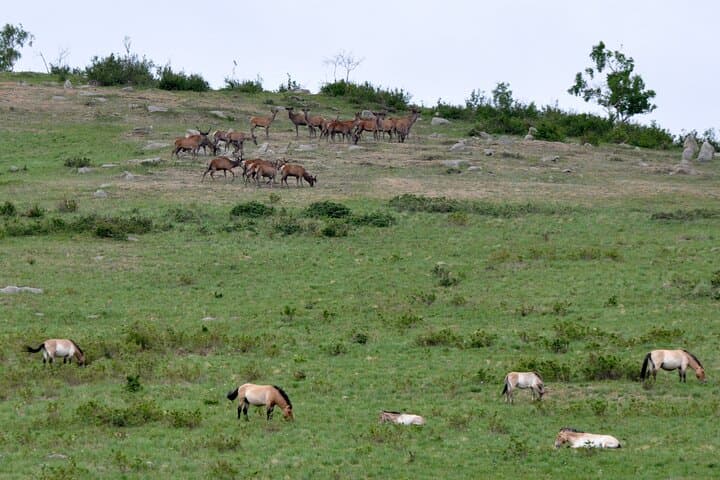
On the final day the route swings north-east to Hustai National Park, the conservation area that reintroduced the Przewalski’s horse (Takhi) to Mongolia in the 1990s. Drives through Hustai move slowly—park roads, binoculars out—searching for small herds, argali tracks, and the occasional marmot silhouette.
Practical edge: distances are modest but driven over rural roads—expect 2–4 hours between major stops. Terrain alternates packed dirt, grassy steppe, rocky temple approaches and short sand ascents. Nights are in guest gers beside nomad families; bedding is simple and warm. Pack layers, a daypack, and a sense of curiosity.
Cultural moments are woven into the itinerary—ankle-bone games, dumpling cooking, milking demonstrations—and guides encourage respectful participation. The trip is compact but intentional: three days that trade hurry for proximity to places and people who still move with the seasons.
moderate.
3 days.
Comfortable with several short hikes, basic horseback/camel riding and long vehicle transfers; good mobility helps.
Pickup is available from prearranged locations and many hotels in Ulaanbaatar—confirm your pickup point at booking and expect a 20-minute pre-departure window.
Gers are traditional guest gers hosted by nomad families; bedding is provided and privacy varies—couples usually get their own ger, larger groups may share a multi-bed ger.
No formal experience is required; guides provide basic instruction and equipment. Notify the operator of any concerns when booking.
Summers are warm to hot by day and cool at night; spring/fall can be windy and cold—pack for variable conditions and sudden changes.
Local hosts prepare traditional meals; advance notice of dietary restrictions allows guides to arrange alternatives when possible.
Hustai gives strong chances to see Takhi but sightings depend on herd movement and weather; expect a guided search with binoculars and patient drives.
The Khogno Khan area has long been a spiritual landscape with temple ruins tied to 17th–19th century monastic life; Hustai is a modern conservation success for rewilding the Takhi.
Hustai operates strict park rules to protect Takhi habitat—stay on roads and follow guide instructions; minimize campfire and waste impact around nomad camps.
Tour Mongolia operates guided outdoor trips and adventures with an emphasis on safety, stewardship, and memorable experiences.
The first morning light in the steppe arrives without fanfare: a wide, cool sky lifting off the edges of a low, grass-scarred ridge. On Essence of Mongolia’s three-day loop you exchange city concrete for a landscape that moves at the pace of grazing herds and the slow creak of a ger door. By midmorning the vehicle has left Ulaanbaatar behind and the road opens to rolling hills, the air picking up a mineral tang that hints at dunes and mountain dust ahead.
The first morning light in the steppe arrives without fanfare: a wide, cool sky lifting off the edges of a low, grass-scarred ridge. On Essence of Mongolia’s three-day loop you exchange city concrete for a landscape that moves at the pace of grazing herds and the slow creak of a ger door. By midmorning the vehicle has left Ulaanbaatar behind and the road opens to rolling hills, the air picking up a mineral tang that hints at dunes and mountain dust ahead.
Day one begins in Gurvanbulag, where guests stay in a family ger and are welcomed with milk tea and fresh curds. The riding here is practical, not polo—the horses are stocky steppe mounts accustomed to short bursts and long walks. In the afternoon a short ride or walk carries you toward wind-sculpted dunes; riders are provided helmets and shin protectors, and guides keep the pace patient for newcomers.
On day two you move to Khogno Khan and the Elsen Tasarkhai dunes. Geologically, Khogno Khan is an outcrop of older volcanic and metamorphic rock rising from loess and alluvial deposits, and the ruined temples of Uvgun Khiid cling to those exposed slopes. The hike to the old temple is a steady 45-minute climb over loose rock and grassy ledges with 150–250 m of elevation change—worth it for the panoramic sweep that follows.
The dunes at Elsen Tasarkhai feel improbably desert-like: sand ridges that push and fold against a greener horizon. Here Bactrian camels take over, carrying riders in single-file across a compact dune system where light changes fast and shadows sharpen contours.
On the final day the route swings north-east to Hustai National Park, the conservation area that reintroduced the Przewalski’s horse (Takhi) to Mongolia in the 1990s. Drives through Hustai move slowly—park roads, binoculars out—searching for small herds, argali tracks, and the occasional marmot silhouette.
Practical edge: distances are modest but driven over rural roads—expect 2–4 hours between major stops. Terrain alternates packed dirt, grassy steppe, rocky temple approaches and short sand ascents. Nights are in guest gers beside nomad families; bedding is simple and warm. Pack layers, a daypack, and a sense of curiosity.
Cultural moments are woven into the itinerary—ankle-bone games, dumpling cooking, milking demonstrations—and guides encourage respectful participation. The trip is compact but intentional: three days that trade hurry for proximity to places and people who still move with the seasons.