THE ADVENTURE COLLECTIVE® · Independent discovery and booking for outdoor travel

Spend a day tracing the ancient pulse of Antalya: Roman baths and stadiums in Perge, the near-perfect acoustics of Aspendos, coastal ruins at Side, and the cool mist of Kurşunlu Waterfall. This private tour pairs archaeology with seaside scenery and a riverside lunch.
Spend a day tracing the ancient pulse of Antalya: Roman baths and stadiums in Perge, the near-perfect acoustics of Aspendos, coastal ruins at Side, and the cool mist of Kurşunlu Waterfall. This private tour pairs archaeology with seaside scenery and a riverside lunch.
You step into a warm morning that smells faintly of citrus and sea salt, the minivan's engine humming as the shoreline of Antalya slides away. The guide speaks in a soft, confident cadence—routes, timings, what to expect—and the city gives way to scrubby hills, pomegranate orchards, and the first columns of Perge rising like a row of old teeth against the horizon.
Verified experiences and guided adventures in the surrounding area.
Operated by Opatrip.com Turkey · Antalya, Antalya
You step into a warm morning that smells faintly of citrus and sea salt, the minivan's engine humming as the shoreline of Antalya slides away. The guide speaks in a soft, confident cadence—routes, timings, what to expect—and the city gives way to scrubby hills, pomegranate orchards, and the first columns of Perge rising like a row of old teeth against the horizon.
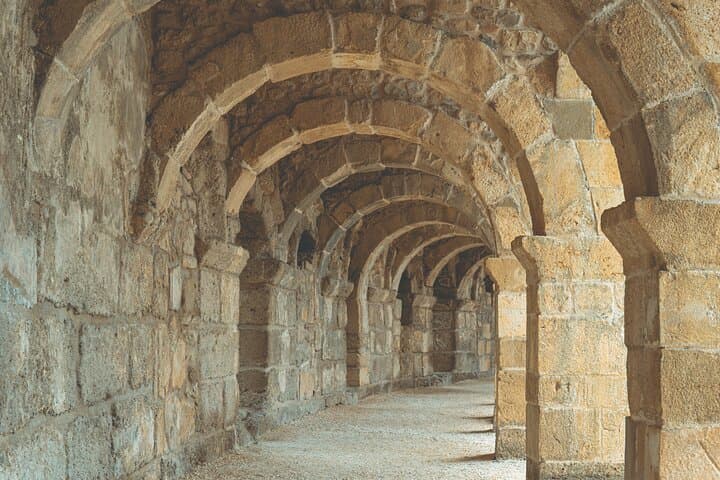
Perge unfurls with the ease of an open book: a colonnaded street still wearing the grooves of chariot wheels, a stadium where bronze-and-tan stones keep the memory of races, and Roman baths where mosaics whisper the names of long-gone patrons. Here, the layers of history are literal—Hellenistic foundations under Roman façades, each phase stacked over the last like chapters.
From Perge the road curves toward Aspendos, where the amphitheater commands attention. Built in the 2nd century A.D., its acoustics are almost mischievous—speak at the center and your voice travels like a current to every seat. Aspendos still hosts performances; the stone seems to remember applause.
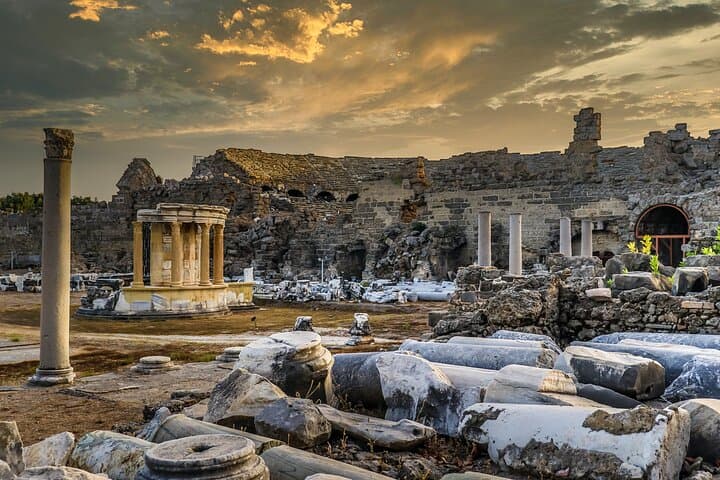
The afternoon slides down to Side, a small coastal town balanced between an active harbor and ancient ruins. The Temple of Apollo perches on a cliff-edge, columns silhouetted against the Mediterranean. You’ll find mosaic floors, a compact theater, and narrow lanes where cafés pour strong Turkish coffee.
The last stop, Kurşunlu Waterfall, gives the day a green exhale. Water finds a route through limestone and moss, daring you to linger where spray cools the skin. The site is quieter than the ruins—local families picnic, herons scan the shallows, and the path hums with insect-song.
Practical edge: this is a full-day private tour—roughly nine hours including transport and lunch. Paths at Perge and Side are mostly flat but uneven; expect gravel, steps and some climb at Aspendos. Temperatures in summer can climb high; early departures and sunscreen matter. Entrance fees and a riverside lunch are included in the tour, and guides handle the logistics—tickets, parking, and the best angles for photos.
For travelers, this tour balances archaeology with landscape—ancient urban planning, Roman engineering and the soft geology that shapes Antalya’s rivers and coastline. Bring sturdy walking shoes, a lightweight layer for coastal breezes, and an appetite for both history and the region’s citrus-forward cuisine. The route is accessible for most fitness levels and rewards patience with clear views into how empires built, performed and retreated back into the earth.
easy.
9 hours.
Suitable for most fitness levels; requires walking on uneven ground and short stairs.
The tour runs about nine hours from hotel pickup to drop-off, including transport, site visits and lunch.
Yes—entrance fees for Perge, Aspendos and Kurşunlu Waterfall are included in the tour price.
Yes; it’s rated easy physically, though be prepared for walking on uneven surfaces and some stairs.
Yes—a riverside restaurant lunch is included; inform the operator of dietary restrictions when booking.
It’s a private tour, so itinerary tweaks are often possible—confirm changes with the guide in advance.
Light, breathable clothing in summer; layered clothing and a light jacket in spring/fall; comfortable, closed-toe shoes are recommended.
Perge and Aspendos were key urban centers in Pamphylia and later the Roman Empire—Aspendos’s theater is one of the best-preserved examples of Roman acoustical design.
Sites are managed to balance visitor access with preservation—stay on marked paths and avoid touching exposed mosaics to minimize wear.
Opatrip.com Turkey operates guided outdoor trips and adventures with an emphasis on safety, stewardship, and memorable experiences.


You step into a warm morning that smells faintly of citrus and sea salt, the minivan's engine humming as the shoreline of Antalya slides away. The guide speaks in a soft, confident cadence—routes, timings, what to expect—and the city gives way to scrubby hills, pomegranate orchards, and the first columns of Perge rising like a row of old teeth against the horizon.
You step into a warm morning that smells faintly of citrus and sea salt, the minivan's engine humming as the shoreline of Antalya slides away. The guide speaks in a soft, confident cadence—routes, timings, what to expect—and the city gives way to scrubby hills, pomegranate orchards, and the first columns of Perge rising like a row of old teeth against the horizon.
Perge unfurls with the ease of an open book: a colonnaded street still wearing the grooves of chariot wheels, a stadium where bronze-and-tan stones keep the memory of races, and Roman baths where mosaics whisper the names of long-gone patrons. Here, the layers of history are literal—Hellenistic foundations under Roman façades, each phase stacked over the last like chapters.
From Perge the road curves toward Aspendos, where the amphitheater commands attention. Built in the 2nd century A.D., its acoustics are almost mischievous—speak at the center and your voice travels like a current to every seat. Aspendos still hosts performances; the stone seems to remember applause.
The afternoon slides down to Side, a small coastal town balanced between an active harbor and ancient ruins. The Temple of Apollo perches on a cliff-edge, columns silhouetted against the Mediterranean. You’ll find mosaic floors, a compact theater, and narrow lanes where cafés pour strong Turkish coffee.
The last stop, Kurşunlu Waterfall, gives the day a green exhale. Water finds a route through limestone and moss, daring you to linger where spray cools the skin. The site is quieter than the ruins—local families picnic, herons scan the shallows, and the path hums with insect-song.
Practical edge: this is a full-day private tour—roughly nine hours including transport and lunch. Paths at Perge and Side are mostly flat but uneven; expect gravel, steps and some climb at Aspendos. Temperatures in summer can climb high; early departures and sunscreen matter. Entrance fees and a riverside lunch are included in the tour, and guides handle the logistics—tickets, parking, and the best angles for photos.
For travelers, this tour balances archaeology with landscape—ancient urban planning, Roman engineering and the soft geology that shapes Antalya’s rivers and coastline. Bring sturdy walking shoes, a lightweight layer for coastal breezes, and an appetite for both history and the region’s citrus-forward cuisine. The route is accessible for most fitness levels and rewards patience with clear views into how empires built, performed and retreated back into the earth.