THE ADVENTURE COLLECTIVE® · Independent discovery and booking for outdoor travel

Trace Jordan’s layered past on an eight-day private tour that pairs Roman ruins and Byzantine mosaics with the carved façades of Petra, the spacious silence of Wadi Rum and a restorative float in the Dead Sea. This itinerary balances guided history with practical logistics—hotels, private transport and a desert camp stay.
Trace Jordan’s layered past on an eight-day private tour that pairs Roman ruins and Byzantine mosaics with the carved façades of Petra, the spacious silence of Wadi Rum and a restorative float in the Dead Sea. This itinerary balances guided history with practical logistics—hotels, private transport and a desert camp stay.
Arrive in Amman and the city meets you with a dry, sun-baked exhale: narrow streets press upward, minarets puncture the skyline, and the Citadel perches like a long-lived neighbor watching over seven hills. Over eight days, this private itinerary moves from Roman colonnades to carved sandstone cities, from pine‑dotted hills in the north to a desert that refuses to be tamed.
Verified experiences and guided adventures in the surrounding area.
Operated by Halino Travel · Amman, Amman Governorate
Arrive in Amman and the city meets you with a dry, sun-baked exhale: narrow streets press upward, minarets puncture the skyline, and the Citadel perches like a long-lived neighbor watching over seven hills. Over eight days, this private itinerary moves from Roman colonnades to carved sandstone cities, from pine‑dotted hills in the north to a desert that refuses to be tamed.
The route reads like a history primer. Jerash opens with its avenue of columns—an intact Roman grid that still suggests the cadence of procession and market day. Ajloun’s 12th-century fortress speaks to Arab military craft under Saladin. Along the King’s Highway, mosaics in Madaba and the viewpoint at Mount Nebo frame Byzantine and biblical layers; Karak Castle sits roughly 1,000 meters above sea level, a Crusader keep that watches over terraced farmland and approaches to the Dead Sea.
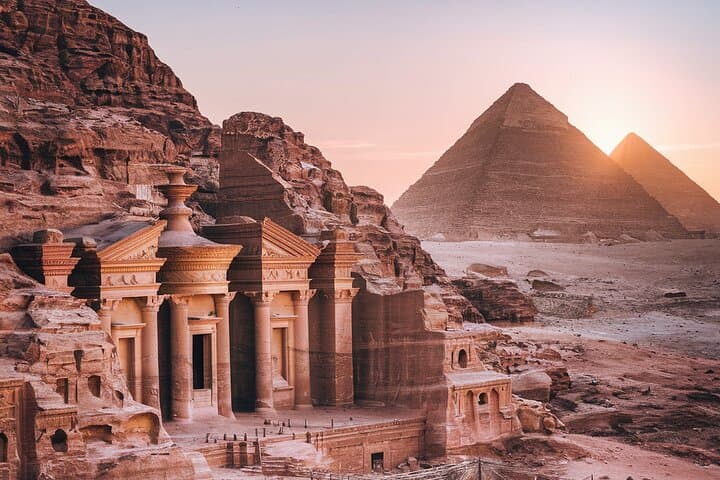
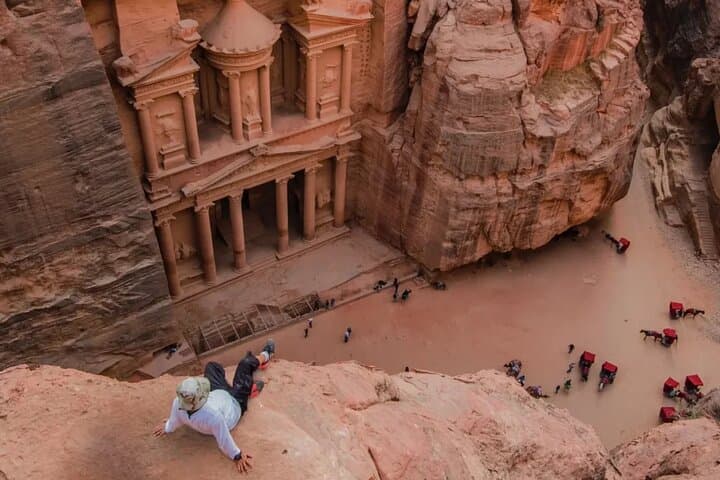
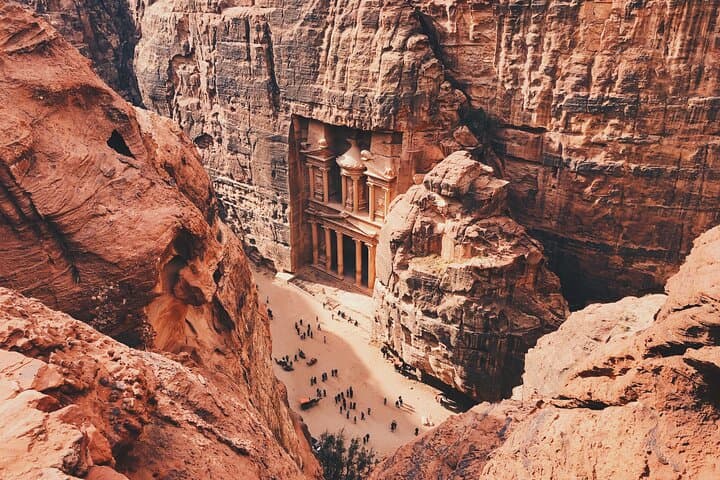
Petra requires a slower tempo. Walk the Siq, a narrow cleft where engineered water channels whisper of Nabataean civic planning, then emerge on the Treasury’s façade—stone that takes on different personalities as the sun moves. Wadi Rum is geological theater: granite and sandstone towers sculpted by wind and ancient seas across a protected 720 km2 reserve. The desert will test scale and silence; dunes and arches shape light that is almost architectural.
The Dead Sea reverses everything—sea-level logic and buoyancy—lying 423 meters below sea level, its dense water demanding that visitors float rather than swim. Aqaba provides a brief marine punctuation with Red Sea reefs and a quieter coastal rhythm.
Practicalities are built into the trip: private A/C transport, English guides at major sites, hotel stays with breakfasts, and an overnight desert camp with private bathroom. Expect full days—Petra alone can take 4–6 hours to explore comfortably. Temperatures swing widely; northern Jordan can be green and cool in spring, the south can blister in summer.
Pack sturdy walking shoes, sun protection, and a small daypack for water and layers. In Petra be ready for uneven stone steps; in Wadi Rum, sand will find its way into everything. Take the provided jeep safari in Wadi Rum to see far reaches; at the Dead Sea, avoid shaving before floating and rinse off promptly after. Tipping customs are modest but customary for guides, drivers, and camp staff.
For history lovers, photographers and first-time travelers, this route balances narrative and logistics: you’re never rushed through a major site, but days are full and require a basic level of fitness. The reward is clear—ancient stone, desert horizons that feel like an argument with scale, and the peculiar calm of floating where the earth dips lowest.
moderate.
8 days (full‑day activities most days).
Moderate fitness required: comfortable walking on uneven surfaces, stairs and occasional sand dunes.
Many nationalities can obtain a visa on arrival; check current entry rules ahead of travel and note that this tour can include visa handling if requested.
The private Petra visit covers the lower site and the Siq; expect 3–6 hours of walking on uneven paths and steps—comfortable shoes and a moderate fitness level are recommended.
The included short jeep safari is family‑friendly, but children should be secured and accompanied; longer off‑road routes can be bumpy.
You float rather than swim; avoid getting saltwater in eyes or open cuts, and rinse off after. Do not dive—the high salinity makes diving dangerous.
The tour includes double/twin hotel rooms; single supplements are typically available—confirm during booking for solo travelers.
Local guides are provided in English for major sites; private tour leaders may offer other languages on request if arranged in advance.
Jordan’s sites span Neolithic settlements, Nabataean engineering in Petra, Roman urban planning in Jerash and Crusader architecture at Karak, reflecting continuous occupation and trade routes.
Wadi Rum is a protected reserve balancing tourism and Bedouin livelihoods; visitors should stay on marked routes and minimize single‑use plastics to limit impact.
Halino Travel operates guided outdoor trips and adventures with an emphasis on safety, stewardship, and memorable experiences.
Arrive in Amman and the city meets you with a dry, sun-baked exhale: narrow streets press upward, minarets puncture the skyline, and the Citadel perches like a long-lived neighbor watching over seven hills. Over eight days, this private itinerary moves from Roman colonnades to carved sandstone cities, from pine‑dotted hills in the north to a desert that refuses to be tamed.
Arrive in Amman and the city meets you with a dry, sun-baked exhale: narrow streets press upward, minarets puncture the skyline, and the Citadel perches like a long-lived neighbor watching over seven hills. Over eight days, this private itinerary moves from Roman colonnades to carved sandstone cities, from pine‑dotted hills in the north to a desert that refuses to be tamed.
The route reads like a history primer. Jerash opens with its avenue of columns—an intact Roman grid that still suggests the cadence of procession and market day. Ajloun’s 12th-century fortress speaks to Arab military craft under Saladin. Along the King’s Highway, mosaics in Madaba and the viewpoint at Mount Nebo frame Byzantine and biblical layers; Karak Castle sits roughly 1,000 meters above sea level, a Crusader keep that watches over terraced farmland and approaches to the Dead Sea.
Petra requires a slower tempo. Walk the Siq, a narrow cleft where engineered water channels whisper of Nabataean civic planning, then emerge on the Treasury’s façade—stone that takes on different personalities as the sun moves. Wadi Rum is geological theater: granite and sandstone towers sculpted by wind and ancient seas across a protected 720 km2 reserve. The desert will test scale and silence; dunes and arches shape light that is almost architectural.
The Dead Sea reverses everything—sea-level logic and buoyancy—lying 423 meters below sea level, its dense water demanding that visitors float rather than swim. Aqaba provides a brief marine punctuation with Red Sea reefs and a quieter coastal rhythm.
Practicalities are built into the trip: private A/C transport, English guides at major sites, hotel stays with breakfasts, and an overnight desert camp with private bathroom. Expect full days—Petra alone can take 4–6 hours to explore comfortably. Temperatures swing widely; northern Jordan can be green and cool in spring, the south can blister in summer.
Pack sturdy walking shoes, sun protection, and a small daypack for water and layers. In Petra be ready for uneven stone steps; in Wadi Rum, sand will find its way into everything. Take the provided jeep safari in Wadi Rum to see far reaches; at the Dead Sea, avoid shaving before floating and rinse off promptly after. Tipping customs are modest but customary for guides, drivers, and camp staff.
For history lovers, photographers and first-time travelers, this route balances narrative and logistics: you’re never rushed through a major site, but days are full and require a basic level of fitness. The reward is clear—ancient stone, desert horizons that feel like an argument with scale, and the peculiar calm of floating where the earth dips lowest.