THE ADVENTURE COLLECTIVE® · Independent discovery and booking for outdoor travel

Move from rainforest to glacier on a private seven-day Machame ascent of Mount Kilimanjaro. This route balances strong acclimatization with a classic summit push—ideal for fit hikers who want guided support, camping comfort, and a real shot at Uhuru Peak.
Move from rainforest to glacier on a private seven-day Machame ascent of Mount Kilimanjaro. This route balances strong acclimatization with a classic summit push—ideal for fit hikers who want guided support, camping comfort, and a real shot at Uhuru Peak.
The morning air at Machame Gate tastes of damp earth and coffee. Porters tighten straps on canvas tents while a small crowd of climbers and guides sort boots and gaiters under dripping canopy. You push through a tunnel of giant lobelias and fern—rainforest leaves that still hold the night's rain—and begin a climb that will move you from warm, cultivated foothills to thin, glacial air above the clouds.
Verified experiences and guided adventures in the surrounding area.
Operated by LAMAGAYA SAFARIS · Moshi, Kilimanjaro Region
The morning air at Machame Gate tastes of damp earth and coffee. Porters tighten straps on canvas tents while a small crowd of climbers and guides sort boots and gaiters under dripping canopy. You push through a tunnel of giant lobelias and fern—rainforest leaves that still hold the night's rain—and begin a climb that will move you from warm, cultivated foothills to thin, glacial air above the clouds.
The Machame Route is a classic southern approach that reads like a cross-section of Kilimanjaro itself: dense rainforest gives way to heath and moorland, then barren high desert and finally a crown of ice and rock. Kibo, Kilimanjaro’s highest volcanic cone, looms as a jagged rim above Mawenzi. The mountain is an extinct volcano made of three cones; the summit, Uhuru Peak (5,895 m), sits on Kibo’s crater rim. Locally, the Chagga people have farmed the lower slopes for generations, terracing the rich volcanic soil and trading honey and bananas in Moshi market.
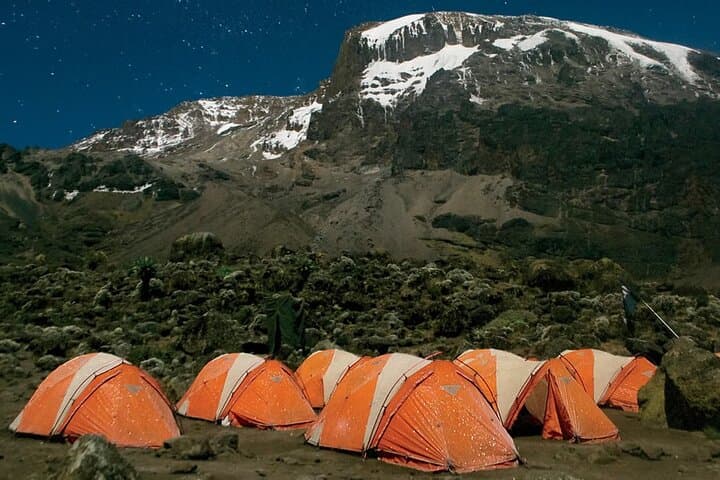
This private seven-day itinerary follows a sensible acclimatization pattern—“walk high, sleep low”—with strategic nights at Machame Camp (3,010 m), Shira Camp (3,845 m), Karanga (3,963 m) and Barafu (4,640 m). The summit push starts around midnight from Barafu: expect 4–6 hours of slow, relentless climbing on scree to Stella Point, then an hour to Uhuru as the sun breaks over a spangled horizon. Total elevation gain from Machame Gate (1,790 m) to Uhuru is roughly 4,100 m; terrain ranges from muddy rainforest trails to loose scree and volcanic ash.
Practical edge: train with long uphill hikes and stair repeats, and build cardio endurance. Hydration and a slow pace are your best medicines against altitude; carry at least 3 liters of water per day and use electrolyte tablets. Footwear needs ankle support for uneven trail and stability on scree. Guides in this program handle logistics—tents, meals, and porters—so pack light for the trail and reserve heavier items for porters.
The climb is both physically demanding and richly rewarding: expect dramatic day-to-night temperature swings, encounters with colobus and blue monkeys in the lower forest, and an otherworldly sunrise from the crater rim. Respect permit rules, support fair porter treatment (check the company’s porter policies), and plan buffer days in Moshi before or after for acclimatization and celebration. With preparation and patience, the Machame Route delivers one of Africa’s most memorable summit experiences.
challenging.
7 days.
Require good cardiovascular fitness and experience with multi-day hikes; training hikes with elevation gain recommended
No technical gear is required for the Machame Route—it's a non-technical trek. Crampons are not normally needed, though guides may carry them if glacial conditions demand.
Success depends on fitness and acclimatization; well-paced 7-day itineraries typically see higher summit rates than shorter routes, but altitude still determines outcome.
Guides monitor symptoms, encourage gradual ascent, hydration and rest; descent is the primary treatment and was built into the itinerary to aid acclimatization.
This program includes camping gear (tents, mattresses), meals as listed, experienced guides, porters and park fees per the operator’s inclusions—confirm specifics at booking.
Dry months (June–October and December–February) provide the most stable weather and clearer summit views, though climbs occur year-round with variable conditions.
Tipping is customary; plan a collective tip distributed among the crew—many operators provide suggested gratuity amounts. Bring small denominations of local currency.
Lower slopes are home to the Chagga people, who have long farmed Kilimanjaro’s fertile volcanic soils and developed terraced agriculture and coffee cultivation around Moshi.
Glaciers on Kibo are retreating; support conscientious operators who follow porter welfare standards, minimize camp footprint and respect park regulations.
LAMAGAYA SAFARIS operates guided outdoor trips and adventures with an emphasis on safety, stewardship, and memorable experiences.
The morning air at Machame Gate tastes of damp earth and coffee. Porters tighten straps on canvas tents while a small crowd of climbers and guides sort boots and gaiters under dripping canopy. You push through a tunnel of giant lobelias and fern—rainforest leaves that still hold the night's rain—and begin a climb that will move you from warm, cultivated foothills to thin, glacial air above the clouds.
The morning air at Machame Gate tastes of damp earth and coffee. Porters tighten straps on canvas tents while a small crowd of climbers and guides sort boots and gaiters under dripping canopy. You push through a tunnel of giant lobelias and fern—rainforest leaves that still hold the night's rain—and begin a climb that will move you from warm, cultivated foothills to thin, glacial air above the clouds.
The Machame Route is a classic southern approach that reads like a cross-section of Kilimanjaro itself: dense rainforest gives way to heath and moorland, then barren high desert and finally a crown of ice and rock. Kibo, Kilimanjaro’s highest volcanic cone, looms as a jagged rim above Mawenzi. The mountain is an extinct volcano made of three cones; the summit, Uhuru Peak (5,895 m), sits on Kibo’s crater rim. Locally, the Chagga people have farmed the lower slopes for generations, terracing the rich volcanic soil and trading honey and bananas in Moshi market.
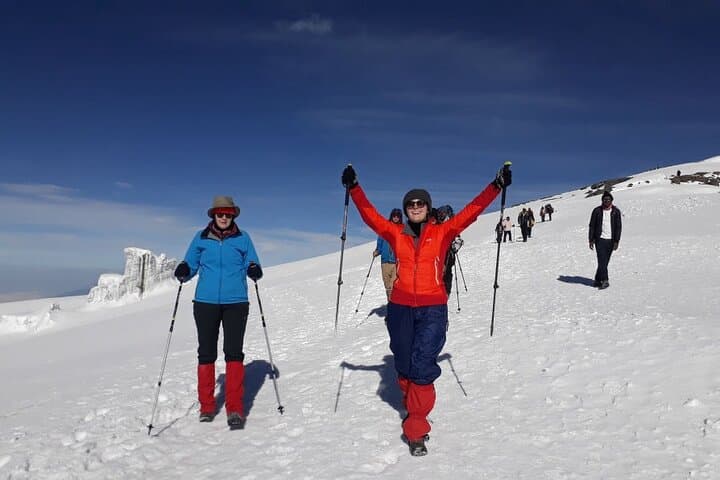
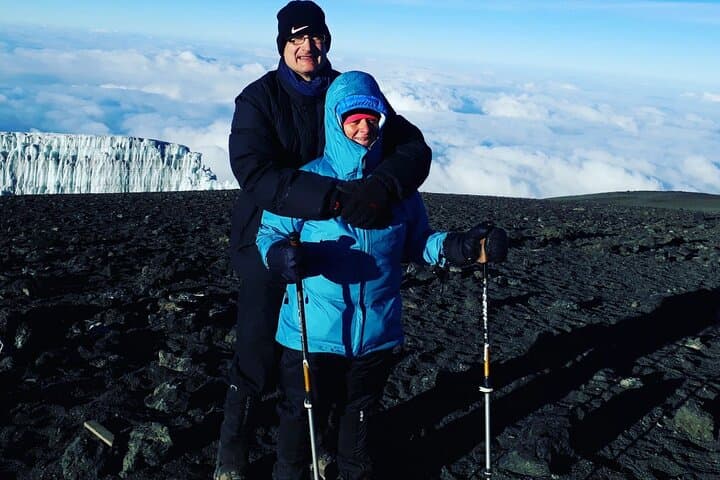
This private seven-day itinerary follows a sensible acclimatization pattern—“walk high, sleep low”—with strategic nights at Machame Camp (3,010 m), Shira Camp (3,845 m), Karanga (3,963 m) and Barafu (4,640 m). The summit push starts around midnight from Barafu: expect 4–6 hours of slow, relentless climbing on scree to Stella Point, then an hour to Uhuru as the sun breaks over a spangled horizon. Total elevation gain from Machame Gate (1,790 m) to Uhuru is roughly 4,100 m; terrain ranges from muddy rainforest trails to loose scree and volcanic ash.
Practical edge: train with long uphill hikes and stair repeats, and build cardio endurance. Hydration and a slow pace are your best medicines against altitude; carry at least 3 liters of water per day and use electrolyte tablets. Footwear needs ankle support for uneven trail and stability on scree. Guides in this program handle logistics—tents, meals, and porters—so pack light for the trail and reserve heavier items for porters.
The climb is both physically demanding and richly rewarding: expect dramatic day-to-night temperature swings, encounters with colobus and blue monkeys in the lower forest, and an otherworldly sunrise from the crater rim. Respect permit rules, support fair porter treatment (check the company’s porter policies), and plan buffer days in Moshi before or after for acclimatization and celebration. With preparation and patience, the Machame Route delivers one of Africa’s most memorable summit experiences.