THE ADVENTURE COLLECTIVE® · Independent discovery and booking for outdoor travel

Move through Jordan in four decisive days: Roman Jerash, Byzantine mosaics in Madaba, the carved rock of Petra, a jeep sunset in Wadi Rum, and buoyant time at the Dead Sea. This private tour pairs door-to-door logistics with hands-on cultural encounters.
Move through Jordan in four decisive days: Roman Jerash, Byzantine mosaics in Madaba, the carved rock of Petra, a jeep sunset in Wadi Rum, and buoyant time at the Dead Sea. This private tour pairs door-to-door logistics with hands-on cultural encounters.
The driver brakes on the shoulder and the silence of the desert folds back into conversation — a wind that has been erasing tracks for millennia, a sky so open it seems to push the horizon away. Over four days you move through Jordan like a careful reader moving through chapters: Roman columns that still remember empire, Byzantine mosaics that hold whole maps in tile, the carved rose façade of Petra that commands a hush, and Wadi Rum’s dune-carved amphitheaters where the sun writes its name in color.
Verified experiences and guided adventures in the surrounding area.
Operated by the horizon services · Wadi Musa, Ma'an Governorate
The driver brakes on the shoulder and the silence of the desert folds back into conversation — a wind that has been erasing tracks for millennia, a sky so open it seems to push the horizon away. Over four days you move through Jordan like a careful reader moving through chapters: Roman columns that still remember empire, Byzantine mosaics that hold whole maps in tile, the carved rose façade of Petra that commands a hush, and Wadi Rum’s dune-carved amphitheaters where the sun writes its name in color.
Day one walks Jerash, a Roman city whose colonnades and oval forum sit on limestone terraces shaped by ancient sea beds. Ajloun Castle follows — a 12th-century fortress of basalt and limestone with views across olive terraces. On day two, Madaba’s mosaic map and Mount Nebo's ridge recall biblical passage and Byzantine craft; the route then points south to Petra, climbing from the highlands down into the canyon that reveals the city of red stone.
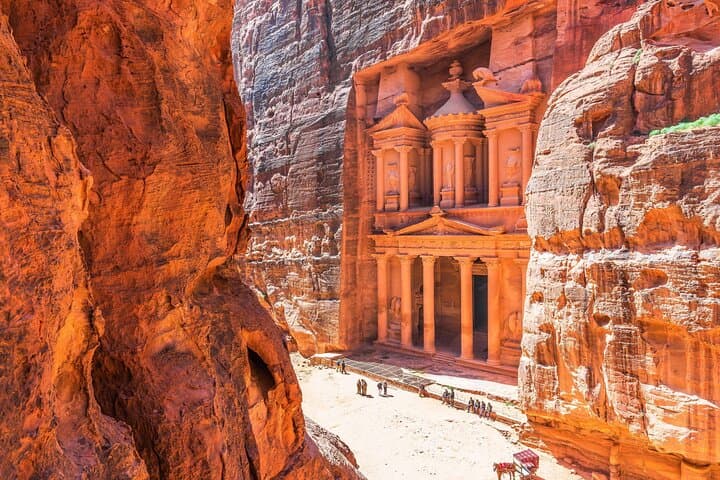
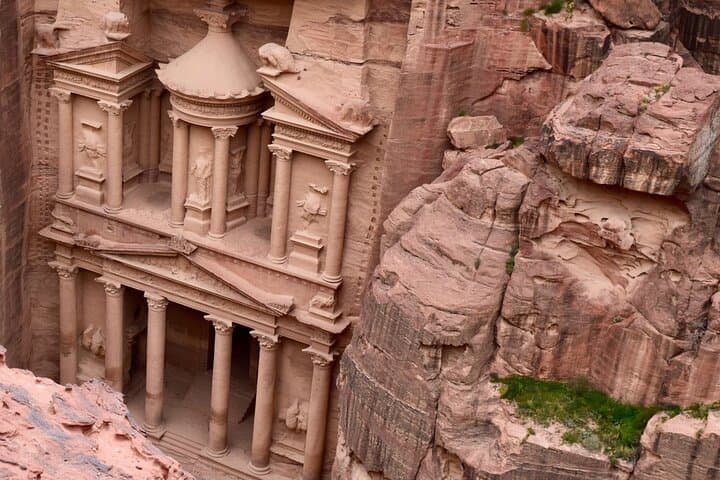
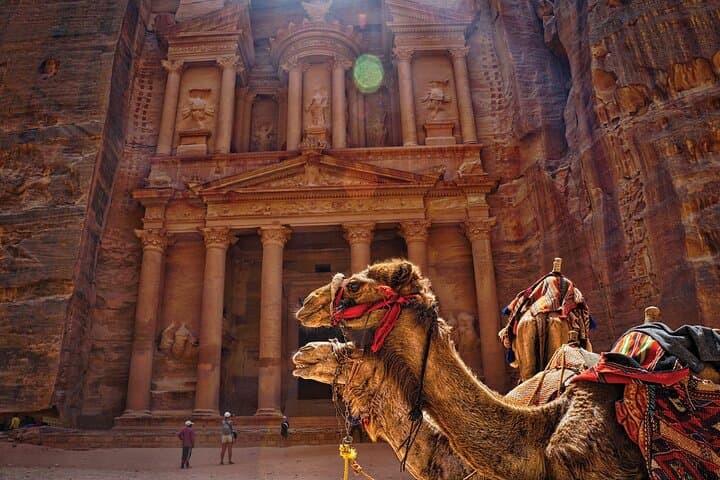
Petra is geology and human hand in dialogue: sandstone layers folded into bands of rose and rust, eroded alcoves becoming doorways, whole facades carved from the living cliff. A full morning here is necessary — the Siq’s narrow throat gives way to the Treasury, then the monastery perched higher, each step a negotiation with steep staircases and hot, dry air. Day three rides to Wadi Rum, where the desert’s wind has sculpted natural arches and flat-topped mountains; a two-hour 4x4 at sunset makes the landscape glow, and a night at a Bedouin camp introduces lunar time, simple meals, and stories told with coffee and gesture.
The fourth day eases into the Dead Sea, where the water pushes you back with buoyancy and mineral-rich mud seems to pull at your skin like a small, warm claim to the earth’s oldest salt. Elevation shifts are dramatic here: Petra sits around 900m above sea level, the Dead Sea at roughly -430m.
Practical guidance: this is a private, door-to-door experience with air-conditioned transport, bottled water, and hotel pickups from Amman. Expect moderate walking—uneven cobbles, sandstone steps, and desert sand. Comfortable walking shoes with grip and sun protection are non-negotiable. Carry electrolytes for inland heat and consider arriving a day early in Amman to acclimatize. Admissions and tips for guides are not always included; bring cash in Jordanian dinars for small purchases and local hospitality.
Culturally, this itinerary threads Ottoman, Byzantine, Roman, and Bedouin histories; respect prayer times and dress modestly in towns. Environmentally, stick to marked routes in Petra and Wadi Rum and avoid taking stones or artifacts — the landscape is sensitive, and small actions preserve it for other travelers.
This is a tour built for motion: sites that demand quiet attention and a few vigorous climbs, offset by time to float and watch the sun set into color. Travel prepared, and Jordan will repay you with a sequence of landscapes that feel simultaneously ancient and immediate.
moderate.
4 days.
Light to moderate fitness: expect multiple half-day walks, stair sections in Petra, and short hikes at sites.
Admissions are generally not included; confirm at booking—bring cash or cards for entrance fees where required.
This is a private tour and can usually be tailored; discuss site order, pacing, or special requests when booking.
The included 4x4 jeep tour runs about two hours, timed to maximize sunset views before camp.
Selected meals are included (camp dinner, some breakfasts); check the itinerary for specific meal inclusions and plan for lunches and snacks.
Yes — pickup from most Amman hotels is provided; precise pickup location and time are confirmed after booking.
The tour is described as suitable for all fitness levels, but Petra and some sites have uneven terrain and stairs; notify the operator of mobility needs in advance.
The route spans Roman (Jerash), Byzantine (Madaba mosaics), Crusader and Ayyubid (Ajloun, Shobak) eras and the Nabataean civilization that created Petra.
Stick to marked paths in Petra and Wadi Rum; local guides and camps increasingly follow low-impact practices—avoid single-use plastics and respect fragile archaeological sites.
the horizon services operates guided outdoor trips and adventures with an emphasis on safety, stewardship, and memorable experiences.
The driver brakes on the shoulder and the silence of the desert folds back into conversation — a wind that has been erasing tracks for millennia, a sky so open it seems to push the horizon away. Over four days you move through Jordan like a careful reader moving through chapters: Roman columns that still remember empire, Byzantine mosaics that hold whole maps in tile, the carved rose façade of Petra that commands a hush, and Wadi Rum’s dune-carved amphitheaters where the sun writes its name in color.
The driver brakes on the shoulder and the silence of the desert folds back into conversation — a wind that has been erasing tracks for millennia, a sky so open it seems to push the horizon away. Over four days you move through Jordan like a careful reader moving through chapters: Roman columns that still remember empire, Byzantine mosaics that hold whole maps in tile, the carved rose façade of Petra that commands a hush, and Wadi Rum’s dune-carved amphitheaters where the sun writes its name in color.
Day one walks Jerash, a Roman city whose colonnades and oval forum sit on limestone terraces shaped by ancient sea beds. Ajloun Castle follows — a 12th-century fortress of basalt and limestone with views across olive terraces. On day two, Madaba’s mosaic map and Mount Nebo's ridge recall biblical passage and Byzantine craft; the route then points south to Petra, climbing from the highlands down into the canyon that reveals the city of red stone.
Petra is geology and human hand in dialogue: sandstone layers folded into bands of rose and rust, eroded alcoves becoming doorways, whole facades carved from the living cliff. A full morning here is necessary — the Siq’s narrow throat gives way to the Treasury, then the monastery perched higher, each step a negotiation with steep staircases and hot, dry air. Day three rides to Wadi Rum, where the desert’s wind has sculpted natural arches and flat-topped mountains; a two-hour 4x4 at sunset makes the landscape glow, and a night at a Bedouin camp introduces lunar time, simple meals, and stories told with coffee and gesture.
The fourth day eases into the Dead Sea, where the water pushes you back with buoyancy and mineral-rich mud seems to pull at your skin like a small, warm claim to the earth’s oldest salt. Elevation shifts are dramatic here: Petra sits around 900m above sea level, the Dead Sea at roughly -430m.
Practical guidance: this is a private, door-to-door experience with air-conditioned transport, bottled water, and hotel pickups from Amman. Expect moderate walking—uneven cobbles, sandstone steps, and desert sand. Comfortable walking shoes with grip and sun protection are non-negotiable. Carry electrolytes for inland heat and consider arriving a day early in Amman to acclimatize. Admissions and tips for guides are not always included; bring cash in Jordanian dinars for small purchases and local hospitality.
Culturally, this itinerary threads Ottoman, Byzantine, Roman, and Bedouin histories; respect prayer times and dress modestly in towns. Environmentally, stick to marked routes in Petra and Wadi Rum and avoid taking stones or artifacts — the landscape is sensitive, and small actions preserve it for other travelers.
This is a tour built for motion: sites that demand quiet attention and a few vigorous climbs, offset by time to float and watch the sun set into color. Travel prepared, and Jordan will repay you with a sequence of landscapes that feel simultaneously ancient and immediate.