
What the day feels like
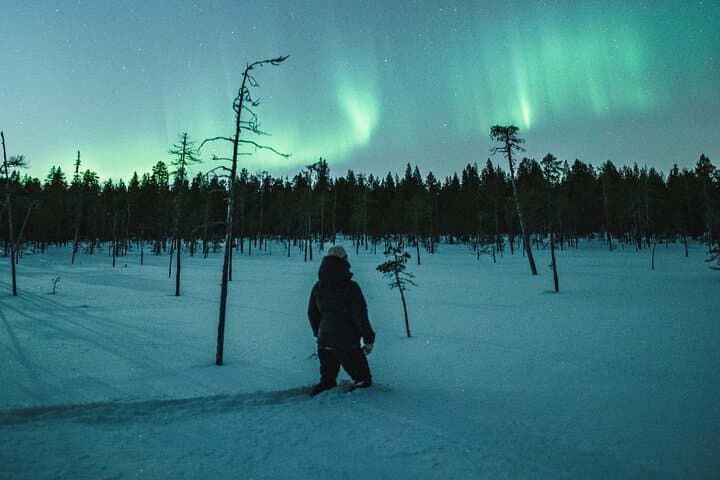
When the daytime hush of Rovaniemi folds into long, cold twilight, the world seems to hold its breath. You lace up snowshoes and step away from the sodium glow of town, each sinking step a soft percussion across a silvered landscape. The trees here keep their own counsel — spruce boughs heavy with snow that drips like slow applause — while the sky, a dark stage, waits for the first curtain of green to unfurl.
This three-hour winter hike is at once simple and elemental: roughly 4–6 kilometers across gently rolling tundra and forest paths, with modest elevation changes (expect about 100 meters of cumulative gain). It’s paced for observation rather than speed, and that pacing is part of the design. You’re not fighting the light; you’re watching it fight back. Guides set a rhythm that keeps you warm and focused, pausing at clearings where the horizon widens and the aurora can sweep from low to high with startling speed.
Rovaniemi sits on the Arctic Circle, a threshold that has shaped both culture and climate. The land beneath your snowshoes is a palimpsest of glacial action and river-sculpted valleys. Where the ice once pushed and paused for millennia, thin esker ridges and flattened plains now collect the drifts. The midnight skies you’re here to read are the same skies that guided Sámi reindeer migrations for centuries. Winter in Lapland is less a season than a language; learning its basic grammar—cold, dark, light—helps you listen.
The local culture is practical and generous. Sámi traditions still inform the cadence of life in the region: knowledge of winds, snow crust, and the telltale bent of a lichen-eaten tree. Even if your guides are not Sámi, they’ll teach you to read the landscape in shorthand: how to approach an open lake frozen to glass, where to stand to avoid light pollution, and which ridgelines make the best backdrops for the aurora. The town itself, a compact mix of relaxed cafés and timber-clad hotels, serves as a quiet counterpoint to the wide Arctic night.
Geology and weather combine to make this an ideal aurora venue. Clear, cold nights let the upper atmosphere’s charged particles paint visible arcs; inland locations like Rovaniemi are sheltered from the maritime cloud banks that can blot out displays farther to the west. But nothing is guaranteed. Solar activity drives the aurora; cloud cover nullifies it. The thrill here is the unpredictability—an active sky is a performance, not a jukebox.
Practicalities matter. A three-hour outing is long enough to require deliberate layering, a reliable headlamp, insulated waterproof boots, and a thermos of something hot. Snowshoes offer flotation across soft drifts and a chance to step off the narrow beaten tracks where the show often plays out best. Guides usually provide snowshoes and poles; expect to carry no more than a small daypack for camera gear and spare layers. Timing is flexible but most groups head out after dinner, between 9 p.m. and midnight, when auroral activity and darkness overlap. If the sky is clear, the aurora often peaks within the first two hours of a calm night.
Safety is straightforward but non-negotiable. Tell your guide about any medical conditions or mobility issues. Frostbite risk increases with exposed skin and windy conditions—use face protection and warm mittens. Check local aurora forecasts (for example, the Finnish Meteorological Institute) and dress for both long standing periods and slow movement; breathable base layers and a windproof outer shell are worth their weight in comfort.
For photographers, this trip is equal parts patience and technique. Bring a wide-angle lens, sturdy tripod, and remote shutter release. Set a wide aperture (f/2.8–f/4), ISO 800–3200 depending on your body and lens, and exposures of 5–15 seconds to start; adjust for aurora intensity. Compose with foreground interest—a leaning pine, a snow-laced rock—to give the ribbons of light context and scale.
Why go? There’s a pragmatic appeal: this is a three-hour, low-to-moderate-effort way to experience one of nature’s grandest spectacles without the logistical heavy lifting of a multi-night expedition. There’s also a quieter reward: the sensation of being small under an enormous sky, of moving deliberately through cold air that seems to sharpen perception. You come for the lights but stay for the way the night changes how you notice details—a moth-silent hush, stars that vibrate at the edge of awareness, breath that fogs and then resolves.
Book smart: windows of clear skies are precious in winter; tours with flexible cancellation policies and small group sizes are best. If your priorities include photography, ask about timing and whether the guide will pause for tripod setups. If you’re new to snowshoes, opt for an introductory orientation so you’re not wasting energy learning technique in the dark.
At the end of the loop, hot drinks are a standard courtesy—anodyne but meaningful—and the walk back to town feels different, like returning from a quiet theater. The lights you chased often linger in memory as more than streaks; they become a measured reminder of how quickly the world can surprise you when you move through it at the right pace.
In short: this is a concise, human-scale Arctic experience. It asks for basic fitness, sensible gear, and a willingness to stand in the cold with your head tilted. In return, it offers a sky that refuses to be ordinary and a landscape that teaches a new acuity for light and silence.
Trail wisdom
Small choices, better day.
Layer pragmatically
Dress in moisture-wicking base layers, an insulating midlayer, and a windproof shell; remove layers as you warm during movement.
Protect extremities
Bring insulated, waterproof boots and warm mittens—fingers and toes are first to stiffen in Arctic nights.
Charge camera batteries
Cold drains batteries fast—carry spares in an inner pocket and keep one warm until needed for photographing the aurora.
Follow guide positioning
Guides choose clearings that minimize light pollution—stay with the group to maximize viewing and safety.
Local knowledge
Read the place, not just the route.
Watch for native species including Reindeer, Snow hare.
Keep an eye out for wildlife during the transition between areas and habitats. Respect distance guidelines.
Respect marked paths and avoid disturbing lichens and tundra vegetation; local operators emphasize Leave No Trace and minimize light pollution during aurora viewings.
Follow the guide's instructions on size limits, ethical handling, and leave-no-trace practices.
Small esker ridgelines just outside Rovaniemi for less light-polluted skies. Frozen riverbanks where reflected aurora adds depth to photos
Locally recommended viewpoints and quiet spots known best to local operators.
Rovaniemi was rebuilt after World War II and developed into the administrative center of Finnish Lapland; its position on the Arctic Circle has long been a cultural crossroads.
Maritime roots and regional tradition shape the waterways and working coasts.
Seasonal guide
Four versions of the same landscape.
Spring
Best forLonger daylight for side activities · Still-good aurora opportunities · Crystalline, cold nights early in season
ChallengesVariable snow conditions · Softer spring snow at lower elevations
Late winter and early spring balance clear nights with slightly warmer temperatures; ideal for combining aurora viewing with daytime exploration.
Summer
Best forMidnight sun experiences · Hiking without snow · Birdwatching
ChallengesNo dark nights for aurora · Midges and insects in warm spells
Summer eliminates aurora chances but opens daytime hiking and wildlife viewing—the snowshoe tour is not available in this season.
Fall
Best forEarly aurora sightings · Fewer tourists · Rich autumn colors before snow
ChallengesUnreliable snowpack · Shorter daylight complicates logistics
Autumn can offer early aurora displays but expect inconsistent snow for snowshoeing; some operators run mixed tours instead.
Winter
Best forPeak aurora viewing · Snowshoeing and winter sports · Arctic cultural experiences
ChallengesExtreme cold spells · Short daylight hours for other activities
Deep winter is prime time: stable snowpack and long nights increase aurora chance, but dress for Arctic temperatures and wind.
Pack with intention
What to bring.
Good to know
Common questions.
Temperatures commonly range from -5°C to -25°C in winter; wind chill can make it feel colder, so dress in insulated layers and protect exposed skin.
Plan the edges
The details that make the day easier.
Rovaniemi sits on the Arctic Circle and is the administrative capital of Finnish Lapland; it is also closely associated with Santa Claus tourism and winter research.
After the hike, warm up with local Lappish cuisine—look for menus featuring reindeer, fresh Arctic fish, and berry-based desserts. Rovaniemi’s cozy cafés and small breweries are good spots to trade photos and stories with guides and other travelers.
- trailhead
- Rovaniemi Airport (RVN)
- short drive to designated meeting point. Driving distance from city center
- typically 10–30 minutes. Cell service: intermittent outside town; expect spotty coverage in remote clearings. Permits: none typically required for guided tours.
Local guides follow Leave No Trace practices and minimize light pollution during viewings; avoid using bright torches and pack out all waste to protect fragile Arctic ecosystems.
Explore by topic
Follow the threads.
Keep exploring
Make the story part of the trip.
In four hours you can move from shaded canyon ferns to wind-scoured coastal ridgelines, guided by someone who knows where the light—and the hidden views—live. This private half-day hike on the Monterey Peninsula or Big Sur is compact, curated, and perfect for travelers who want depth without a multiday commitment.
 Related story
Beneath a sky of shifting light, Skaftafell’s ice reads like a map of time. This three-hour guided glacier hike mixes technical instruction with geology and culture: compact, safe, and unforgettable.
 Related story
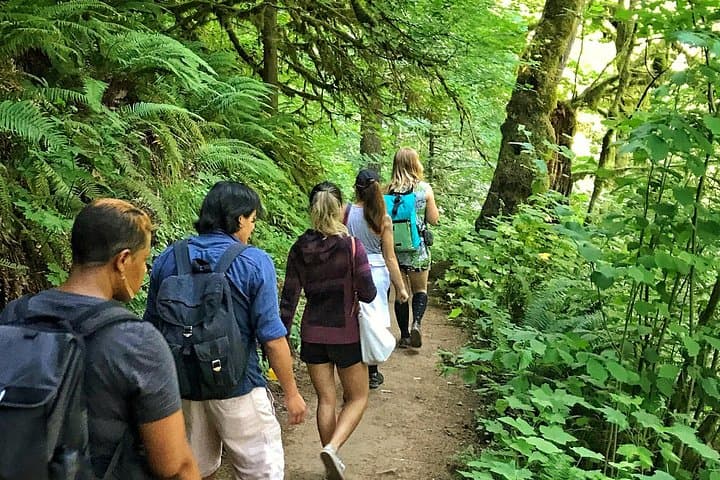
Lose the city for a few hours without leaving it: this 5-mile, 900-foot-gain Forest Park loop threads old-growth pockets, city viewpoints, and cultural landmarks for a compact taste of Portland’s wild side. Expect moss, roots, and stories.