
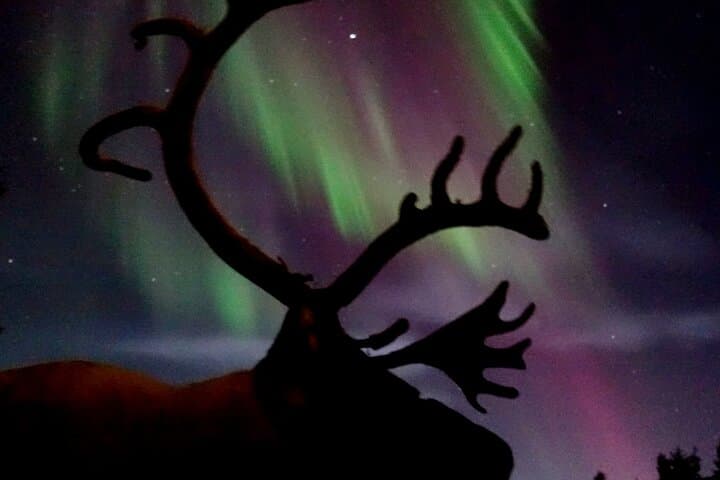
What the day feels like
There is a moment in deep Lapland when the world seems to hold its breath. The sky unspools a curtain of green and violet, and beneath that living ceiling the forest becomes a silhouette theatre—trees reaching like black hands, the snow a soft, soundless stage. You sit wrapped in furs on a wooden sleigh, the reindeer exhaling tiny clouds of steam, and the only movement that matters is the slow, steady hoofbeat that carries you away from light and toward the vast, electric night. This is Jukkasjärvi—an Arctic hamlet that doubles as a doorway to the aurora and a place where reindeer are not just scenery but partners in travel.
The Northern Lights tour with Reindeer is a three-hour winter outing that feels cinematic but is quietly straightforward: a short transfer into the forest, a gentle sleigh ride through stands of birch and pine, then stops for photos and hot drinks while guides read the sky. It is not a strenuous expedition—its magic is timing and place. The terrain is flat to rolling, a patchwork of frozen river plains and packed forest tracks where sleds slip and creak. Temperature dictates rhythm here; when the aurora wakes, the cold sharpens senses and cameras alike, and the night stretches long enough to savor.
Jukkasjärvi sits on the banks of the Torne River, roughly 17–20 kilometers from Kiruna, and its landscape is written by ice and time. The Torne has shaped the valley, supplying the clear ice that builders harvest each winter to construct the famed Icehotel—an annual architecture project that ties local craft to global tourism. The presence of the Sámi is woven through this place: reindeer herding is both livelihood and culture, and local guides will often share practical, living knowledge about how the seasons and the animals intersect. The reindeer on this tour are calm, accustomed to travelers, and treated as animals with routines and rights rather than props. Observing handlers at work gives a glimpse into a living tradition that predates modern borders.
Geology here feels patient. Under the snow lies bedrock from the ancient Scandinavian Shield, and in winter the land reads like a map of elemental forces—glacial outwash plains, river-ice plains, and isolated pillars of rock and forest where the terrain rises and drops. This geology, combined with long winter nights and low light pollution, makes Jukkasjärvi a reliable stage for auroral displays.
Practically speaking, this is a three-hour window of intense, curated immersion. The operator provides warm blankets and hot beverages; guests supply the layers, camera batteries, and curiosity. The tour works best on clear nights, but guides are skilled at reading cloud breaks and moving to darker microclimates. Expect to be outdoors for most of the time; the pace is contemplative rather than adrenaline-driven. This makes the trip perfect for travelers who want a visceral Aurora experience without the backcountry planning or cross-country skiing fitness requirements.
Prepare like you would for any serious winter night: thermal base layers, a windproof outer shell, insulated boots, and a face covering for bitter gusts. Bring a tripod and spare camera batteries—cold drains cells fast—and learn a few basic night-aurora camera settings beforehand. Respect the reindeer and their herders: follow the guide's instructions when approaching animals, avoid sudden movements, and do not offer food unless specifically invited. Tipping is customary if the service felt personal and attentive.
Timing matters. The aurora season in Swedish Lapland runs from late September through April, but the heart of winter—December through March—offers long, dark nights with stable cold and high aurora probability. For clearer skies and a better balance of daylight activities, February often emerges as the sweet spot: strong auroral activity, manageable darkness for daytime exploration, and reliably cold nights that bring crisp skies.
Why go on a reindeer sleigh for the aurora when there are snowmobiles, huts, and heated minibuses? The answer is intimacy. A sleigh slows the world. There is space to listen to the way snow changes under hoof, to exchange stories with a handler by headlamp, and to watch the sky without the distraction of an engine. The reindeer have agency in the landscape; they navigate the micro-ecologies that machines cannot. For photographers, there is a cinematic composition to be found in the low bows of light, the animal silhouettes, and the natural foregrounds that deep-snow lighting provides.
This tour is not just a checklist item; it is an encounter. It pairs spectacle with context: Sámi knowledge, an introduction to reindeer behavior, and a chance to experience the polar night as a lived environment rather than a mere backdrop. Practical travelers will appreciate the instant confirmation booking, the mid-range price that reflects a small-group, guided model, and the reasonable three-hour commitment that fits into a broader Lapland itinerary.
If the aurora is the sky's main act, the reindeer are the local chorus—steady, patient, and quietly essential. When you leave, you take more than photographs. You take a sense of scale: how small human plans feel beneath an Arctic sky and how, sometimes, slowing down is the best way to arrive at wonder.
Trail wisdom
Small choices, better day.
Layer for Arctic Nights
Dress in insulating layers, including a windproof outer shell and insulated boots; temperatures can plummet after sunset.
Protect Camera Batteries
Carry spare batteries in an inner pocket to keep them warm; cold rapidly drains power during long exposure shots.
Respect Reindeer Space
Follow guide instructions when approaching animals—avoid feeding or loud movements to keep stress low for the herd.
Book for Clear Nights
Choose dates with flexible scheduling to improve chances of a clear-sky aurora display.
Local knowledge
Read the place, not just the route.
Watch for native species including Reindeer, Arctic fox (rare).
Keep an eye out for wildlife during the transition between areas and habitats. Respect distance guidelines.
Operators work with local herders and follow guidelines to minimize disturbance to reindeer and their grazing areas; visitors should avoid straying from established routes.
Follow the guide's instructions on size limits, ethical handling, and leave-no-trace practices.
Walk the frozen banks of the Torne River at twilight for quiet aurora views. Visit a local Sámi camp or cultural center to learn reindeer-herding practices
Locally recommended viewpoints and quiet spots known best to local operators.
Jukkasjärvi has been a Sámi reindeer-herding region for centuries and is home to the Icehotel tradition, which blends local materials with contemporary design.
Maritime roots and regional tradition shape the waterways and working coasts.
Seasonal guide
Four versions of the same landscape.
Spring
Best forLonger daylight · Snowy landscapes · Fewer crowds
ChallengesUnstable melt conditions · Variable temperatures
Late winter-into-spring offers more daylight and quieter trails, but melting snow can change route conditions and visibility.
Summer
Best forMidnight sun adventures · Hiking and river activities
ChallengesNo auroras · Reindeer calves and different herd patterns
Summer in Lapland is vibrant but unsuitable for aurora tours; this activity is primarily a winter pursuit.
Fall
Best forEarly aurora season · Crisp skies · Quiet trails
ChallengesUnpredictable weather · Shorter nights
Autumn can bring strong auroral displays, though nights are shorter and weather less predictable than deep winter.
Winter
Best forAurora viewing · Sleigh rides · Snow-covered scenery
ChallengesExtreme cold · Limited daylight
Winter is peak season for aurora tours and sleigh rides—long nights and stable cold increase visibility but require proper gear.
Pack with intention
What to bring.
Good to know
Common questions.
The experience runs about three hours from start to finish, including sleigh time, stops for photos, and warm drinks.
Plan the edges
The details that make the day easier.
The Icehotel in Jukkasjärvi, the world’s first, was founded in 1989 and is rebuilt each winter using ice harvested from the Torne River.
After the ride, warm up with traditional Sámi dishes such as suovas (smoked reindeer) or a reindeer stew at a local lodge; the Icehotel’s restaurant and nearby cafés offer Arctic cuisine and craft beers—look for operators and eateries run by local Sámi entrepreneurs to support the community.
- Closest airport
- Kiruna Airport (KRN); Driving distance: ~17–20 km from Kiruna to Jukkasjärvi; Cell service: generally available near town and lodges but limited on forest tracks; Permits: none typically required for guided sleigh tours—book in advance, especially in peak winter months.
Respect reindeer and herding lands: do not feed animals, stay on guided routes, and support operators who employ local Sámi staff and practice low-impact touring.
Explore by topic
Follow the threads.
Keep exploring
Make the story part of the trip.
In four hours you can move from shaded canyon ferns to wind-scoured coastal ridgelines, guided by someone who knows where the light—and the hidden views—live. This private half-day hike on the Monterey Peninsula or Big Sur is compact, curated, and perfect for travelers who want depth without a multiday commitment.
 Related story
Beneath a sky of shifting light, Skaftafell’s ice reads like a map of time. This three-hour guided glacier hike mixes technical instruction with geology and culture: compact, safe, and unforgettable.
 Related story
Lose the city for a few hours without leaving it: this 5-mile, 900-foot-gain Forest Park loop threads old-growth pockets, city viewpoints, and cultural landmarks for a compact taste of Portland’s wild side. Expect moss, roots, and stories.