
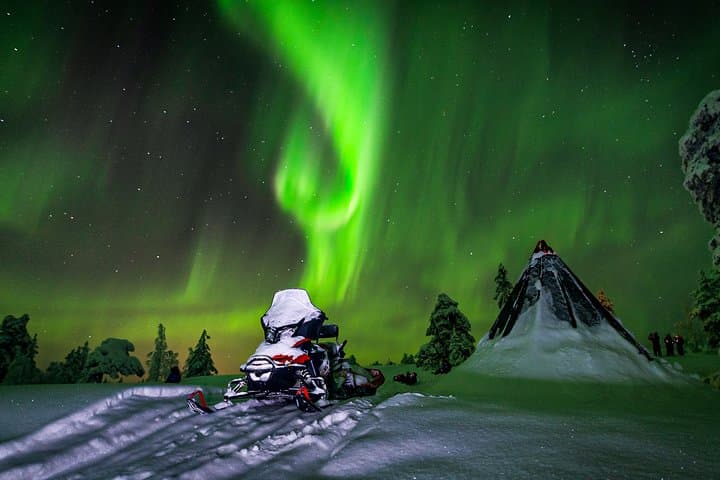
What the day feels like
The engine growls like a distant animal, low and patient, while the tundra around us exhales steam into the polar night. Snow arcs from under tracked runners, ghosting away in silver filaments as our group threads between low birch and lichen-bare ridges. Above, the sky is a black bowl waiting to be stirred. When the first green sash unfurls—thin, wavering, then suddenly thick and alive—it feels less like seeing a phenomenon and more like being invited into a conversation the Arctic’s held for millennia.
This is Hunting Northern Lights by Snowmobiles, a five-hour guided sortie out of Saariselkä in Finnish Lapland. It’s not a passive ride; you steer, you listen, you breathe. The machines give you speed and reach—access to wide-open places where light pollution is a foreign idea—and they amplify the intimacy of aurora watching. There’s a practical cadence to the experience: helmet checks, a short walk to stretch frozen legs, the hush of standing near a river as the lights ripple overhead. The whole thing feels calibrated to purpose—maximize your chances at nights that otherwise might be spent peering through town lights.
Saariselkä sits inside the auroral oval, the ring around Earth’s geomagnetic pole where auroras are most frequent. The land itself is Lapland’s layered story: ancient Precambrian bedrock ground down beneath a veneer of glacial tills and peat. The terrain you'll cross on a snowmobile—flat fell ridges, boggy mires frozen firm, and thin tree lines—is the result of repeated ice ages that scoured and shaped the region. Culturally, this is Sámi country. Reindeer herding has shaped the rhythms here for centuries, and the soft hoofpaths and seasonal migration routes still influence modern trails and local economy.
Practically speaking, the operator runs roughly a five-hour tour (about 300 minutes) that balances riding time and downtime for aurora viewing. The winter price listed from Viator is about $201.49 USD per person for the standard outing; operators can swap snowmobiles for ATVs in early winter or November if there’s insufficient snow. Guides are experienced with Arctic weather and aurora hunting—reading cloud cover, chasing clear pockets, and finding dark vantage points away from resort glow.
Why book this? Because a snowmobile turns aurora hunting from a tense waiting game into a kinetic, outdoor pursuit. You’re not just hoping the lights show up—you’re actively pushing into places that increase the odds, and the motion itself amplifies the thrill. Yet this experience isn’t for adrenaline alone. There’s a meditative quality when your group stops, motors cut, and the sky does its thing; the Arctic feels suspended, a private performance for anyone willing to brave the cold.
What to expect: you’ll be briefed on safety and riding technique, fitted with a full-face helmet and often insulated overalls, and taken out in small groups led by a guide. Expect flat, low-rolling topography rather than steep climbs; the focus is exposure to clear skies rather than technical terrain. Bring a camera with manual settings and a tripod—the aurora rewards long exposures—and plan to be out several hours, so dress in layers and protect batteries from the cold.
Timing matters. The aurora season in Lapland runs from late September to early April in terms of darkness, with prime months often February and March when clear nights and deep snow align. But logic here is probabilistic: the lights can surprise you on marginal nights and disappoint on ultra-active ones if clouds intervene. Operators hedge this with route flexibility—if clouds obscure one valley, your guide will motor to another.
Safety and comfort are straightforward if you prepare: learn basic throttle and braking under the guide’s watch, avoid sudden steering inputs on crusted snow, and keep moisture off electronics. Expect operator instructions in English; many guides also explain local lore about the aurora—how Sámi communities view the phenomenon and the old taboos and respect owed to the sky. Respect for the land is built into the trip: keep to the guide’s path, don’t disturb reindeer, and follow cold-weather hygiene—especially when sharing small shelters or snowmobile gear.
For photographers, bring spare batteries and a wide-angle lens, and set cameras to manual focus at infinity. Use a remote shutter or two-second timer to avoid shake, and start with an exposure of around 8–15 seconds at ISO 800–1600, aperture as wide as possible. Then adapt to the aurora’s brightness.
If snow is low and ATVs are used instead, the core experience—chasing clear skies across Lapland—remains intact, though the tactile feel and tracks will differ. Cancellation policies are generally flexible; this particular operator notes free cancellation if you act in advance, and they’ll switch vehicles or tweak itineraries based on conditions.
This outing is equal parts machine and moment: the snowmobile delivers you into the dark, and the sky decides whether to answer. Either way, the ride itself—through pine shadows and across frozen rivers under a crystalline sky—leaves you with a visceral sense of place. And when the aurora unfurls, you don’t just watch it; you ride beneath it.
Trail wisdom
Small choices, better day.
Dress in layers
Bring a moisture-wicking base layer, insulating mid-layer, and a windproof outer shell—temperatures and wind chill can change quickly while moving.
Protect camera batteries
Keep spares in an inside jacket pocket; cold drains batteries fast during long-exposure aurora shots.
Follow the guide’s line
Guides choose routes to avoid thin ice and sensitive reindeer grounds—stay in formation and obey instructions.
Hydrate and snack
Cold can blunt thirst—carry an insulated water bottle and high-energy snacks to maintain warmth and focus.
Local knowledge
Read the place, not just the route.
Watch for native species including Reindeer, Ptarmigan.
Keep an eye out for wildlife during the transition between areas and habitats. Respect distance guidelines.
Respect marked routes to avoid damaging fragile tundra and lichen; operators minimize disturbance by using established tracks and advising on wildlife etiquette.
Follow the guide's instructions on size limits, ethical handling, and leave-no-trace practices.
Kakslauttanen’s glass igloos for a warm aurora-watching alternative. Short snowshoe loops near Saariselkä offering quiet daytime exploration
Locally recommended viewpoints and quiet spots known best to local operators.
Lapland has a long Sámi heritage; reindeer herding shaped migratory routes and local place names still used today.
Maritime roots and regional tradition shape the waterways and working coasts.
Seasonal guide
Four versions of the same landscape.
Spring
Best forLonger nights early in season · Stable cold spells · Good snowpack late March
ChallengesVariable melt in late spring · Shortening aurora windows
Early spring (late February–March) often provides stable cold nights and deep snow—great for riding and photography; late spring sees shorter aurora hours.
Summer
Best forMidnight sun experiences · Hiking alternative activities · Boat and fishing trips in the region
ChallengesNo aurora due to midnight sun · Limited snow for snowmobiles
Summer rules out aurora hunting due to continuous daylight; operators may offer ATV or different seasonal activities instead.
Fall
Best forOnset of darkness for aurora season · Fewer tourists · Crisp, clear nights
ChallengesUnreliable snow cover in November · Cold snaps and wet conditions
Autumn brings darkness back to Lapland—good aurora potential—but early season trips may switch to ATVs if snow is sparse.
Winter
Best forPeak aurora viewing · Snowmobile access · Classic Lapland scenery
ChallengesExtreme cold nights · Short daylight hours
Winter offers the most reliable conditions for snowmobiling and aurora hunting; dress for prolonged cold and watch for wind chill.
Operator details
What the booking data adds.
Included
- ✓Winter adventure gear and helmet
- ✓Organizer's liability insurance
- ✓Hot drinks and light snacks by open fire
- ✓Guidance services
- ✓Approx. 2 h snowmobile driving
- ✓Transportation
Not included
- —Solo driving available for an additional fee
- —Ivalo transfer available for an additional fee
Good to know
- ✓Specialized infant seats are available
- ✓Not recommended for pregnant travelers
- ✓Suitable for all physical fitness levels
- ✓Please inform us in advance if you have any dietary restrictions or food allergies.
- ✓Valid driving license needed for the driver, bring it with you.
Pack with intention
What to bring.
Good to know
Common questions.
No—operators provide a safety and handling briefing; tours are guided and suitable for beginners under supervision.
Plan the edges
The details that make the day easier.
Saariselkä lies within the auroral oval—the area with the highest probability of seeing the Northern Lights—making it one of Europe’s most reliable aurora-viewing regions.
After a night of snowmobile hunting, warm up with traditional Sámi fare—reindeer stew (poronkäristys) and crisp bread—at a local lodge, then try a wood-fired sauna to restore circulation; several small cafés and hotel restaurants in Saariselkä serve locally brewed beers and baked goods.
- Closest airport
- Ivalo (IVL) ~35–40 km; Driving distance from Saariselkä village: typically 0–20 minutes to meeting point; Cell service: good near town, spotty in remote clearings; Permits: none for guided tours, but respect private reindeer fence lines.
Operators use established trails to minimize tundra damage; travelers should avoid leaving tracks off-route, pack out all waste, and follow guide instructions to protect reindeer grazing areas.
Explore by topic
Follow the threads.
Keep exploring
Make the story part of the trip.
In four hours you can move from shaded canyon ferns to wind-scoured coastal ridgelines, guided by someone who knows where the light—and the hidden views—live. This private half-day hike on the Monterey Peninsula or Big Sur is compact, curated, and perfect for travelers who want depth without a multiday commitment.
 Related story
Beneath a sky of shifting light, Skaftafell’s ice reads like a map of time. This three-hour guided glacier hike mixes technical instruction with geology and culture: compact, safe, and unforgettable.
 Related story
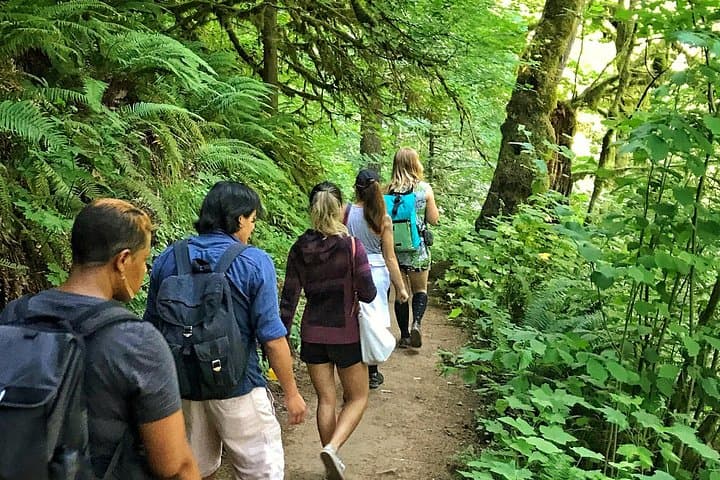
Lose the city for a few hours without leaving it: this 5-mile, 900-foot-gain Forest Park loop threads old-growth pockets, city viewpoints, and cultural landmarks for a compact taste of Portland’s wild side. Expect moss, roots, and stories.