
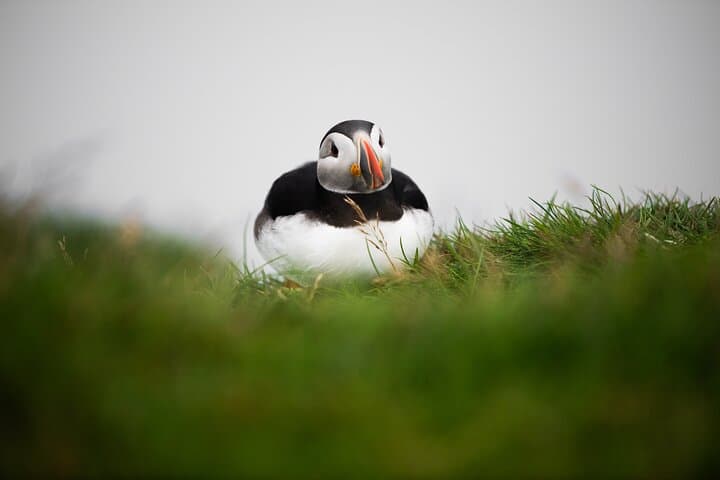
What the day feels like
The ferry leans into the swell and the Faroe wind cuts like a promise. Ahead, a low, green silhouette rises from the North Atlantic—Mykines—its cliffs scored into terraces, topped with turf and a solitary lighthouse that looks hand-built to brave the weather. As the boat threads between jagged islets, the first black-and-white specks appear: puffins like dropped buttons on the grassy slopes, their orange feet flashing as they hop from burrow to cliff-edge. On Mykines you feel the ocean pressing in on three sides and wildlife running the show. The island’s birds—puffins, fulmars, guillemots—announce themselves with a chorus you can almost map to the waves.
This tour collapses the logistics of island travel into an intimate eight-hour loop: a ferry from Tórshavn, a guided hike across Mykines’ compact interior, time among the puffin cliffs, a stroll through the near-abandoned village, and a return across the harbor. That structure makes it deceptively accessible: you don’t need to be a hardened mountaineer to get close to one of Europe’s most famous seabird colonies, but you do need to move with purpose over wet turf and wind-scoured trails.
Geology and natural history are written in the island’s bones. Mykines formed from basaltic lava flows and subsequent wave erosion carved deep gullies and sheer faces that the seabirds favor. The plateaus of peat and short grass are prime real estate for puffins to burrow; from April to August the island becomes a living nursery. Mykines is also a Ramsar-designated wetland, recognized for its importance to migratory and breeding seabirds—an important conservation status that colors how visitors are asked to behave here.
Culturally, Mykines reads like a study in resilience and change. The tiny village—stone houses with turf roofs—was once a small fishing settlement. Today just a handful of residents remain year-round; sheep graze free and the island’s human rhythms are aligned to weather windows. Local guides often share stories of old boat landings, the rhythms of island life, and the ways Faroese communities balance subsistence traditions with modern conservation.
On the trail the experience oscillates between the elemental and the domestic. One minute you’re negotiating peat that squishes underfoot and staring down a sheer cliff that seems to drop into an untamed surf; the next you’re passing a low stone wall and a tidy turf roof where someone once kept geese. Puffins are the headline act—they’re curious and comically earnest, arriving and departing from the sea with fish in their beaks—but the rich cast includes razorbills, kittiwakes, and the occasional skua, which keeps a watchful eye from the air.
Practical notes are simple but essential. Expect a full day: about eight hours total including the ferry. The walking itself is moderate and uneven—plan for 3–6 kilometers of hiking with roughly 150–250 meters of vertical gain, depending on how far up the cliffs you go. Trails are often wet and can be exposed to stiff winds; a good set of waterproof layers and sturdy boots changes the day from slog to pleasure.
For photographers the island is generous: low-angle light, dramatic sea stacks, and the compact, watching faces of puffins. But remember that birds are best viewed without stress—keep distance, move slowly, and use a long lens rather than approaching burrows. Guides will often point out quieter spots where the birds are more accustomed to humans.
Timing matters. Puffin season runs through the breeding months; late May to July is the sweet spot for numbers and activity, but mid-summer usually gives you longer daylight and gentler crossings. Weather is fickle; ferry crossings can be canceled on rough days, so build buffer time into your itinerary if Mykines is the trip’s priority.
The experience itself is quietly transformative. It’s not a rush of technical climbing or a multi-day wilderness push; it’s a day that places you in the rhythm of an island shaped by wind and sea, where humans are guests in a colony ruled by birds. You leave with grass on your boots, salt in your hair, and a clearer sense of the Faroe Islands’ fragile, dramatic charm.
Why go? For close encounters with one of Europe’s densest puffin colonies, for the dramatic coastal geology, and for the simple satisfaction of a well-run day trip that still feels like an expedition. Bring respect, bring patience, and be prepared to let the wind steer a little of your time. On Mykines the landscape has personality—rugged, blunt, hospitable in its own austere way—and it rewards travelers who arrive prepared and ready to listen.
Trail wisdom
Small choices, better day.
Layer for wind and drizzle
Temperatures change quickly and wind makes it colder—wear a breathable waterproof shell and a warm midlayer.
Sturdy, waterproof footwear
Trails are peat-soft and often muddy; ankle-supporting waterproof boots help with traction and comfort.
Respect nesting birds
Keep distance from burrows and avoid sudden movements—use a telephoto lens instead of approaching wildlife.
Check ferry status before you go
Crossings depend on sea conditions—confirm departure times and cancellation policies in advance.
Local knowledge
Read the place, not just the route.
Watch for native species including Atlantic puffin, Common guillemot (razorbill and kittiwake frequently observed).
Keep an eye out for wildlife during the transition between areas and habitats. Respect distance guidelines.
Mykines is treated as a protected bird sanctuary; visitors are asked to stay on paths, avoid disturbing nests, and pack out all waste to protect fragile habitats.
Follow the guide's instructions on size limits, ethical handling, and leave-no-trace practices.
Walk out to Mykineshólmur and the lighthouse for panoramic views (conditions permitting).. The near-empty village paths behind the harbor offer quiet scenes of traditional turf-roofed houses and grazing sheep.
Locally recommended viewpoints and quiet spots known best to local operators.
Mykines’ village reflects a long history of isolated Faroese life—once more populated, the island now maintains only a few permanent residents whose livelihoods historically centered on fishing and bird harvesting.
Maritime roots and regional tradition shape the waterways and working coasts.
Seasonal guide
Four versions of the same landscape.
Spring
Best forArriving nesting seabirds · Fewer visitors · Dramatic storms
ChallengesUnstable weather · Colder temperatures
Late spring sees the first big influx of puffins and seabirds, but crossings can still be rough and conditions change rapidly.
Summer
Best forPeak puffin activity · Long daylight · Calmer seas
ChallengesMore tourists · Occasional fog
Summer—especially June and July—offers the best chance to see large numbers of puffins and enjoy more stable weather.
Fall
Best forDramatic light · Fewer crowds · Storm-watching
ChallengesDeparting birds · Shorter daylight
Autumn brings strong skies and quieter trails, but many seabirds begin to leave and crossings become less reliable.
Winter
Best forStorm-swept scenery · Solitude
ChallengesFerry cancellations · Very short days · Cold winds
Winter is rarely chosen for visits; services are limited, crossings are often canceled, and conditions can be hazardous.
Operator details
What the booking data adds.
Included
- ✓Ferry Ticket
- ✓Private transportation
- ✓Hiking Fee
- ✓Lunch
- ✓All Fees and Taxes
- ✓Guide
Good to know
- ✓Specialized infant seats are available
- ✓Travelers should have at least a moderate level of physical fitness
Pack with intention
What to bring.
Good to know
Common questions.
The guided portion on the island typically involves 3–6 kilometers of walking, taking 2–4 hours depending on stops and your pace; the full tour is about 8 hours including ferry time.
Plan the edges
The details that make the day easier.
Mykines is included in a Ramsar site designation for important wetlands and hosts one of the largest Atlantic puffin breeding colonies in the North Atlantic.
Return to Tórshavn for fresh-caught fish at harbor-side eateries, try traditional Faroese lamb specialties, and sample local brews or a coffee in the Old Town—pair the day’s salty wind with a warm, hearty plate.
- Closest airport
- Vágar Airport (FAE) with ~45–60 minutes drive to Tórshavn; ferry departs from Tórshavn harbour for guided tours; driving distance from Tórshavn city center to the ferry port is minimal; cell service is limited on Mykines—expect spotty coverage; no formal permits but respect Ramsar protections and local guide instructions.
This is a sensitive seabird sanctuary—stay on designated trails, keep your distance from nests, never feed wildlife, and pack out all trash; avoid drone use without explicit permission to prevent disturbance.
Explore by topic
Follow the threads.
Keep exploring
Make the story part of the trip.
In four hours you can move from shaded canyon ferns to wind-scoured coastal ridgelines, guided by someone who knows where the light—and the hidden views—live. This private half-day hike on the Monterey Peninsula or Big Sur is compact, curated, and perfect for travelers who want depth without a multiday commitment.
 Related story
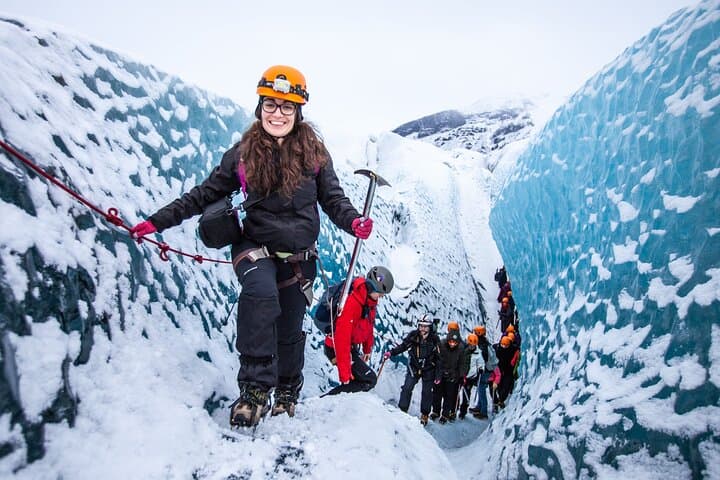
Beneath a sky of shifting light, Skaftafell’s ice reads like a map of time. This three-hour guided glacier hike mixes technical instruction with geology and culture: compact, safe, and unforgettable.
 Related story
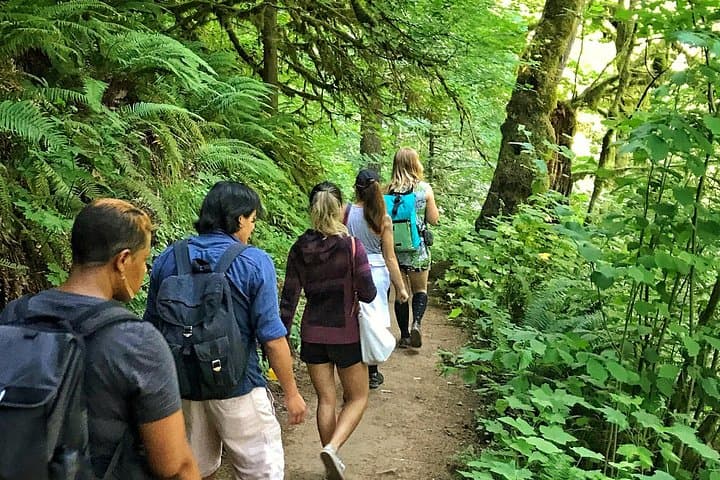
Lose the city for a few hours without leaving it: this 5-mile, 900-foot-gain Forest Park loop threads old-growth pockets, city viewpoints, and cultural landmarks for a compact taste of Portland’s wild side. Expect moss, roots, and stories.