
What the day feels like
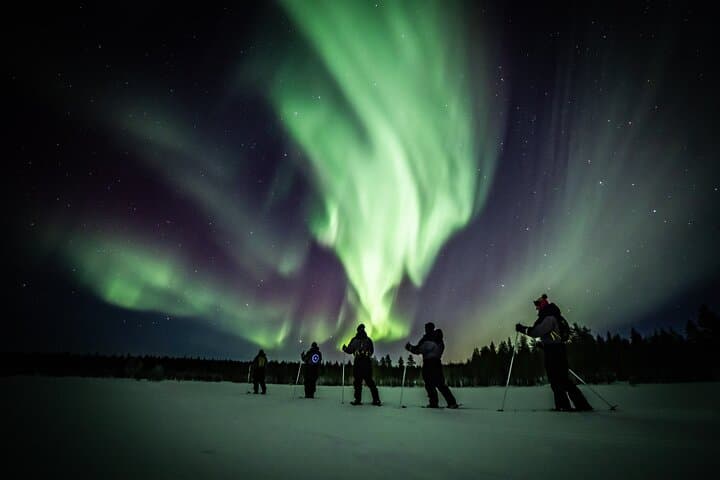
We move like a small constellation across the snow—one headlamp after another—each beam cutting a white ribbon through the black of an Arctic forest. Breath fogs in the beam, a soft hiss beneath skin-tight hoods. The skis are wider than the ones you’d take to groomed runs; they are designed to float, to make you a light-footed visitor in a deep, sleeping landscape. Above the pines, the sky keeps its own counsel. When the aurora wakes it does so slowly, as if testing the horizon: a pale green smear that flexes and then unfurls into a vaulted curtain. The trees beneath are patient spectators, their branches bowed by snow, catching ribbons of light and reflecting an impossible, cool palette back at us.
This Private Northern Lights skiing adventure starts deliberately: from an office on the edge of Rovaniemi we kit up in specialist backcountry skis and cold-weather clothing provided by the outfitter, check cameras and batteries, and drive a short way into territory that is dark by design—no distant town lights, only the thrum of our minivan. About three and a half hours is all the itinerary promises; it’s more than enough time to move, to listen, and to stand still and watch.
Lapland’s nights are decisive teachers. The region around Rovaniemi sits on the Arctic Circle, where winters are long and the nights are luminous with potential. Geologically, you’re gliding over the Fennoscandian Shield—ancient rock gently scoured and shaped by ice ages, now wearing a green-brown coat of taiga interrupted by frozen rivers and marshy flats. Culturally, the land carries the quiet imprint of Sámi people, whose reindeer herding traditions have threaded human life into this environment for millennia. Rovaniemi itself was flattened in World War II and largely redesigned by modernists like Alvar Aalto, which gives the town a postwar clarity that contrasts with the old rhythms of the surrounding wilderness.
The experience is focused and elemental: motion, cold, dark, and sky. The guides are more than route-finders; they’re translators. They read snow, find the quiet clearings that make good light frames, tune camera settings, and—when the aurora bursts—position you where trees won’t silhouette awkwardly. There’s no aurora guarantee; that’s part of the deal. The operator emphasizes nature-first values: the night is for exploring the forested backcountry that’s accessible only by these specialized skis, with the Northern Lights as a possible, thrilling reward.
Why choose a private, guided night-ski for the aurora? Compared to standing around in a town’s parking lot, this is a sensory recalibration. The deep snow muffles city sounds; the air is sharper; you will notice the small things—lichen clinging to branches, the rainbow sheen on a wolf track (though wolves are invisible here more often than not), the slow breath of a distant reindeer as it passes through a clearing. And for photographers, there’s a practical bonus: fewer competing lights and longer windows to compose long exposures.
Practicalities are straightforward. The tour runs about 210 minutes, usually starting after dinner. Expect a gentle to moderate workout: you’re using rocking, kick-turn friendly skis and moving in untracked powder, which engages your core and legs constantly. Temperatures can plunge well below freezing; the guides supply helmets, skis, poles, and sometimes insulated boots, but bring your own base layers, insulated jacket, and warm socks. A good headlamp is mandatory; red-light modes help preserve night vision for both skiers and cameras.
This is a private tour with a premium price—reflecting the bespoke guide attention, specialized equipment, and small group logistics that take you into remote clearings. There’s an element of risk and reward: intense cold and an unpredictable sky balanced by an intimate wilderness experience that urban aurora-chasers rarely see.
If you go, plan to savor both motion and stillness. Let the forest’s rhythm set your pace: glide, stop, breathe, listen. Bring extra batteries—camera and phone batteries bleed charge quickly in Arctic temperatures—and a thermos of something warm to drink on the ride back. Support local providers: guides are often Sámi or deeply embedded in the region’s tourism economy, and a private tour lets you pay directly for that expertise.
For anyone who loves quiet night travel, cold-weather craft, and the chance—however unlikely—of witnessing the aurora from a white clearing surrounded by pines, this outing is an elegant, efficient way to experience Lapland at night. It’s not about conquering a vista; it’s about being present in a rare kind of dark and, if the sky agrees, watching it light itself anew.
Distance and elevation aren’t the point here—the groomed tracks are swapped for variable, backcountry terrain—but expect several kilometers of ski in deep powder and gentle rises that keep your heart honest. Prepare for motion under your feet and for hours of low light that reward slow, deliberate photography.
A final note: the Northern Lights are a force that cannot be booked. What you can guarantee is the quality of your night—skis that float, guides who know the land, and an intimate, private route that puts you where light feels closest to the skin. That’s reason enough to plan the trip.
Trail wisdom
Small choices, better day.
Layer for long, cold nights
Wear moisture-wicking base layers, an insulating midlayer, and a windproof shell; temperatures can drop rapidly once you stop moving.
Protect batteries from the cold
Carry spare camera and phone batteries in an inner pocket close to your body to prevent rapid drain.
Bring a red-light headlamp
A red-filtered headlamp preserves night vision and makes it easier to work with camera settings without blinding others.
Hydrate and eat before you go
Cold nights sap energy; have a carbohydrate-rich snack and drink to sustain effort and keep circulation steady.
Local knowledge
Read the place, not just the route.
Watch for native species including Reindeer, Great Grey Owl (and other nocturnal birds).
Keep an eye out for wildlife during the transition between areas and habitats. Respect distance guidelines.
The Arctic’s lichen and tundra are fragile—stick to established routes, avoid trampling vegetation, and pack out all trash.
Follow the guide's instructions on size limits, ethical handling, and leave-no-trace practices.
Ounasvaara fell viewpoint for panoramic daytime vistas. Small, privately run Sámi reindeer farms on Rovaniemi’s outskirts offering cultural visits
Locally recommended viewpoints and quiet spots known best to local operators.
Rovaniemi was heavily destroyed during World War II and reconstructed in the postwar era, with modernist influence from architects like Alvar Aalto.
Maritime roots and regional tradition shape the waterways and working coasts.
Seasonal guide
Four versions of the same landscape.
Spring
Best forLonger daylight windows · Stable cold nights · Better chance of clear skies
ChallengesVariable melt conditions underfoot · Occasional thaw-freeze cycles · Longer daytime can reduce aurora visibility
Late winter into early spring (February–April) often delivers cold, stable nights with clearer skies—good for night photography and comfortable skiing.
Summer
Best forMidnight sun experiences · Daytime backcountry skiing (on glaciers) · Birdwatching and hikes
ChallengesNo darkness for aurora viewing · Many winter services closed · Different gear required
Summer is not suitable for aurora night-skiing; long daylight hours eliminate darkness and most winter-focused operators pause services.
Fall
Best forCrisp transition days · Fewer tourists · Seeing the first snows
ChallengesUnpredictable snow cover · Shorter but inconsistent nights · Cold snaps can arrive suddenly
Early winter onset can bring variable conditions—there may be enough snow for skis but nights are less predictably cold than mid-winter.
Winter
Best forNorthern Lights viewing · Consistent deep snow · Night-time skiing adventures
ChallengesExtreme cold and short daylight · Some roads or services limited · Need for robust cold-weather gear
High winter (December–March) is the primary season: deep snow, long nights, and the best window for aurora-hunting from backcountry clearings.
Operator details
What the booking data adds.
Included
- ✓warm clothing & winter boots
- ✓minivan transportation
- ✓skis & poles, headlamps
- ✓hotel pick-up & drop-off
- ✓Wilderness/photography guide
- ✓night time skiing trip to Arctic nature
- ✓collection of edited photos
- ✓hot drinks
Not included
- —Gratuities
Good to know
- ✓Public transportation options are available nearby
- ✓Specialized infant seats are available
- ✓Not recommended for travelers with spinal injuries
- ✓Not recommended for travelers with poor cardiovascular health
- ✓Travelers should have at least a moderate level of physical fitness
Pack with intention
What to bring.
Good to know
Common questions.
No—aurora activity is natural and unpredictable; the tour focuses on backcountry experience and night photography, but sightings depend on solar activity and clear skies.
Plan the edges
The details that make the day easier.
Rovaniemi sits on the Arctic Circle and is officially recognized as the hometown of Santa Claus—a position that has made the town a center for Arctic tourism.
After a night ski, head back to Rovaniemi for a bowl of reindeer stew at Restaurant Nili or warm up with coffee and cloudberry pie at the Arktikum café; local craft beers or a dram of Lappish spirits make for a convivial wind-down, and small Sámi-run shops sell authentic handicrafts if you want to support local artisans.
- Closest airport
- Rovaniemi Airport (RVN)
- Typical transfer to the meeting office
- 10–30 minutes from town center
- Driving distance to forest
- commonly 15–45 minutes by minivan
- Cell service
- reliable in town, patchy in deep forest clearings
- Permits
- none required for guided tours
Respect fragile lichen and ground cover—avoid leaving tracks off established winter routes, support certified local guides, and pack out all waste to protect Arctic habitats.
Explore by topic
Follow the threads.
Keep exploring
Make the story part of the trip.
In four hours you can move from shaded canyon ferns to wind-scoured coastal ridgelines, guided by someone who knows where the light—and the hidden views—live. This private half-day hike on the Monterey Peninsula or Big Sur is compact, curated, and perfect for travelers who want depth without a multiday commitment.
 Related story
Beneath a sky of shifting light, Skaftafell’s ice reads like a map of time. This three-hour guided glacier hike mixes technical instruction with geology and culture: compact, safe, and unforgettable.
 Related story
Lose the city for a few hours without leaving it: this 5-mile, 900-foot-gain Forest Park loop threads old-growth pockets, city viewpoints, and cultural landmarks for a compact taste of Portland’s wild side. Expect moss, roots, and stories.