
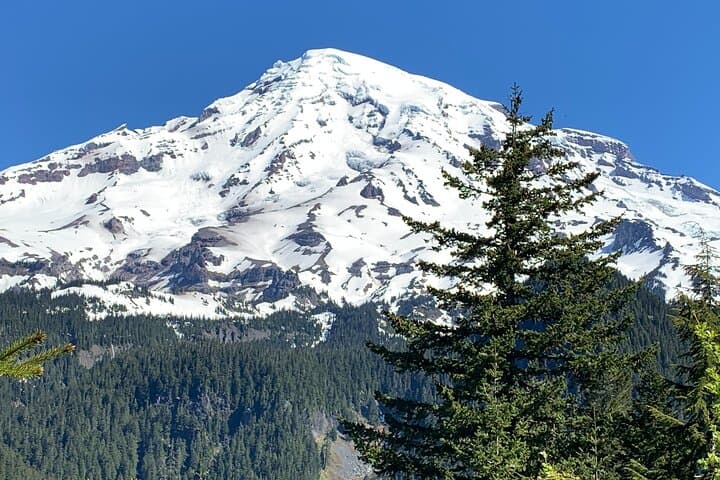
What the day feels like
By the time the vehicle eases off the highway and the glacial silhouette of Mount Rainier fills the windshield, the air seems to change—colder, dryer, and somehow cleaner. On this full-day guided loop from Seattle you don’t race the mountain so much as move around it: stops at old-growth forest, brisk short hikes to waterfalls, and vantage points that throw the park’s jagged icefields and alpine meadows into sharp relief. It’s a long day—10 to 11 hours of driving, stops and short hikes—but it’s paced for people who want to soak in the variety that makes Mount Rainier National Park a singular Pacific Northwest landscape.
The mountain itself is a story in stone and ice. A stratovolcano towering to 14,411 feet, Rainier’s glaciers carve the park into bowls, ridges and cascades. Your guide will likely point out the Nisqually and other glaciers from overlooks, explaining how the glaciers feed rivers that dare you closer to their spray at waterfalls. At lower elevations, the forest has its own gravity—old-growth Douglas firs and western redcedars whose trunks remember centuries of snow and fire. Nature here feels both ancient and urgent: the alpine meadows are fragile, the rivers alive with seasonal rush, and weather that can flip from sun to squall in an hour.
The human history threads through the landscape, too. For millennia, the Puyallup and Muckleshoot peoples have considered the mountain a place of cultural and spiritual meaning. Euro-American visitors came next, and Mount Rainier was designated a national park in 1899—one of the earliest protected sites in the U.S. The park’s trails, visitor centers, and roads are a century’s worth of access punctuated by conservation efforts to protect fragile alpine meadows and the old-growth below.
On a guided hike like this, the itinerary is part scenic drive, part interpretive walk. Expect shorter hikes from trailheads such as Paradise and other iconic pullouts, where the guide will choose routes based on snow, trail conditions, and the day’s light. In summer, you’ll get wildflower hits on meadows with glacier backdrops; in shoulder seasons you may trade blooms for the hush of snow and the crunch of microspikes underfoot—providers include snowshoes or crampons from November through June when necessary.
Why do this trip? Because it folds a dozen quintessential Mount Rainier experiences—glaciers, waterfalls, tall trees, and mountain panoramas—into a single guided day. For travelers based in Seattle who don’t have time for overnight backcountry trekking, it’s a concentrated primer on the park’s best moods. For photographers, it’s a chance to frame glaciers against sky and hunt reflections in alpine tarns; for families, the shorter hikes and interpreters make the landscape more accessible.
Practical notes you’ll want before you go: the tour runs roughly 10–11 hours, with hotel pickup typically from Seattle. There’s a park entrance fee (paid per vehicle or via an annual pass) and the weather can quickly change—layers and waterproof gear are nonnegotiable. Cell service is intermittent inside the park, so download maps and bring a printed confirmation of your booking. Footwear should be sturdy and broken-in; trail surfaces range from packed dirt to snow and scree depending on season.
Safety and stewardship are part of the rhythm here. Your guide will walk you through Leave No Trace basics—stay on trails, pack out waste, and avoid trampling fragile meadows. Wildlife sightings (elk grazing near subalpine meadows, marmots on talus fields) are common if you keep respectful distance. Also, be prepared for the altitude’s subtle pull at Paradise’s 5,400-foot elevation: take your time on ascents, hydrate, and tell your guide if you feel off.
If you’re planning this as a one-day investment, timing matters. Summer—July through early September—opens the widest range of stops and the best wildflower displays. Shoulder seasons offer moodier light and fewer crowds but require more layered gear; winter and spring tours depend on road access and may use snow gear for safety. Booking in advance is wise: the tour often lists as likely to sell out, and instant confirmation means you can secure a spot without waiting.
When the day winds down and you’re driving back, you’ll understand why Rainier draws people back: the mountain gives different answers on each visit. This guided hike isn’t a summit attempt; it’s a deep, many-textured encounter—a compact education in geology, ecology, and human history, delivered along trails that are as accessible as they are humbling. Whether you’re after waterfall mist, glacier vistas, or the quiet company of trees that have stood here for centuries, this trip stitches those ambitions into one manageable, unforgettable day.
Trail wisdom
Small choices, better day.
Layer for mountain weather
Bring a moisture-wicking base, insulating mid-layer, and waterproof shell—conditions can shift rapidly even in summer.
Hydrate early and often
Carry at least 2 liters of water and refill when possible; higher elevations dehydrate you faster.
Sturdy footwear matters
Choose ankle-supporting hiking boots for mixed terrain, from packed dirt to rocky viewpoints.
Respect meadows and wildlife
Stay on marked trails to protect fragile alpine plants and observe animals from a distance.
Local knowledge
Read the place, not just the route.
Watch for native species including Elk, Marmot.
Keep an eye out for wildlife during the transition between areas and habitats. Respect distance guidelines.
The park emphasizes Leave No Trace practices to protect delicate alpine meadows and glacial-fed waterways; guided groups help minimize individual impact on trails.
Follow the guide's instructions on size limits, ethical handling, and leave-no-trace practices.
Grove of the Patriarchs boardwalk—an intimate old-growth detour. Mowich Lake area for quieter lakeside views (road access varies seasonally)
Locally recommended viewpoints and quiet spots known best to local operators.
Mount Rainier has been a cultural landmark for Puyallup and Muckleshoot peoples for millennia and became a U.S. national park in 1899—one of the nation's earliest protected landscapes.
Maritime roots and regional tradition shape the waterways and working coasts.
Seasonal guide
Four versions of the same landscape.
Spring
Best forSnowfields and quiet trails · Early waterfall flow
ChallengesSnow-covered roads · Limited access to high-elevation stops
Spring can be a mix of lingering snow and swollen waterfalls; guides provide snowshoes or crampons when trails remain icy.
Summer
Best forWildflower meadows · Full road access and warm days
ChallengesHigher visitor numbers · Sunny days can still be cool at elevation
Summer is the most accessible season—clear roads and open trails make it ideal for a comprehensive day tour.
Fall
Best forCrisp light and quieter trails · Fall colors at lower elevations
ChallengesEarly snow possible · Shorter daylight hours
Fall offers dramatic skies and fewer crowds, but be ready for colder mornings and potential early snow above treeline.
Winter
Best forSnow landscapes and quiet solitude · Snowshoeing opportunities
ChallengesRoad closures and limited access · Trailhead parking and visibility issues
Winter tours run with winter gear when accessible—expect fewer stops and more time spent enjoying snowy viewpoints.
Operator details
What the booking data adds.
Included
- ✓Trekking poles
- ✓Bottled water
- ✓Crampons
- ✓All Fees and Taxes
- ✓Snowshoes
- ✓Air-conditioned vehicle
Not included
- —Food is not provided and you can bring your own lunch or buy lunch to-go in a grocery store where we have a restroom stop. There is also a cafeteria in the visitor center in the national park.
Good to know
- ✓Public transportation options are available nearby
- ✓Specialized infant seats are available
- ✓Not recommended for travelers with spinal injuries
- ✓Not recommended for pregnant travelers
- ✓Not recommended for travelers with poor cardiovascular health
- ✓Travelers should have at least a moderate level of physical fitness
- ✓Not recommended for travelers with knee or hip problems
Pack with intention
What to bring.
Good to know
Common questions.
The tour lasts approximately 10–11 hours and includes guided shorter hikes, scenic driving stops at park highlights, and interpretive commentary; transport from Seattle is typically included—check your booking for exact pickup details.
Plan the edges
The details that make the day easier.
Mount Rainier is the highest mountain in Washington state at 14,411 feet (4,392 meters) and hosts one of the largest systems of glaciers in the contiguous United States.
After the hike, head into the gateway town of Ashford for a hearty meal and local beers at inns and lodges, or drive back to Seattle for seafood and craft brews—either option pairs well with the day’s mountain appetite.
- Closest major airport
- Seattle-Tacoma International (SEA); Approx. drive from Seattle to park access: ~2 hours to Paradise; Cell service: intermittent inside park; Permits
- Passes
- Mount Rainier National Park entrance fee required; Road access may be seasonal.
Trails and meadows at Mount Rainier are fragile—stick to designated paths, pack out all waste, and avoid picking wildflowers to preserve habitat and the experience for future visitors.
Explore by topic
Follow the threads.
Keep exploring
Make the story part of the trip.
In four hours you can move from shaded canyon ferns to wind-scoured coastal ridgelines, guided by someone who knows where the light—and the hidden views—live. This private half-day hike on the Monterey Peninsula or Big Sur is compact, curated, and perfect for travelers who want depth without a multiday commitment.
 Related story
Beneath a sky of shifting light, Skaftafell’s ice reads like a map of time. This three-hour guided glacier hike mixes technical instruction with geology and culture: compact, safe, and unforgettable.
 Related story
Lose the city for a few hours without leaving it: this 5-mile, 900-foot-gain Forest Park loop threads old-growth pockets, city viewpoints, and cultural landmarks for a compact taste of Portland’s wild side. Expect moss, roots, and stories.