
What the day feels like
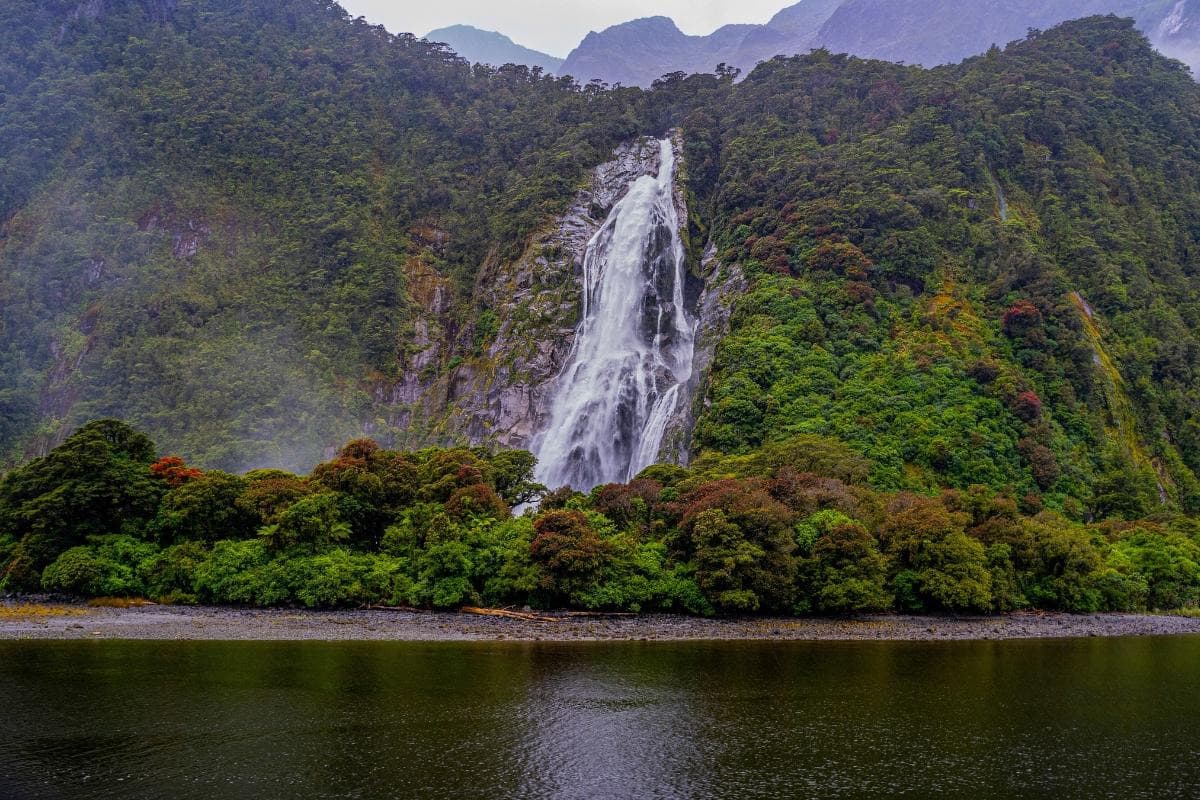
The first time the falls reveal themselves you don't so much approach them as are drawn into their orbit. From the wharf at Milford Sound, the cliff face breaks open in a vertical seam and Bowen Falls pours—an endless, silver thread unspooling from a cloud-damp ledge, the water shredding into mist long before it reaches the fiord below. On a damp morning the spray smells like mineral and moss; gulls ride the updrafts and the boat's engine hum becomes background to the world being rearranged by gravity.
Bowen Falls is small in footprint but huge in presence: a hanging waterfall that announces with urgency the glacial history of Fiordland. It sits in the shadow of Mitre Peak and within earshot of Stirling Falls, yet visitors return again and again for the intimate encounter—standing on a short, wet track or watching from the deck of a cruise as the torrent dares you to get closer.
Geology and history are as immediate as the spray. Fiordland's cliffs were carved by ice during the last ice ages; glaciers gouged deep U-shaped valleys and left behind steep, amphitheater walls where tributaries used to feed the main ice streams. Those tributaries became hanging valleys—perfect launchpads for waterfalls like Bowen Falls. The Māori name for the greater area, Piopiotahi, is woven into local stories and underscores that Milford Sound’s landscape has been a place of reverence for centuries. European visitors arrived later; today the Department of Conservation balances public access with protection of this fragile, fern-skimmed environment.
There are three simple ways to experience Bowen Falls, and each suits a different kind of traveler. For many, the standard Milford Sound coach-and-cruise from Queenstown or Te Anau is the most practical: the road to Milford is scenery in motion—alpine lakes, beech forest and hairpin turns—before the cruise slips into the fiord and reveals waterfalls like a slide deck of the last ice age. Choose a nature-focused cruise if you want expert commentary and the chance to edge close to cliff faces where seals snooze on ledges.
If you prefer to see the land from the air, a scenic flight or helicopter—options range from short transfers to glacier landings—will track along Milford Sound and call out features you can't appreciate from sea level. Helicopter routes commonly climb alongside Bowen Falls and Mitre Peak, giving lateral perspective on how the waterfalls thread down the rock. For a slower, more culinary experience, the Fiordland Jewel luxury lunch cruise pairs the waterfall views with chef-prepared food and a quieter onboard atmosphere.
And there’s the simplest option: step off the boat and take the short shoreline walk to the base of Bowen Falls. The path is less than a kilometer each way, with boardwalks and steps that keep you close to dripping tree ferns and slick rock. The trail can be muddy and primitive in places, but the payoff is tactile—boulders rimmed in green, a constant hiss of water, and the thrum of the fall above. It’s the best way to feel the spray on your face and understand the scale of the place.
Practicalities matter here. Milford weather is famously changeable; rain is part of the ecosystem that makes these cliffs possible, so dress for wet. If you’re planning a day from Queenstown or Te Anau, coach-and-cruise combos are efficient and leave the driving to local experts. Scenic flights and helicopter experiences are spectacular for photography and rapid transit—look for options that include a landing if you want time on the ground. Boat cruises range from basic sightseeing runs to nature cruises with onboard guides; Stirling Falls is more commonly approached by larger boats, but Bowen Falls is visible on most journeys and can be visited on foot from the wharf.
Safety and respect are non-negotiable. Stay on marked tracks, avoid the cliff edge and give wildlife plenty of space—seals and penguins use the shoreline as resting grounds. Bring waterproof layers, a lens cloth for your camera, and sturdy, grippy footwear. In winter, the track can be icy and the spray freezing—pack traction aids if you expect cold conditions.
Bowen Falls doesn't require hours of effort to appreciate; that economy is part of its charm. It's the waterfall you can touch without a long trek, the one that rewards a short stop with a lasting impression. Take a moment to stand in the mist, listen to the water break, and remember that everything you see here—the plunging falls, the steep cliffs, the tiny, fierce flora clinging to rock—was scored by glaciers and still reshaped every season by weather. Then get back on the boat or the road and watch the fiord slide by in a new light.
Why go? Bowen Falls is an accessible microcosm of Fiordland: dramatic geology, abundant wildlife, and that elemental feeling of being close to a raw, wet edge of the world. Whether you arrive by coach-and-cruise, soak in aerial views from a helicopter, or do the short shoreline walk, the site provides a high-reward, low-effort taste of Milford Sound—perfect for travelers who want an intimate nature hit without a multi-day commitment.
Trail wisdom
Small choices, better day.
Wear waterproof layers
Spray and sudden rain are constant; a breathable rain jacket and quick-dry base layers keep you comfortable during the walk or on deck.
Protect your camera
Bring a lens cloth and a zip-lock bag for quick sheltering—spray will fog lenses and drip on electronics.
Plan travel time to Milford
Coach trips from Queenstown or Te Anau take several hours; choose an organized coach-and-cruise to avoid complex logistics.
Stay on marked paths
The shoreline walk to the base is short but can be slippery—use handrails where provided and respect closure signs.
Local knowledge
Read the place, not just the route.
Watch for native species including New Zealand fur seal, Bottlenose dolphin.
Keep an eye out for wildlife during the transition between areas and habitats. Respect distance guidelines.
Fiordland National Park is managed to protect sensitive habitats—stay on tracks, avoid disturbing wildlife, and prefer operators that follow DOC guidelines.
Follow the guide's instructions on size limits, ethical handling, and leave-no-trace practices.
Harrison Cove—visible on some aerial routes with striking rock and glacier remnants. Short shore walk behind the Milford wharf—early morning light and fewer crowds make for quiet photos
Locally recommended viewpoints and quiet spots known best to local operators.
Milford Sound is part of Piopiotahi, a landscape long known to Māori; its dramatic cliffs were carved by glaciers during the last ice ages.
Maritime roots and regional tradition shape the waterways and working coasts.
Seasonal guide
Four versions of the same landscape.
Spring
Best forwaterfall volume · wildflower displays · fewer crowds
Challengesunpredictable rain · muddy trails
Spring (Sept–Nov) brings high flows from snowmelt and bright new growth; expect wet trails but powerful falls.
Summer
Best forlong daylight · calmer weather · boat availability
Challengestourist crowds · occasional heavy rain
Summer (Dec–Feb) offers the most reliable weather and frequent cruise schedules—ideal for combining boat and air options.
Fall
Best forautumn light for photography · cooler temperatures · fewer tour buses
Challengesshorter days · increasing rain
Autumn (Mar–May) yields crisp light and quieter facilities, though showers become more common.
Winter
Best forsnow-capped peaks from the air · dramatic icy spray · solitude
Challengesicy tracks · reduced services and potential flight cancellations
Winter (Jun–Aug) is atmospheric and stark; take traction aids and check weather for flights and cruises.
Pack with intention
What to bring.
Good to know
Common questions.
Most visitors arrive via Milford Sound cruises that depart from the Milford wharf; coach-and-cruise tours from Queenstown or Te Anau are common. Scenic flights and helicopter transfers also land or fly past the falls.
Plan the edges
The details that make the day easier.
Bowen Falls is a hanging waterfall carved by glacial action and drops approximately 162 meters (about 531 feet) into Milford Sound.
Milford’s tiny visitor community leans on DOC and tour operators; after a wet morning at the falls, locals recommend seafood chowder at the visitor café and locally caught salmon further inland in Te Anau.
- Access
- coach, cruise or flight. Nearest larger towns: Te Anau (approx. 2 hrs) and Queenstown (approx. 4 hrs). Facilities: visitor terminal with café and restrooms. Time needed: 30–90 minutes for a shore visit; half- to full-day if coming from Queenstown.
Choose operators that follow Fiordland’s environmental guidelines, avoid single-use plastics, stay on marked tracks and don’t feed or approach marine wildlife.
Explore by topic
Follow the threads.
Keep exploring
Make the story part of the trip.
In four hours you can move from shaded canyon ferns to wind-scoured coastal ridgelines, guided by someone who knows where the light—and the hidden views—live. This private half-day hike on the Monterey Peninsula or Big Sur is compact, curated, and perfect for travelers who want depth without a multiday commitment.
 Related story
Beneath a sky of shifting light, Skaftafell’s ice reads like a map of time. This three-hour guided glacier hike mixes technical instruction with geology and culture: compact, safe, and unforgettable.
 Related story
Lose the city for a few hours without leaving it: this 5-mile, 900-foot-gain Forest Park loop threads old-growth pockets, city viewpoints, and cultural landmarks for a compact taste of Portland’s wild side. Expect moss, roots, and stories.