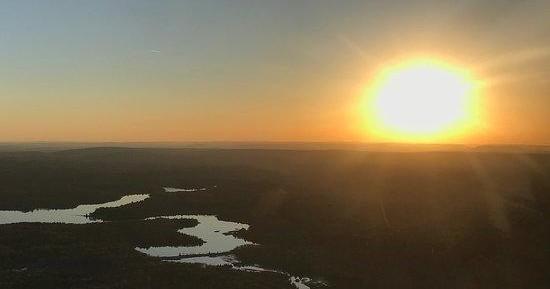
White Haven sits at the hinge between river-carved canyons and a broad, forested plateau—an intersection that reads beautifully from the air. An air tour here is not merely a view; it’s a reorientation. From above you can read the landscape as layers of geology and history: the narrow, chiseled throat of Lehigh Gorge where water once powered mills and tamed whitewater; the long, rounded ridgelines of the Poconos, a patchwork of hardwoods and evergreen stands; and the lattice of old rail grades and coal-era scars that recall the region’s industrial past. Short flights out of small grass strips and nearby municipal airports maximize that reading. In a single sortie you’ll move from tight canyon-carved drama to the broad, sunlit sweep of valley farmland and the blue-gray silhouettes of distant ridges.
Air tours in and above White Haven have an immediacy that ground-based outings can’t match. A sunrise balloon drift evens out the topography and offers quiet, panoramic light that warms cliff faces and tip-tops the forest canopy. Helicopter hops deliver a more kinetic perspective—low passes along river bends and access to remote overlook vistas where a hiker would take hours to arrive. Fixed-wing sightseeing is economical and photogenic: a thirty- to sixty-minute loop gives enough time to trace the river corridor, circle the Delaware Water Gap skyline, and taste the shifting mosaic of meadows, suburban fringes, and pure wilderness. Because the region’s attractions are compact, air tours here feel intimate rather than expansive—an hour-long flight covers the highlights in crisp detail without fatigue or sensory overload.
Seasonality shapes the experience in ways that matter. Fall is the obvious headliner: foliage flares in saturated reds and golds, and the gorge becomes a ribbon of contrasting dark water flanked by a searing palette. Spring is rewarding for a different reason—rising water levels and unfurling leaves that create dynamic contrast in aerial photography. Summer brings dense canopy and longer windows for evening flights after storm fronts pass. Winter can be crystalline and striking on clear days, but cold-air turbulence, reduced daylight and increased cancelations mean you’ll need flexible scheduling. Weather and visibility rules these tours more than any local permit, so expect last-minute changes and a prioritization of safety over itinerary. The payoff is that every successful flight feels curated by the landscape and the light—a brief, elevated story of the Poconos, told from a craft that makes the region’s scale instantly legible.
Air tours condense varied terrain—canyons, ridgelines, rivers, and townscapes—into a single panoramic arc, making White Haven an efficient base for aerial sightseeing.
Operators typically offer several aircraft types: hot-air balloons for slow, contemplative flights; light aircraft for economical scenic loops; and helicopters for dynamic, low-altitude passes and rapid access to narrow views.
The harbor is the gateway, and the Pacific becomes the classroom.
Because local airspace is uncluttered and points of interest are close together, tours are often short (30–90 minutes), making them accessible to travelers with limited time or those seeking a single, dramatic outing.
Safety and weather are the primary constraints. Visibility, wind, and river gorge thermals can mean cancellations or reroutes—book with flexible plans and a morning or late-afternoon window for better odds.
Choose by purpose
Whale watching, snorkeling, sunset sailing, cultural canoeing, harbor sightseeing, or private chartering.
Start near the city
Waikiki and Honolulu Harbor are primary hubs, with some trips launching near Hanauma Bay.
Confirm the vessel
Gangways, shaded seating, and boarding requirements vary according to vessel size and operator.