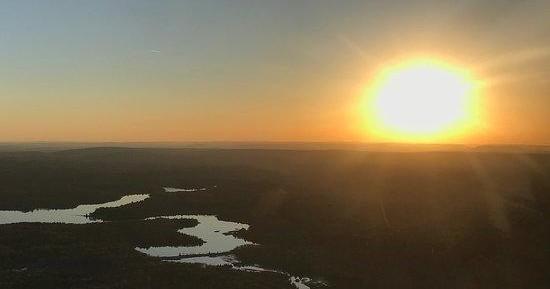
There are places where looking down alters what you think you know about a landscape. Mount Cobb is one of them. From the ridge-top roads and small-town lanes, the region reads as wooded hills, glinting water and the occasional cleared meadow. From the air, patterns emerge — long, narrow lakes and reservoirs threaded by inlets; old logging scars that have rebloomed into uneven forest; and the rhythmic contour of the Endless Mountains stepping east toward the Poconos. Air tours strip away context and replace it with scale and sequence: you see the shoreline of Lake Wallenpaupack unfurl, the checkerboard of second-growth forest and fields, and the way small valleys funnel weather and light.
Taking to the air here is less about adrenaline and more about perspective. Small-plane and helicopter flights provide low-altitude intimacy that highlights geological texture and seasonal color; hot-air balloon ascents deliver slow, painterly drift over harvest fields and tree-lined lakes. These flights are an invitation to read the land: to catch the ripple of late-summer storms moving across ridgelines, to watch shoreline cottages retreat into fall flame, or to spot nesting herons along quiet coves. For photographers and nature lovers, the air removes obstructions — no trees, no buildings — and replaces them with a panoramic continuity that’s hard to replicate on a trail or a lake.
There’s also a human history you can feel from above. Northeastern Pennsylvania bears the imprint of extractive industries and rural farming: tidelines of reclaimed land, long narrow clearings cut for utility corridors, and the small footprints of town centers. From the sky these marks tell a story of change and recovery; they reveal how the landscape has been managed, abandoned, and regrown. An air tour can therefore be both visually thrilling and quietly informative — a lesson in natural processes, seasonal cycles, and the ways communities sit within their terrain.
Finally, air tours pair exceptionally well with other outdoor activities here. A morning flight crowned by a lakeside breakfast, an afternoon hike on private or public trails, or an evening on the water after seeing the contours of the shoreline from above makes for a layered adventure. The air tour, frankly, reorients your whole trip: routes you thought might be unremarkable from the road become obvious natural attractions once you’ve seen their outline against the horizon.
Types of flights: Expect short scenic hops in 4–6-seat light-aircraft, occasional helicopter charters, and seasonal balloon lifts. Operators vary across the Poconos and from small regional airfields serving Mount Cobb.
Best uses: Aerial photography, fall foliage viewing, scouting routes for hikes and paddling, understanding watershed patterns, and quiet sightseeing that complements hiking, boating, and fishing.
The harbor is the gateway, and the Pacific becomes the classroom.
Accessibility: Air tours are typically launched from nearby small airports or private strips; ground access is often easy from I-380 and local roads. Many providers will pick up from local lodging or public meeting points but confirm logistics when booking.
Choose by purpose
Whale watching, snorkeling, sunset sailing, cultural canoeing, harbor sightseeing, or private chartering.
Start near the city
Waikiki and Honolulu Harbor are primary hubs, with some trips launching near Hanauma Bay.
Confirm the vessel
Gangways, shaded seating, and boarding requirements vary according to vessel size and operator.