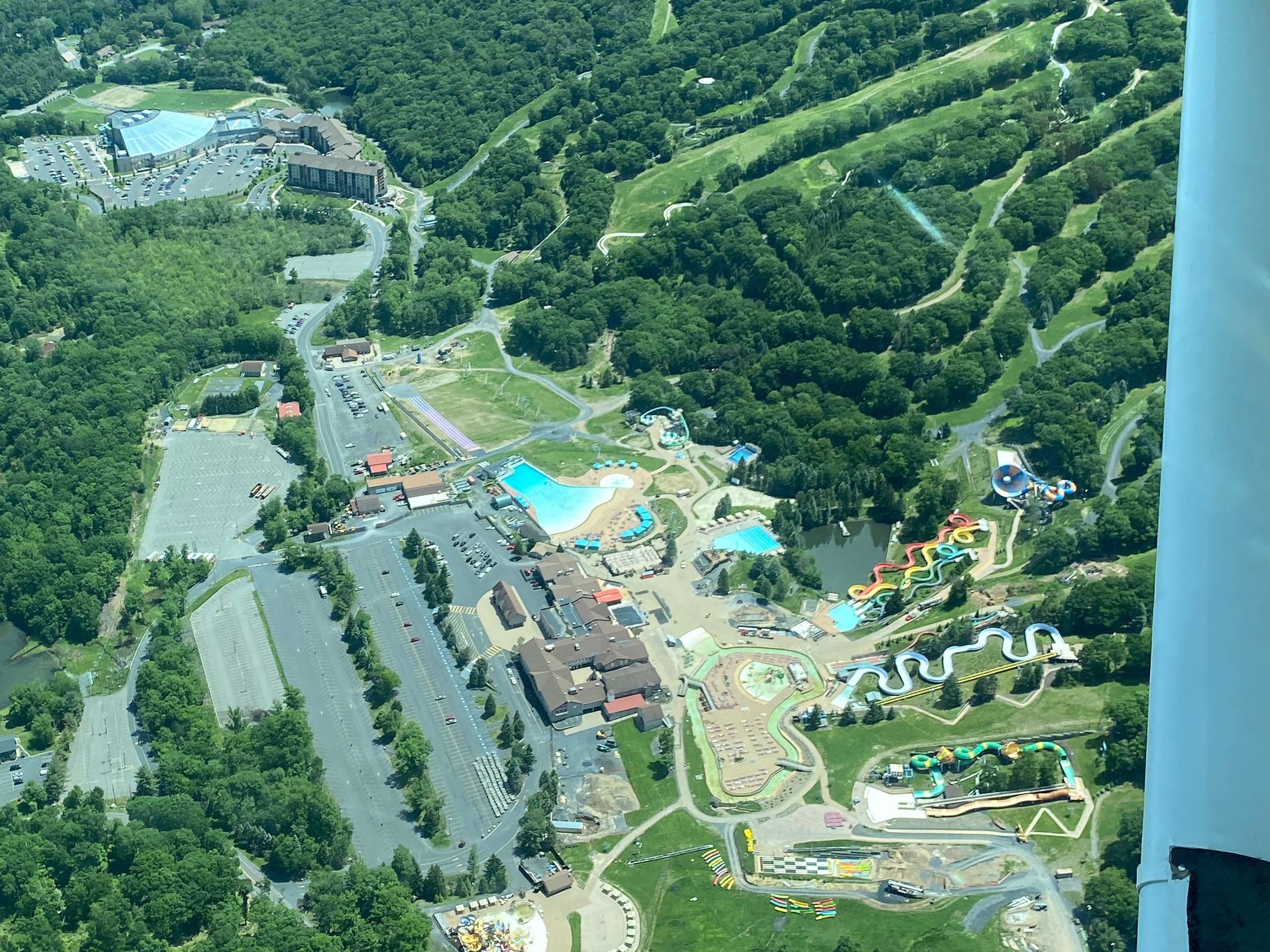
There’s a particular hush that arrives just before sunrise in the Poconos—the kind that holds its breath while hot-air balloons inflate and pilots scan the horizon for the first reliable breeze. In and around Blakeslee that hush dissolves into motion: wicker baskets lift from meadow edges and glide above patchwork farmland, paragliders launch from ridge edges into sunlit thermals, and skydivers fall through layers of cumulus with the blue-green quilt of forests and lakes beneath them.
Blakeslee itself is modest, but its geography magnifies airborne experiences. Low ridgelines and kettle lakes create predictable updrafts and scenic corridors; the nearby tree-line and open fields give pilots and jumpers room to plan approaches without the complications of dense urban airspace. Because the area sits in the Pocono transition zone between Appalachia’s folds and broad valley floors, weather patterns can change rapidly—morning calm often gives way to afternoon thermals that lift paragliders and, occasionally, cap soaring windows for glider pilots.
What distinguishes air activities here is the intimacy of scale. Flights and jumps are rarely about altitude records; they’re about perspective. A balloon ride over fog-tipped valleys lets you read the landscape as a cartographer would—farm parcels, winding creeks, and ringed shorelines of recreational lakes. Paragliding in the afternoons is tactile: you feel the lift, make minute steering decisions, and land back in a meadow with your wing already collapsing like a sleeping bird. Skydiving options often operate from nearby drop zones rather than Blakeslee proper, meaning a short drive connects you to full-service providers who handle gear, tandem instruction, and aircraft operations.
Complementary activities naturally pair with air days. Early-morning balloon flights are easiest to coordinate with lakeside breakfasts or sunrise photography walks; afternoons of paragliding or soaring go well with trail runs that warm the body before launch; and a day that includes a nearby skydiving center pairs well with a relaxed evening at a local brewpub to decompress. For planning: weather windows rule the schedule. Operators and pilots watch wind shear, cloud base, and thermal forecasts closely—if the sky looks flat and gray, flights are often grounded. For would-be fliers, that unpredictability is part of the rhythm: plan for flexible mornings and keep accommodations and transport adaptable.
Air activity variety: scenic ballooning, tandem skydiving at nearby drop zones, paragliding and paramotoring launches within short drives. Operators vary by season.
Landscape and accessibility: low ridgelines and open farmland create forgiving landing zones and multiple launch options for non-technical flyers.
The harbor is the gateway, and the Pacific becomes the classroom.
Weather-driven scheduling: calm mornings favor ballooning; afternoons bring thermals for paragliders but can also produce stronger winds that cancel flights.
Choose by purpose
Whale watching, snorkeling, sunset sailing, cultural canoeing, harbor sightseeing, or private chartering.
Start near the city
Waikiki and Honolulu Harbor are primary hubs, with some trips launching near Hanauma Bay.
Confirm the vessel
Gangways, shaded seating, and boarding requirements vary according to vessel size and operator.