
What the day feels like
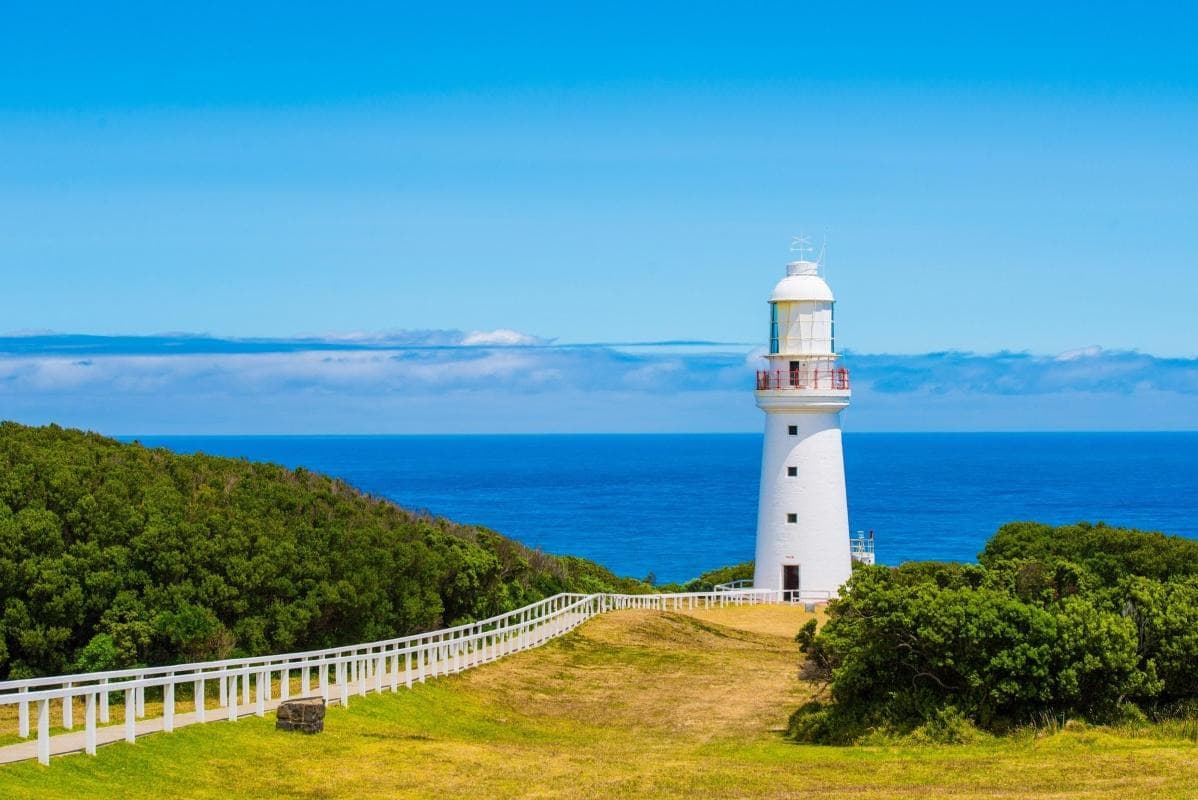
A wind-bent eucalyptus grove greets you first, branches trained by salt and weather into a single, patient gesture toward the Southern Ocean. The path narrows, gravel whispering underfoot, and then—sudden and inevitable—the white cylinder of Cape Otway Lightstation appears against a bruise-blue horizon. Standing where land thins into cliff, the lighthouse has supervised one of Australia’s most treacherous stretches of coastline since 1848. It doesn’t merely mark the coast; it keeps a long, steady counsel with the sea.
Walk the headland and you’ll feel that conversation: waves nudging the cliffs far below, small birds darting the wind, a scent that is part salt and part damp forest. The Lightstation is set at the edge of Great Otway National Park, where coastal scrub and cool temperate rainforest meet. This is where the ocean dares you to look further, and the forest answers with a cool, green hush.
Maritime history is written into every stone here. The Cape Otway Lightstation is one of Australia’s oldest surviving lighthouses, completed in 1848 to warn ships of the jagged coastline and the hidden shoals that have felled many a vessel. Nearby, the remains of telegraph buildings and the museum exhibit the island-of-stone role this headland has played—an outpost for lifesaving, signal-keeping and weather observation. Shipwrecks are part of the narrative; their stories surface in plaques and in the rumour of old maritime routes that once threaded close to shore.
Geologically, these cliffs are patient storytellers: layered sandstones and ancient marine sediments compressed and revealed over millennia. From above, the coastline reads like a topographic score—beaches, headlands, and offshore stacks that the ocean carves into their shapes with stubborn, steady rhythm. The same coastal processes sculpt the 12 Apostles further west along the Great Ocean Road, a sweep of shoreline visible on aerial tours and winding drives.
Culture here is local and resilient. The land and sea are the reason Apollo Bay exists—fishing boats, cafes serving freshly caught fish, and farms that trade in Otway raspberries and dairy. The Cape Otway headland also lies on the traditional lands of the Gadubanud and other Indigenous groups, whose relationship to these waters goes back millennia; look for interpretive panels at the site that acknowledge this living cultural history.
Why visit? The Lightstation is compact but layered: it’s a history lesson, a photography subject, a vantage point for migrating whales, and a place to stand where the sky and sea feel larger. For travelers with time, the lighthouse pairs beautifully with two of the region’s signature experiences. From the air, private helicopter tours that thread the Great Ocean Road and pass over Bells Beach, Lorne, and the 12 Apostles offer a cinematic perspective—Cape Otway slips into view as a solitary sentinel. For those who prefer the intimate pace of the road, a private three-day Great Ocean Road tour lets you explore the Otways on foot, linger in rainforest gullies like Maits Rest, and sleep in Apollo Bay so you can walk the morning fog from your doorstep.
Practicalities matter here. The Lightstation precinct is accessible by car from Apollo Bay in under an hour and makes an excellent half-day stop within a longer Great Ocean Road itinerary. Expect winds that can cut through layers; the lighthouse tower and museum are open seasonally with guided options that let you climb and look outward—the stairwell to the lantern room is the kind of small exertion rewarded by panoramic views. Trails around the headland are short but uneven in places, and boardwalks protect sensitive dune vegetation.
If you’re planning a visit, time it for low wind and clear skies if your priority is photography or visibility; dawn and late afternoon deliver the warm light that sculpts the cliffs. If you’re there between May and September you may spot migrating whales from the headland—bring binoculars and patience. For a deeper encounter, include a guided walk into the Otway rainforest: the contrast between salt-scented cliffs and the humid, fern-rimmed gullies inland is striking.
Safety and stewardship: stick to marked paths and interpretive signs, especially around cliffs and fragile dune systems. The Otways are habitat for koalas and other native species; keep your distance and refrain from feeding wildlife. Packing should be pragmatic: sturdy shoes for mixed terrain, a windproof layer, water, and a camera with a mid-range zoom for wildlife and landscape shots.
Visit Cape Otway Lightstation to stand in a place where navigation, natural history and human stories intersect. Take a moment on the bluff and you’ll understand why lighthouses are symbols: not just of warning, but of steadiness in a landscape that is always shifting. Whether you arrive by private helicopter to see the coast from above or by slow coastal drive to explore forest trails and fishing towns, the Lightstation offers a concentrated, rewarding taste of the Great Ocean Road’s wild heart.
Trail wisdom
Small choices, better day.
Dress for wind and spray
Layer a windproof shell over a warm mid-layer—conditions change quickly on the headland and the spray can be chilling even on mild days.
Bring binoculars
Whale migrations and seabirds are best viewed from the headland; a 8–10x pair will reveal flukes and distant stacks clearly.
Stay on marked paths
Cliff edges and dune vegetation are fragile; boardwalks protect habitat and keep you safe from undercut edges.
Combine with a guided tour
A private Great Ocean Road tour or helicopter flight extends the perspective—see the Lightstation from the air or access deeper Otway walks with a guide.
Local knowledge
Read the place, not just the route.
Watch for native species including koala, southern right whale.
Keep an eye out for wildlife during the transition between areas and habitats. Respect distance guidelines.
The Lightstation sits inside Great Otway National Park and management focuses on protecting coastal vegetation and native fauna; visitors are asked to stay on boardwalks to minimize erosion and habitat disturbance.
Follow the guide's instructions on size limits, ethical handling, and leave-no-trace practices.
Maits Rest rainforest walk—a short boardwalk through ancient myrtle and fern gullies.. Cape Otway Telegraph Station ruins and small museum exhibits adjacent to the Lightstation.
Locally recommended viewpoints and quiet spots known best to local operators.
The Cape Otway Lightstation was completed in 1848 and is one of the oldest surviving mainland lighthouses in Australia, built to warn vessels navigating the hazardous Bass Strait approaches.
Maritime roots and regional tradition shape the waterways and working coasts.
Seasonal guide
Four versions of the same landscape.
Spring
Best forwildflowers · mild weather · birdwatching
Challengeschangeable rain showers · windy days
Spring brings wildflowers and refreshed forest greens; mornings can be misty but temperatures are comfortable for walks.
Summer
Best forlong daylight · beach access · aerial tours
Challengescrowds · hot afternoons
Summer has long, clear days ideal for helicopter tours and coastal drives—expect more visitors and pack sun protection.
Fall
Best fordramatic light · fewer crowds · wildlife spotting
Challengescooler temperatures · early dusk
Autumn’s warm light sharpens rock textures and reduces crowds—dress warmly for evenings as temperatures drop.
Winter
Best forwhale migration viewing · rainforest atmosphere · storm-watching
Challengescold winds · heavy rain
Winter offers prime whale-watching and moody seascapes; bring waterproofs and allow time for slower exploration.
Pack with intention
What to bring.
Good to know
Common questions.
About a 40–50 minute drive (roughly 40–45 km) along the Great Ocean Road, making Apollo Bay a convenient base.
Plan the edges
The details that make the day easier.
Cape Otway Lightstation, completed in 1848, is one of the oldest surviving lighthouses on mainland Australia and played a key role in guiding ships through the hazardous Bass Strait.
Apollo Bay’s seafood—especially locally caught fish and traditional fish-and-chips—pairs naturally with coastal walks; local producers sell Otway berries and cheeses, and interpretive panels acknowledge the Gadubanud people as traditional custodians of the land.
- Location
- Cape Otway Lightstation, Great Ocean Road. Access: Car from Apollo Bay ~45 minutes. Time needed: 2–4 hours. Facilities: visitor centre, museum, guided tours. Best for: history, whale watching, coastal views.
Respect boardwalks and signage to protect fragile dune systems and koala habitat; choose operators who follow low-impact landing and flight protocols for helicopter tours.
Explore by topic
Follow the threads.
Keep exploring
Make the story part of the trip.
Set out from Bass Harbor for a private, customizable day on Blue Hill Bay — lighthouses, puffins, seals, and the chance to feel Acadia from the water. Small groups, local captains, unforgettable views.
In four hours you can move from shaded canyon ferns to wind-scoured coastal ridgelines, guided by someone who knows where the light—and the hidden views—live. This private half-day hike on the Monterey Peninsula or Big Sur is compact, curated, and perfect for travelers who want depth without a multiday commitment.
 Related story
Beneath a sky of shifting light, Skaftafell’s ice reads like a map of time. This three-hour guided glacier hike mixes technical instruction with geology and culture: compact, safe, and unforgettable.