
What the day feels like
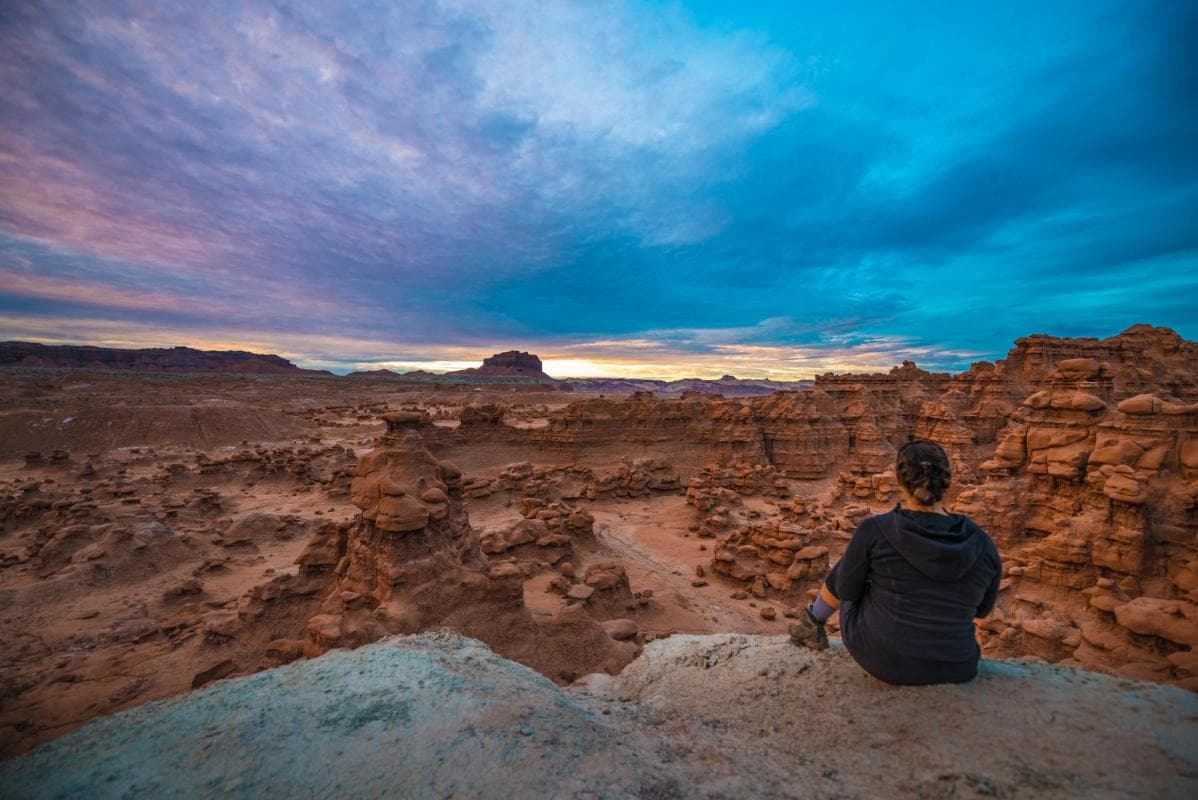
On a low, wind-scrubbed plateau in central Utah the sandstone stands up like a crowd—bunched, bulbous, and improbably human in silhouette. Dawn drapes an orange ribbon across the courtyard of rock and the goblins come alive. They are not mythical creatures but the park’s nickname for the thousands of mushroom-shaped hoodoos—short, rounded towers of Entrada sandstone that seem to be caught mid-mutter or mid-dance. You walk among them and the world rearranges itself into a scale that shrinks the map in your pocket and makes your feet feel like an instrument for reading the landscape.
Goblin Valley State Park is compact—less than 15 square miles—but it delivers a concentrated lesson in erosion, solitude, and the high desert’s theater of light. The first hour after sunrise is when the stone indeed feels animated: warm, shadowed hollows create eyes and mouths; narrow washes dare you deeper into their lines. Families come for the otherworldly playground; climbers and photographers come to hunt angles; guided groups come for low-angle canyoneering and technical introductions that make the place a surprisingly active frontier.
Geology here is the show’s script. The hoodoos are carved from Jurassic Entrada Sandstone—deposited roughly 170 million years ago—by cycles of freezing and thawing, wind abrasion, and chemical weathering. Where the caprock resists erosion and the softer layers beneath give way, the goblins form. The landscape is a palimpsest; underfoot an older layer of Curtis Formation appears, mesas and slickrock dissolve into the sculpted pockets that define the park.
Culturally, the valley sits in the greater Colorado Plateau region, an area shaped by Indigenous presence and later by ranchers and Mormon settlers. The nearby towns—Hanksville, Green River, and the small communities strewn along Highway 24—offer practical bases and a quietly defiant hospitality that fits the spare surroundings. The valley also has a modern pop-culture footnote: parts of the 1999 sci-fi comedy Galaxy Quest were filmed here, an apt pairing of alien-set visuals and real-world oddness.
For travelers, Goblin Valley rewards a range of approaches. You can spend an hour looping a short interpretive trail and be satisfied; you can camp and stretch the day into stargazing; or you can sign up for a guided canyoneering session that threads you through narrow washes and requires scrambling, route-finding, and the kind of local knowledge that keeps you out of loose rock and off fragile pedestals. The standard guided option available through local outfitters is a roughly 4-hour canyoneering adventure—suitable even for fit beginners—where guides teach fundamental ropework and route choices while you skirt slot-canyon narrows and peer through natural alcoves.
Practical details are deceptively important here. Distances are short, but heat is honest: summer highs frequently hit the 90s–100s °F (32–38°C), and there’s little shade in the sculpted basin. Trails are largely unmarked beyond the main parking areas, which makes a map, an awareness of landmarks, and conservative timekeeping essential. The park has a campground offering tent and RV sites; cell service is intermittent, so plan for self-sufficiency and tell someone your plans. If you’re on a day trip from Salt Lake City, expect 3.5–4 hours of driving; from Moab it’s roughly 1.5–2 hours. The “Pick Your Park” private day tours from Salt Lake frequently include Goblin Valley as an option, pairing the valley’s surreal playground with nearby highlights depending on your route.
How to structure a visit: arrive at first light for a short loop to capture the stone in cool light, then break out for a guided canyoneering session mid-morning if the temperature allows. Break for lunch at the picnic areas and save the afternoon for easy walks, bouldering on the goblins’ bases, or an hour of solitude among the fins. If you’re camping, set up before twilight—Goblin Valley is remote enough to offer a cathedral-like night sky; the Milky Way often spills straight overhead.
Planning logistics and safety: sturdy footwear is non-negotiable. Sandstone can be slick when wet and crumbly where weathered. Carry four liters of water per person for day hikes in summer, and plan your ropes and technical gear through a guide service if you’re not comfortable leading canyons. The park is low elevation—around 5,000–6,000 feet—so sun management matters: wide-brim hats, high-SPF sunscreen, and lightweight layers that cover rather than just cool.
Leave No Trace is especially important here. The hoodoos are fragile; walking on top of the small pedestals accelerates erosion. Stay on designated paths where provided, and treat the goblins not as playgrounds to be reshaped but as formations to be admired. That ethic is common to area outfitters and park staff; when you book a guided canyoneering trip, you’re often simultaneously booking stewardship and education.
Goblin Valley isn’t about conquering peaks or earning vertical kilometers. It is about scale, curiosity, and the childlike permission to scramble over a landscape that looks like a fossilized carnival. For photographers it’s a dream of shapes and light; for families, a safe place to teach route-finding and respect for fragile environments; for solo travelers, a place whose quiet can push you toward small revelations—how long a day lasts in the desert, how bright stars can be when the neighboring towns go dark.
If you go, go with a plan but leave space for the whimsical: a midday nap against a sun-warmed boulder, a sudden detour into a wash that reveals a hidden amphitheater, the hush of dusk when the goblins stand like sentinels. Goblin Valley feels designed to keep your attention; it asks only that you respond with curiosity and do no harm.
Recommended bookable activities that amplify the experience: a local 4-hour canyoneering adventure introduces technical skills and safe passage through narrow slots and bowl-like alcoves; private day tours from Salt Lake City pair Goblin Valley with other Utah icons if you’re on a tight timeline. Both options add context, conservation-minded instruction, and the local knowledge that transforms a walk among the goblins into a fuller—and safer—adventure.
Trail wisdom
Small choices, better day.
Go at sunrise or sunset
Light is everything here—soft morning and late-afternoon sun reveal texture and color while crowds thin out.
Book a guided canyoneering session
Local guides know safe routes and teach ropework and scrambling techniques tailored to the park’s sandstone terrain.
Carry extra water and a shade layer
Summer heat is intense; aim for 3–4 liters per person for half-day outings and wear sun-protective clothing.
Respect fragile formations
Don’t climb on thin pedestals or chisel the stone—walk only on durable surfaces and follow marked areas.
Local knowledge
Read the place, not just the route.
Watch for native species including desert cottontail, western rattlesnake (observe from a distance).
Keep an eye out for wildlife during the transition between areas and habitats. Respect distance guidelines.
The park emphasizes visitor education and Leave No Trace practices to protect fragile sandstone; guided groups often include stewardship briefings.
Follow the guide's instructions on size limits, ethical handling, and leave-no-trace practices.
Chimney Rock overlook—short diversion for a panoramic view across the goblin field. The lesser-used upper benches on the valley rim where morning light hits the formations differently
Locally recommended viewpoints and quiet spots known best to local operators.
The area sits on the Colorado Plateau and contains Jurassic Entrada Sandstone; ranching and later recreational development shaped its modern access as a state park.
Maritime roots and regional tradition shape the waterways and working coasts.
Seasonal guide
Four versions of the same landscape.
Spring
Best forwildflower displays · mild hiking · photography at golden hour
Challengesoccasional spring storms · mud in washes
Spring offers cool temperatures and occasional wildflowers; watch for variable weather and slick sandstone after rains.
Summer
Best forextended daylight · camping · stargazing after sunset
Challengeshigh daytime heat · scarce shade
Summer brings long days and excellent nights for stars but requires strict hydration and early starts to avoid heat.
Fall
Best forcomfortable hiking · color contrasts · fewer crowds
Challengescooler nights · potential for sudden storms
Fall is the sweet spot—cool days, brilliant light, and comfortable temps for canyoneering and photography.
Winter
Best forsnow-dusted landscapes · quiet solitude
Challengescold temperatures · possible icy patches on sandstone
Winter can be peaceful with dramatic contrasts; bring insulated layers and be cautious of icy surfaces on ledges.
Pack with intention
What to bring.
Good to know
Common questions.
Day-use requires an entry fee at the park entrance; no special permit is required for general hiking, but commercial guided activities should be booked through licensed operators.
Plan the edges
The details that make the day easier.
The hoodoos in Goblin Valley are carved from Jurassic Entrada Sandstone deposited about 170 million years ago; portions of the valley were used as a filming location for the movie Galaxy Quest (1999).
Nearby Hanksville and Green River offer small-town diners, a ranching legacy, and local guide services—their hospitality matches the region’s low-key, do-it-yourself ethos.
- Drive time
- ~3.5–4 hours from Salt Lake City, ~1.5–2 hours from Moab. Park fee required; campground available; limited cell service; guided canyoneering typically 4 hours.
Stay on durable surfaces, avoid climbing fragile pedestals, pack out all trash, and follow guide instructions—small actions protect formations that took millions of years to form.
Explore by topic
Follow the threads.
Keep exploring
Make the story part of the trip.
Set out from Bass Harbor for a private, customizable day on Blue Hill Bay — lighthouses, puffins, seals, and the chance to feel Acadia from the water. Small groups, local captains, unforgettable views.
In four hours you can move from shaded canyon ferns to wind-scoured coastal ridgelines, guided by someone who knows where the light—and the hidden views—live. This private half-day hike on the Monterey Peninsula or Big Sur is compact, curated, and perfect for travelers who want depth without a multiday commitment.
 Related story
Beneath a sky of shifting light, Skaftafell’s ice reads like a map of time. This three-hour guided glacier hike mixes technical instruction with geology and culture: compact, safe, and unforgettable.