
What the day feels like
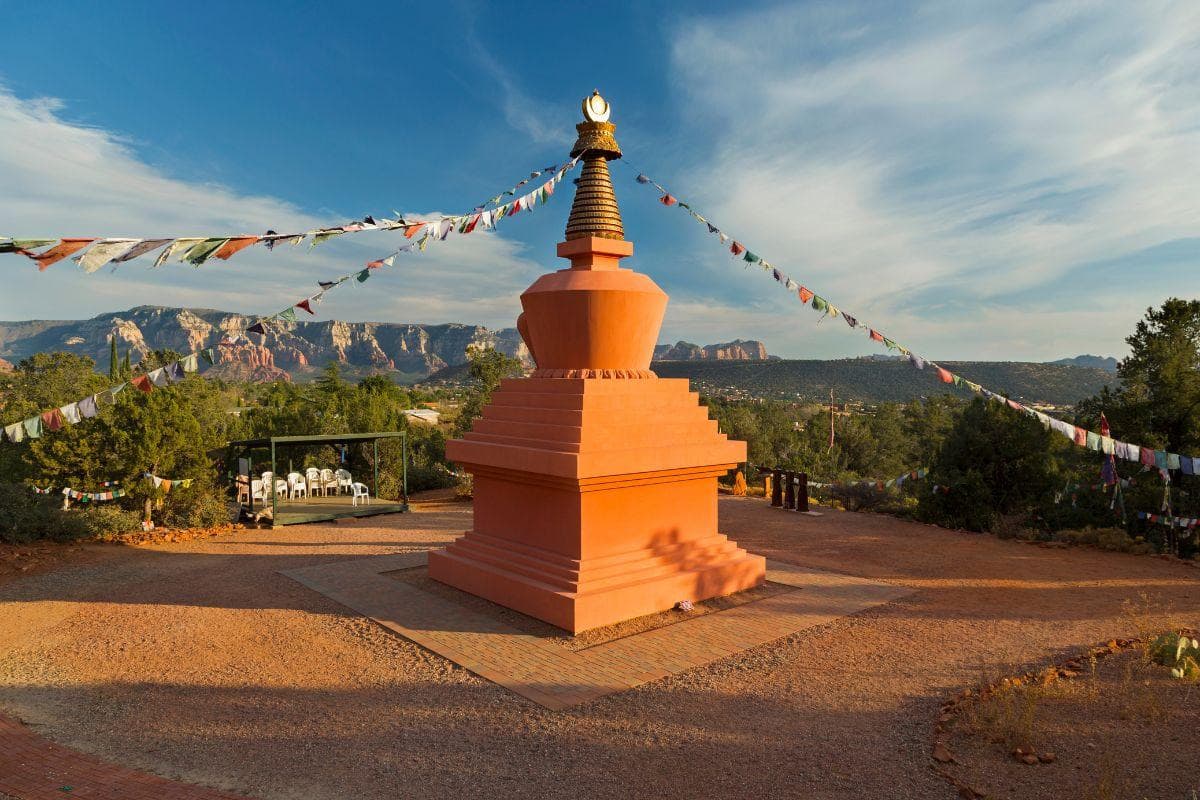
You arrive in Sedona with the red rock silhouette of Cathedral and Bell Rock etched against a sky that leans from blue to copper. The road narrows, pine needles shift under tires, and then the world tilts: a white-and-gold spire sits low against sandstone cliffs, a strangely domestic monument in a landscape famous for its vertical drama. The Amitabha Stupa—calm, compact, deliberately out of scale with the cliffs behind it—feels less like an attraction and more like an invitation. It asks you to slow down.
A short, easy loop threads the park. The path is forgiving—packed dirt interrupted by a few stone steps and sandy shoulders. The air has that high-desert clarity: every smell is sharper, from the resinous bite of piñon pine to the faint sweetness of juniper berries. Local wind drafts tease the prayer flags strung like soft punctuation, and occasional chimes answer the weather. Visitors arrive quietly: some to sit and breathe, others to circle the stupa clockwise with palms together, eyes soft, practicing walking meditation. Even if you don't come for formal practice, the place alters the usual tourist tempo; phones go away, steps become deliberate, and the rocks—so often photographed from busy trailheads—feel like neighbors rather than backdrops.
The Amitabha Stupa is a cultural hinge that folds several storylines together: modern Buddhist practice in North America, Sedona's reputation as a spiritual hub, and the deeper geologic time written into the red stone. ‘Stupa’ literally means a mound or monument; in Mahayana and Vajrayana traditions it represents the enlightened mind. Here, it’s also a communal center—quiet, accessible, and intended for contemplation rather than spectacle. The land itself tells another story: the red comes from iron oxide staining sandstone layers deposited in Permian-aged seas and deserts, then uplifted and sculpted into buttes and fins.
This combination—spiritual architecture set within dramatic geology—makes the park uniquely suited to low-impact adventures. You can treat it as a gentle out-and-back, a photography stop at golden hour, or the calm finish to a longer day of hiking at nearby trails like Bell Rock Pathway and Courthouse Butte. Walk the loop once for orientation, then find a bench, a shaded boulder, or a grassy incline and stay. The site invites small rituals: lighting (or refraining from) incense, ringing the bell, or reciting a line of poetry. The scent of the desert and the whisper of summer winds feel like subtle accomplices.
Practical planning is plain but worth doing right. The park sits just a few minutes north of Sedona’s central corridor and is usually free to enter, with limited on-site parking—arrive early for sunrise or later in the afternoon for better light and fewer people. The walk is short (roughly 0.6–1 mile round-trip depending on routes you take) with minimal elevation gain; it’s accessible for most walkers but has some uneven sections, so sturdy shoes are recommended. Dogs are sometimes seen on short leashes, but check local signage on arrival—this is a place many treat as sacred.
Timing matters for experience and photos. Sunrise bends the stone and stupa into soft pastels and is prime for quiet meditation; sunset bathes the red rock in saturated orange and casts long, dramatic shadows—perfect for wide-angle frames. Summer brings intense sun; pack water and a light hat and move slower. Fall and spring offer the most comfortable temps and the clearest, most cinematic light.
Bring the right gear, but keep it simple: a daypack with water and sun protection, a wide-angle lens if you’re shooting the stupa with the red rocks behind it, and a small travel blanket or sitting pad if you plan to linger. Respect the site: the stupa is a sacred object for many, and the park functions as both a public space and a place of practice. Maintain quiet, leave no trace, and keep the rituals personal rather than performative.
Pairings make the visit richer. A morning here followed by a hike up Airport Mesa gives you vertical perspectives of Sedona’s bowl; an afternoon of wandering the Stupa and then browsing gallery-lined streets in the Village of Oak Creek maps a cultural arc from reflection to social energy. Local guides often recommend combining the park with a sunset jeep tour or a half-day mountain-bike run, then finishing with a slow dinner of Southwestern fare—chile-rubbed meats, prickly pear cocktails, and shared plates that feel like an extension of the communal atmosphere you find at the stupa.
For the practical-minded traveler, the great appeal of Amitabha Stupa and Peace Park is its accessibility. You don’t need technical skills or a long itinerary to be rewarded. What you do need is intention: a willingness to trade hurry for a slower pace and a few minutes to let the place work on you. The rocks keep their indifference—you are the one who changes. In a town built on dramatic vistas and spiritual searching, this small park is a necessary counterpoint: not a peak to conquer, but a point from which to see more clearly.
When you leave, you’ll likely carry less than you thought you needed: a slowness in your stride, a photograph or two framed against red cliffs, perhaps the residue of a clearer breath. That’s the compact power of the place. The stupa stands steady, a small, deliberate architecture of stillness, and the rocks keep on being rock—neither claiming nor relinquishing anything. In that mutual indifference there is a kind of generosity. Come for the landscape; stay for the silence; leave with a slower pace and a sharper sense of where you are in the world.
Trail wisdom
Small choices, better day.
Arrive at sunrise or late afternoon
Early morning offers the quietest experience and cool temperatures; late afternoon gives the richest light for photos.
Pack water and sun protection
High-desert sun is intense even on short walks—carry at least one liter per person and wear a hat and sunscreen.
Respect the site’s quiet
The stupa is a sacred monument; keep voices low, avoid intrusive photography of people meditating, and follow on-site signage.
Combine with nearby hikes
Pair a visit with Bell Rock or Airport Mesa for varied perspectives and a fuller day in Sedona’s landscape.
Local knowledge
Read the place, not just the route.
Watch for native species including Mule deer, Western scrub-jay.
Keep an eye out for wildlife during the transition between areas and habitats. Respect distance guidelines.
The park operates with a leave-no-trace ethic; visitors are encouraged to stay on trails, pack out waste, and honor the quiet to minimize impact on both cultural practice and habitat.
Follow the guide's instructions on size limits, ethical handling, and leave-no-trace practices.
A low bench on the park’s northwest side that frames a dramatic view of the stupa against Bell Rock at sunset.. A quiet spur trail north of the park that offers closer looks at local juniper formations and fewer visitors.
Locally recommended viewpoints and quiet spots known best to local operators.
The stupa is a modern Buddhist monument established to promote peace and reflection, set within the long geological story of Sedona’s uplifted Permian sandstone.
Maritime roots and regional tradition shape the waterways and working coasts.
Seasonal guide
Four versions of the same landscape.
Spring
Best forcomfortable daytime hiking · wildflower spotting · clear photography
Challengesoccasional spring storms · variable temperatures
Spring brings mild temperatures and blooming desert plants, ideal for contemplative walks and clear skies for photos.
Summer
Best forearly-morning meditation · short outings · evening golden hour
Challengesintense midday heat · strong sun exposure
Visits are best early or late in the day to avoid heat; carry extra water and sun protection.
Fall
Best forcomfortable hiking · dramatic light · photography
Challengesbusy weekends · cooler evenings
Fall’s crisp air and clear light make it one of the most pleasant times to visit; expect more visitors on weekends.
Winter
Best forquiet solitude · snow-dusted photos · short reflective walks
Challengescold mornings · possible icy patches
Winter offers peaceful, less-crowded moments and occasional snow-dusted landscapes—dress warmly for morning and evening.
Pack with intention
What to bring.
Good to know
Common questions.
No, the park is free to enter and open to the public; donations may be accepted for upkeep and activities.
Plan the edges
The details that make the day easier.
Stupas are ancient Buddhist monuments symbolizing the enlightened mind; Sedona’s red color comes from iron oxide (hematite) staining the region’s sandstone.
Sedona blends Indigenous history (Yavapai-Apache lands) with a thriving arts scene and Southwestern cuisine—look for local galleries, Navajo craft fairs, and restaurants serving red-chile dishes and prickly pear-infused drinks.
Practice Leave No Trace: stay on designated paths, take all trash with you, avoid loud music, and be mindful of the stupa’s cultural significance to reduce impact.
Explore by topic
Follow the threads.
Keep exploring
Make the story part of the trip.
Set out from Bass Harbor for a private, customizable day on Blue Hill Bay — lighthouses, puffins, seals, and the chance to feel Acadia from the water. Small groups, local captains, unforgettable views.
In four hours you can move from shaded canyon ferns to wind-scoured coastal ridgelines, guided by someone who knows where the light—and the hidden views—live. This private half-day hike on the Monterey Peninsula or Big Sur is compact, curated, and perfect for travelers who want depth without a multiday commitment.
 Related story
Beneath a sky of shifting light, Skaftafell’s ice reads like a map of time. This three-hour guided glacier hike mixes technical instruction with geology and culture: compact, safe, and unforgettable.