
What the day feels like
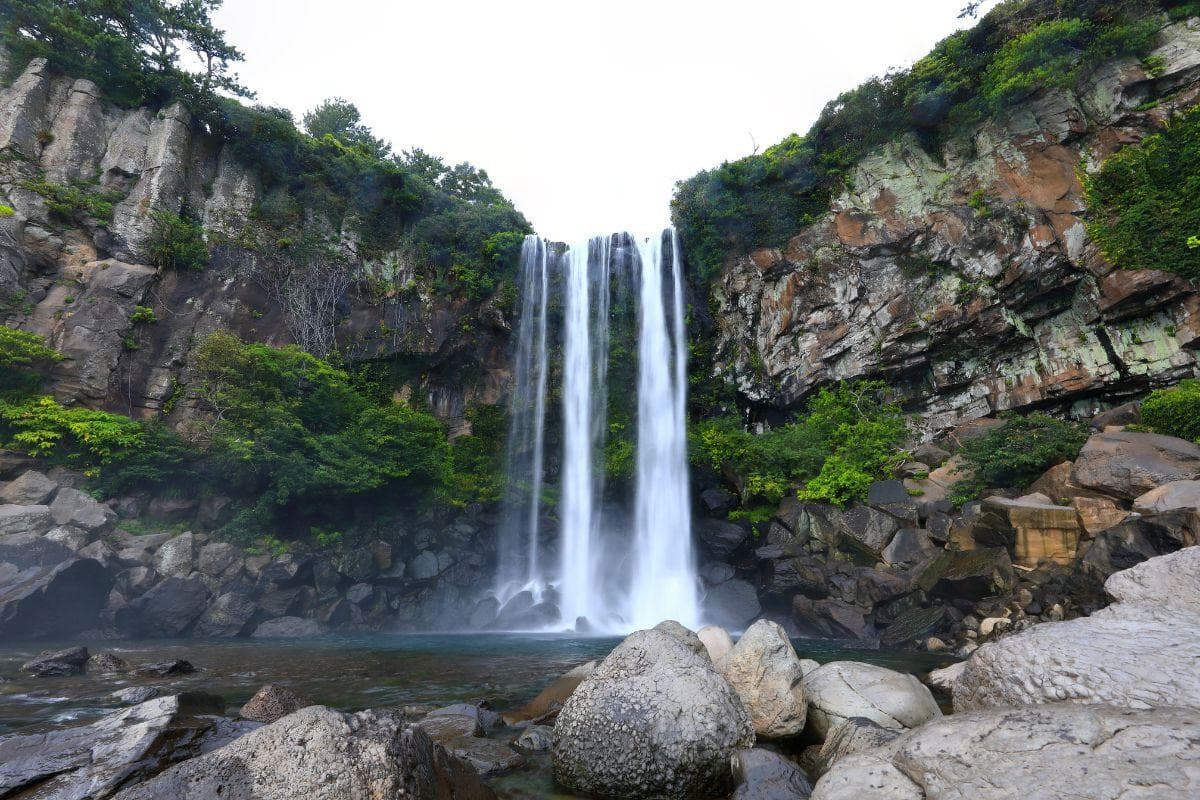
On a gray-misted morning the sea breathes right through Jeongbang Waterfall. Salt air threads the spray and the plunge of water becomes a percussion that drowns out the nearby road—until you step onto the viewing platform and the sound settles into something tactile, a steady heartbeat against basalt. From the cliff the cascade drops roughly 23 meters, slamming into a rocky coastal shelf and scattering foam toward the yawning blue of the Korea Strait. You feel small and steady at once: geology, tide, and human memory layered in the same place.
Jeongbang Waterfall sits on the southern side of Jeju Island in Seogwipo, one of the few falls in Asia that empties directly into the sea. That physical oddity is only part of its appeal. The surrounding coast is a ledger of volcanic episodes—columnar basalt outcrops and black lava rocks that funnel currents and shape the way spray and wind move around the cliff. For travelers with an appetite for both easy access and elemental drama, Jeongbang offers an immediate, coastal experience without a long hike: a short descent from the parking and a handful of viewing terraces put the spectacle within reach for almost everyone.
The place carries layers of local culture and legend. Jeju's haenyeo—the island’s famed women divers—have harvested these waters for centuries. Their freediving culture and stoic independence are woven into local identity and visible at nearby museums and coastal villages; seafood you’ll find in Seogwipo—abalone hot stone pot rice among them—comes with that history attached. Historically, Jeju’s landscape formed from towering volcanic activity; the basalt cliffs and the rounded oreums (small volcanic cones) are a reminder that the island is, geologically, still young.
Practicality is part of Jeongbang’s charm. It’s an accessible stop on many private and taxi-based island tours: combine it with Jusangjeolli’s hexagonal columns, the Haenyeo Museum, or a short Olle coastal walk to craft a day that is at once scenic and deeply local. Typical guided itineraries allow 45–90 minutes at Jeongbang—enough time to watch the tide, take photos from multiple angles, and walk the short coastal paths that thread toward Cheonjiyeon Waterfall and the Old Port of Seogwipo.
For hikers and photographers, timing matters. Morning light softens the basalt’s edges and, on calm days, the waterfall’s reflection pools with the slack tide; late afternoon brings stronger winds and a more dramatic spray against a setting sun. Rain and winter storms turn the site theatrical but also slippery—grip and caution are non-negotiable. The viewing platforms are well built but the rocks below are not: do not descend off marked paths to reach the water line.
If you have more time, the surrounding geography rewards longer plans: Sangumburi crater, Seongsan Ilchulbong (Sunrise Peak), and the island’s Olle trails are all within an easy drive. Many local operators offer half-day or full-day private tours that let you customize how long you linger at each stop; taxi tours are also a practical, budget-friendly way to see south and east Jeju without the logistics of a rental car. For travelers on a cruise layover, private highlight tours will make Jeongbang a stop on a tight schedule—just notify your driver ahead of time if you want to prioritize photography or a seaside coffee.
How to prepare: pack a lightweight rain shell and quick-dry layers, sturdy shoes with good traction, and a waterproof camera cover—spray will find every seam. Bring local currency for small parking fees, snacks, and the seafood stalls in Seogwipo. Respect the haenyeo traditions: ask before photographing divers, and consider visiting the Haenyeo Museum to learn more about the living culture that still harvests these waters.
In a single coastline sweep, Jeongbang Waterfall offers an elemental lesson: the island’s fire-born geology meets ocean in a performance that’s easy to access but never banal. It’s not a long trek or a remote expedition; it’s a place where time and tide meet culture and geology, and where a short visit can leave you wanting to return for the longer story of Jeju.
Practical snapshot: expect 45–90 minutes at the site, minimal elevation change (a few dozen steps from parking down to terraces), and strong coastal winds at certain times of day. Best gear: non-slip shoes, a windproof shell, and a camera you don’t mind getting misted. Combine Jeongbang with Jusangjeolli, the Haenyeo Museum, or a coastal Olle route for a full-day picture of southern Jeju.
Trail wisdom
Small choices, better day.
Aim for morning light
Visit early to avoid crowds and to get softer light on the basalt cliffs; tide and wind are often calmer then.
Grip-aware footwear
The viewing area and coastal rocks are slippery—wear shoes with good traction rather than flip-flops.
Respect the haenyeo
If divers are working nearby, observe from a distance and ask before photographing them—this is living culture, not a performance.
Combine nearby sights
Pair Jeongbang with Jusangjeolli or the Haenyeo Museum for a fuller half-day of geology and culture.
Local knowledge
Read the place, not just the route.
Watch for native species including Seabirds such as terns and cormorants, Intertidal fish visible in rock pools at low tide.
Keep an eye out for wildlife during the transition between areas and habitats. Respect distance guidelines.
Stay on marked paths and avoid removing stones or shells; support local businesses and cultural institutions that work with haenyeo cooperatives to help sustain traditional livelihoods.
Follow the guide's instructions on size limits, ethical handling, and leave-no-trace practices.
Jusangjeolli cliff formations a short drive away for dramatic basalt columns. Haenyeo Museum for context on Jeju’s women divers and local seafood culture
Locally recommended viewpoints and quiet spots known best to local operators.
Jeongbang sits within Seogwipo, a town shaped by maritime culture and volcanic geology; the haenyeo (women divers) from these waters have been harvesting seafood and shaping local culture for generations.
Maritime roots and regional tradition shape the waterways and working coasts.
Seasonal guide
Four versions of the same landscape.
Spring
Best forWildflowers near coastal paths · Moderate temperatures for walking
ChallengesUnpredictable showers · Windy days
Spring brings mild weather and coastal blossoms; bring a light waterproof layer for occasional rain and gusts.
Summer
Best forLush island greenery · Evening coastal walks
ChallengesHigh humidity · Crowds and midday heat
Summer is busy and humid—visit early or late in the day to avoid heat and peak crowds.
Fall
Best forClear skies & color · Optimal photography conditions
ChallengesCooler mornings · Stronger autumn winds at the coast
Autumn is the sweet spot: clear views, crisp air, and great light for photos; layer up for coastal breezes.
Winter
Best forDramatic seas and low-season solitude · Unique cloud formations
ChallengesCold winds, rough surf · Reduced services at some attractions
Winter offers solitude and dramatic waves—dress warmly and avoid getting too close to the water line during storms.
Pack with intention
What to bring.
Good to know
Common questions.
Most visitors spend 45–90 minutes at Jeongbang—enough time for photos, a short coastal walk, and a snack; combine with nearby sites for a half-day.
Plan the edges
The details that make the day easier.
Jeongbang Waterfall is one of the few waterfalls in Asia that falls directly into the ocean, a feature that makes it geographically unique and popular with visitors.
Seogwipo’s market stalls and seaside restaurants serve Jeju specialties—abalone hot stone pot, fresh seafood, and the island’s famed black pork. Visit the Haenyeo Museum or chat with local vendors to learn how diving traditions shape food and community.
- Time
- 45–90 minutes | Access: short walk from parking with steps | Cost: small parking
- access fee possible | Combine
- Jusangjeolli, Cheonjiyeon, Haenyeo Museum
Stick to marked paths, avoid taking natural souvenirs, reduce single-use plastics, and support local haenyeo cooperatives and vendors to help sustain both culture and coastline.
Explore by topic
Follow the threads.
Keep exploring
Make the story part of the trip.
Set out from Bass Harbor for a private, customizable day on Blue Hill Bay — lighthouses, puffins, seals, and the chance to feel Acadia from the water. Small groups, local captains, unforgettable views.
In four hours you can move from shaded canyon ferns to wind-scoured coastal ridgelines, guided by someone who knows where the light—and the hidden views—live. This private half-day hike on the Monterey Peninsula or Big Sur is compact, curated, and perfect for travelers who want depth without a multiday commitment.
 Related story
Beneath a sky of shifting light, Skaftafell’s ice reads like a map of time. This three-hour guided glacier hike mixes technical instruction with geology and culture: compact, safe, and unforgettable.