
What the day feels like
The water taxi eases into Glade Wharf with the soft, patient sigh of a fjord. Rain beads on the boat’s canopy one moment and falls through cathedral beech canopies the next; light in Fiordland is never static, shifting like an actor behind gauze. You step onto the dock with a small pack and a strange quiet—no roads, no hum of engines beyond the occasional ripple of a launch—only the track itself, threading from lake edge into the green heart of the South Island.
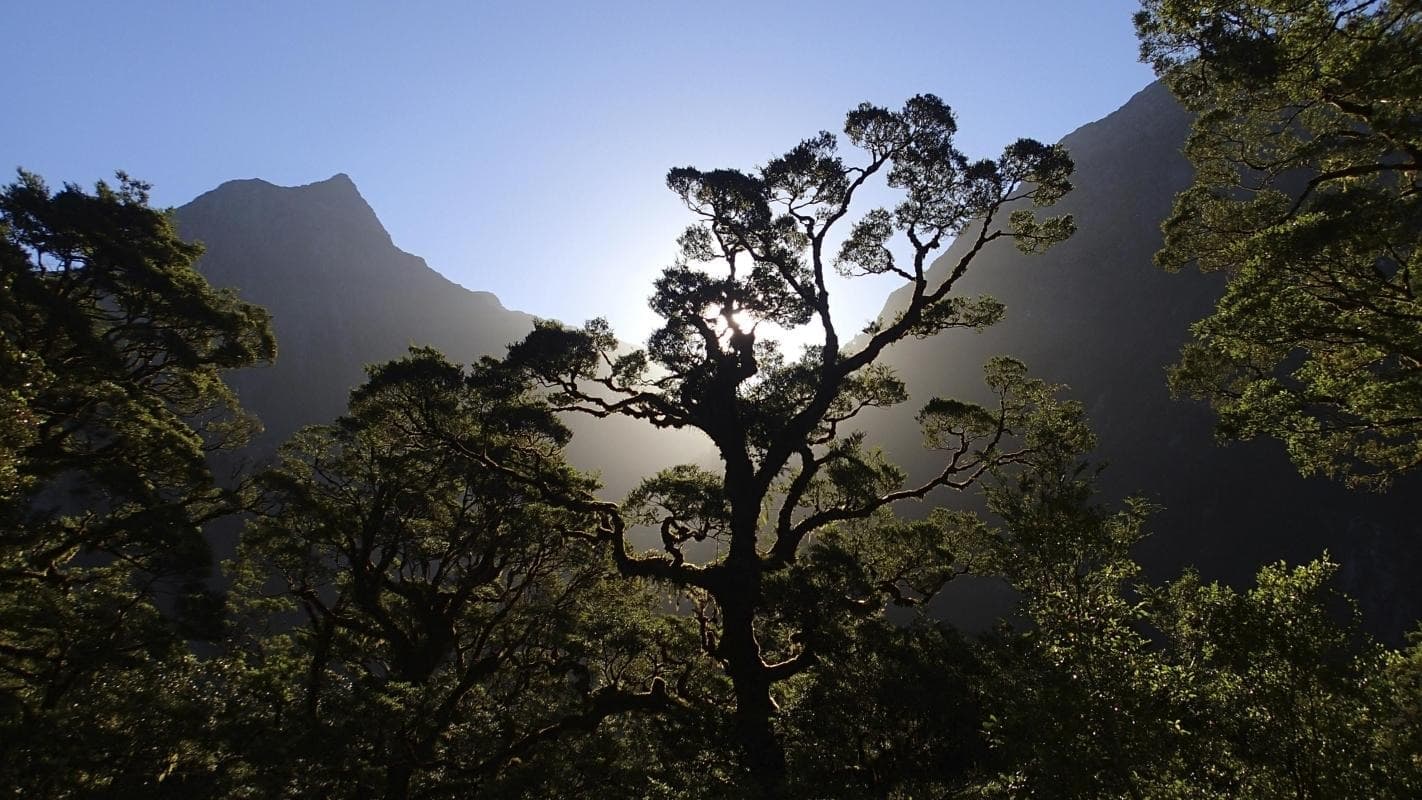
The Milford Track is that kind of walk: a measured retreat into one of the most intact tracts of temperate rainforest on earth. At 53.5 kilometers between Lake Te Anau and Milford Sound (Piopiotahi), it is commonly done as a 3–4 day tramp, although day-walk options from Lake Te Anau via water taxi let families and shorter-stay travelers taste a slice of the route without committing to huts and heavy packs. The flora is immediate—towering southern beech, mosses that look like hair draping every branch, and ferns that lay like green hands across the understory—while the geology is grand and blunt: steep mountains cleaved by ice, valley floors shaped by ancient glaciers, waterfalls that plummet with diplomatic indifference.
That plunging drama is nowhere more evident than at Sutherland Falls, which drops in dramatic tiers for roughly 580 meters and is visible on approaches to the Mackinnon Pass. The pass itself, the highest point on the track at roughly 1,100 meters, is the place the forest yields to alpine tussock and the scale of Fiordland’s mountain system becomes tangible. On a clear morning, the pass looks like a sharp, wind-swept spine; on a rain-streaked afternoon it pulls cloaks of cloud tight around itself, and you move through it as a weathered thing moves through a doorway.
The track has cultural and conservation layers too. This land is part of Te Wahipounamu, a UNESCO World Heritage area, and has been part of Ngāi Tahu customary use long before European surveyors arrived. European history layered on top of that with guided walks and early tourism, but today the Department of Conservation manages the Milford Track as one of New Zealand’s Great Walks: carefully maintained huts, booked quotas, and a logistics system that ensures the area’s ecological footprint stays as light as possible.
Two practical ways to experience this corridor of wilderness stand out. First, the classic multi-day tramp: you move steadily from hut to hut, carrying a daypack and leaving heavy kit to hut systems—know that huts fill early in the season and reservations are required. Second, more accessible options let you sample the track without the full immersion: a water taxi from Lake Te Anau drops you near the start for a day walk along the lower track, or you can book a helicopter transfer from Milford Sound Airport that skims the park’s sharp edges, giving aerial views of the track, hidden alpine lakes and the Sutherland Falls in one efficient sweep. Both options make the landscape legible in different frequencies—close and tactile on foot, grand and graphic from a helicopter.
If you go, be deliberate: Milford Track rewards pacing and preparation. Weather changes fast; a blue-sky plan can become an exercise in wet-weather endurance by dusk. Huts are comfortable but rustic—bring a cozy sleeping liner and a small personal towel. On the moves, trails vary from boardwalk through marshy forest to steep, stone-laid staircases up to the pass. River fords are usually bridged but water levels after heavy rain can alter conditions quickly. Hydration is easy (clear streams and hut water), but purification tablets or a lightweight filter offer reassurance.
Leave time for the details. Look for the small birdlife—tui and bellbirds dart through canopy gaps; kea may toy with pack straps in alpine sections, and if you’re still at dawn you could see a fantail dancing its erratic flight. Watch the undergrowth for native orchids and the laser-precision fall lines of moss. Sit by a river and count nothing. If your trip is a day walk, the water taxi option is a practical, family-friendly way to feel the track’s rhythm without the commitment of an overnight tramp. If you want to see the whole line in a single, sweeping perspective, a helicopter transfer gives you a cinematic corridor: mountain ridges, hanging valleys, and waterfalls that look like ink on paper.
Packing for Milford is less about maximalism and more about intelligent layering and redundancy: breathable rain shells, reliable boots, a headlamp, and a small first-aid kit. Book huts or day-boat seats well in advance in summer (the high season) and consider a guided operator if you prefer to leave logistics—permit booking, transfers, and nutrition plans—to someone else. Respect the DOC rules: limit fire use, practice Leave No Trace, and follow hut etiquette to preserve the route for everyone.
For anyone whose ideal trip balances challenge with comfort, who wants silence without austerity, Milford Track is a rare offering. It’s a place that politely demands attention: you move through it and it accumulates into your memory not as a single scene but as a stacked portfolio of sensations—cold river spray on hands, the creak of old beech trunks in wind, the horizontal rain that feels like it’s resetting the world. Whether you walk the entire route, take the water taxi for a day, or get a helicopter’s sweeping vantage, you’ll come away with a clear impression: this is landscape made to slow you down, and if you listen, it will speak in the simple, uncompromising language of rock, water and long-standing forest.
Trail wisdom
Small choices, better day.
Book huts and transfers early
Milford Track huts and water taxis fill quickly in summer; reserve months in advance through DOC and operators.
Layer for variable weather
Bring a breathable waterproof shell and mid-layer—conditions change rapidly from lake edge to Mackinnon Pass.
Carry a small daypack for essentials
If you’re doing a day walk, bring water, snacks, a headlamp and lightweight rain gear even for short outings.
Respect hut etiquette
Keep noise low, store food in designated areas and follow DOC rules to protect the track’s fragile ecosystem.
Local knowledge
Read the place, not just the route.
Watch for native species including tui, kea.
Keep an eye out for wildlife during the transition between areas and habitats. Respect distance guidelines.
Quotas, hut systems and permitted transport limit human impact; follow Leave No Trace, use designated hut facilities and book through DOC or approved operators.
Follow the guide's instructions on size limits, ethical handling, and leave-no-trace practices.
Early-morning reflections on Lake Te Anau—glass-smooth water mirrors mountain silhouettes. The moss-draped side-valleys off the main track—quiet, less-traveled micro-ecosystems
Locally recommended viewpoints and quiet spots known best to local operators.
The Milford Track is part of Te Wahipounamu and has long been a travel route; it later became one of New Zealand’s signature Great Walks under DOC management.
Maritime roots and regional tradition shape the waterways and working coasts.
Seasonal guide
Four versions of the same landscape.
Spring
Best forwildflower displays · fewer crowds · birdsong
Challengesunpredictable weather · muddy trail sections · cool nights
Spring brings fresh greens and fewer people but expect variable conditions—pack warm layers and waterproofs.
Summer
Best forlong daylight hours · easier trail conditions · full hut services
Challengescrowds · higher temps and UV · early bookings required
Summer (Dec–Feb) is peak season with stable trail conditions; book huts and transport well in advance.
Fall
Best forautumn colors · quieter trails · crisp air
Challengesshorter daylight · increasing rain · some services reduce frequency
Fall offers vivid light and thinner crowds but cooler days and earlier sunsets—plan your daily mileage accordingly.
Winter
Best fordramatic snow-dusted scenery · solitude · auroral light
Challengessnow and ice on Mackinnon Pass · limited hut services · short daylight
Winter is for experienced, well-prepared trampers; expect snow at higher elevations and reduced logistics support.
Pack with intention
What to bring.
Good to know
Common questions.
Yes—overnight huts and quotas are managed by DOC; book huts and any water taxi or transport months ahead during peak season.
Plan the edges
The details that make the day easier.
The Milford Track runs 53.5 km between Lake Te Anau and Milford Sound and is one of New Zealand’s famous Great Walks, frequently described as one of the world’s finest day-to-day tramps.
Te Anau is the main gateway town—expect local cafes serving venison and fresh southern seafood, small outfitters offering guided trips, and a community invested in conservation and responsible tourism.
- Distance
- 53.5 km; Typical duration: 3–4 days; Book huts
- water taxis through DOC or operators; Options
- full multi-day tramp, day-walk water taxi, helicopter transfers; Nearest town: Te Anau.
Stick to the track, use hut facilities and carry out all non-biodegradable waste; choose certified operators for water taxis and helicopter flights to support low-impact practices.
Explore by topic
Follow the threads.
Keep exploring
Make the story part of the trip.
Set out from Bass Harbor for a private, customizable day on Blue Hill Bay — lighthouses, puffins, seals, and the chance to feel Acadia from the water. Small groups, local captains, unforgettable views.
In four hours you can move from shaded canyon ferns to wind-scoured coastal ridgelines, guided by someone who knows where the light—and the hidden views—live. This private half-day hike on the Monterey Peninsula or Big Sur is compact, curated, and perfect for travelers who want depth without a multiday commitment.
 Related story
Beneath a sky of shifting light, Skaftafell’s ice reads like a map of time. This three-hour guided glacier hike mixes technical instruction with geology and culture: compact, safe, and unforgettable.