
What the day feels like
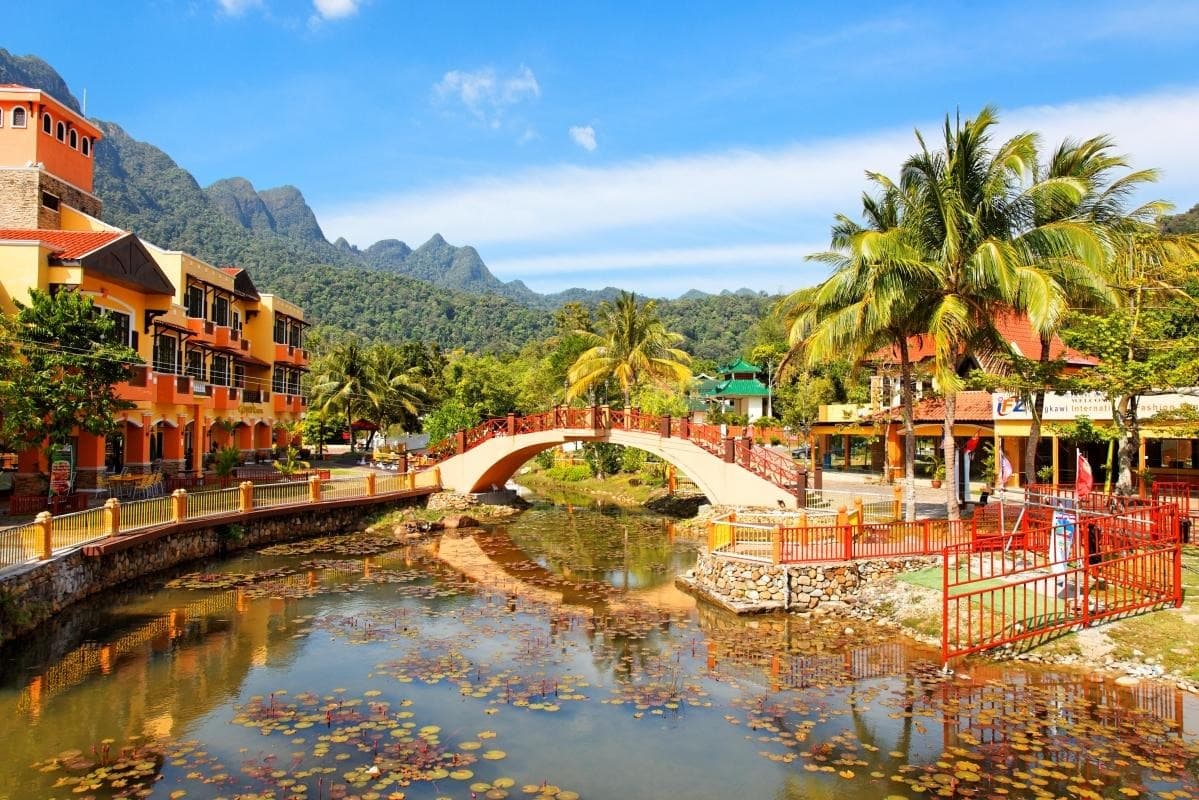
The first time you step into Oriental Village Langkawi the mountain announces itself before you see it: Machinchang rising like an old spine of stone, cloaked in rainforest and fog that parts just enough to reveal a ribbon of cable climbing its flank. The village sits at that mountain’s foot—a tidy, sun-dappled courtyard ringed with craft stalls, 3D art, and cafés—yet every direction points uphill. The planet here has a way of persuading you to look up.
A typical visit begins with a gondola that feels like a promise. The Langkawi SkyCab lifts you more than 600 vertical meters in roughly 15 minutes; below, the forest thins into chasms and a scattering of islets dissolves into the Andaman Sea. At the top station, the Langkawi Sky Bridge arcs across a gorge—124 meters of curved suspension that lets you walk above the canopy and watch clouds push themselves through rocky teeth. The sensation is practical and elemental: vertigo stitched to perspective.
Oriental Village is not a single attraction but a clever staging ground. Built around a small lake and a neat square of shops and eateries, it’s where families stock up on cold drinks, where photographers set up tripods, and where cliffside adventures begin. Beyond the cable car you can thread into easy trails, descend to Telaga Tujuh (Seven Wells) waterfall, or choose a 90-minute ATV ride that punches through jungle tracks and past braided streams. For those who want water and geology over adrenaline, half-day mangrove cruises through the Kilim Geoforest Park—home to dramatic limestone outcrops and a roar of birdlife—are easy to add to the itinerary.
The story of Langkawi’s mountain is older than the tourist infrastructure. Machinchang is part of the Mat Chincang formation, one of Southeast Asia’s oldest exposed rock sequences, dated to several hundred million years ago. That deep time gives the island’s karst towers their patient, weathered look—and it’s precisely why the area was designated part of the Langkawi UNESCO Global Geopark. The stones here tell a slow story of uplift, sea level change, and tropical weathering. Locals weave different narratives: myths of eagles and spirits, of fishermen guided by stars across the archipelago. Oriental Village sits at the intersection of these narratives, a modern launching pad for natural history and local life.
Practically speaking, the village works because it concentrates the essentials. Ticket desks, visitor centers, and shuttle services simplify getting onto the SkyCab (there are often express or priority options through many tour operators). The cable car route has two mid-stations and several viewing platforms, but the top station is where most people linger—two open-air decks give 360-degree views and the SkyGlide inclinator offers an alternate route to the walking path for those who prefer less climbing.
The walk across the Sky Bridge is an experience that is part architecture, part weather. On a windless morning it feels like a placid suspension of time; later in the afternoon, a sea-breeze makes the bridge sway and the view unspool in dramatic bands of light. If you’re nervous about heights, time your visit early—mornings are cooler and less crowded—or choose the glass-panel-free sections of the bridge. For families with small children, note that the bridge has screened sections but still requires attention: children move fast, and the drop is real.
Food at Oriental Village leans to approachable Malaysian classics—banana leaf rice, grilled seafood, and thick, iced teh tarik—served at open-air stalls that often double as people-watching platforms. Vendors sell inexpensive sarongs, hand-carved trinkets, and functional souvenirs. If you want a quieter meal, drive 15–20 minutes to Tanjung Rhu for soft sand and calmer waters, then return to the village for a late-afternoon cable car ride when the light turns buttery.
What makes Oriental Village a useful base is choice: you can spend two calm hours browsing stalls and sipping coffee, or string together a full day of distinct experiences—cable car, Sky Bridge, Durian Perangin waterfall, an ATV run, and a mangrove cruise—without wasting hours in transit. For independent travelers, shared full-day tours offer a budget-friendly way to access priority tickets to the SkyCab that beat long on-site lines. Private tours are a smart option for cruise passengers with tight shore schedules; many include express lane access to the SkyCab.
Practicalities you’ll care about: arrive early (opening at ~9 a.m.) to avoid queues and the midday heat; wear sturdy shoes if you plan to hike or take an ATV; carry reef-safe sunscreen and a water bottle—Langkawi sun is efficient. If you’re visiting during the monsoon period, expect short, heavy showers; many vendors are prepared, but some trails and the ATV sections may close with poor weather. Finally, respect wildlife—monkeys in the village are clever and persistent; don’t feed them.
Oriental Village Langkawi is an ideal day’s architecture: part natural theater, part activity hub. It’s not remote wilderness, and you won’t leave smelling of smoke and sweat; instead, the place teaches a different, modern kind of travel skill: how to layer experiences—aloft and on the ground, shallow bay and limestone canyon—into a single clear day. If you like your adventure with a practical edge—a sky bridge that thrills but is engineered, a cable that removes a long climb, an ATV that gets you muddy without a long approach—Oriental Village is purposeful and generous. The mountain asks for a little effort and gives back wide angles, and for many travelers, that exchange is precisely why they plan a trip here.
Trail wisdom
Small choices, better day.
Beat the lines
Arrive at opening (around 9 a.m.) to avoid long SkyCab queues and afternoon heat; tour operators offering express tickets can save hours.
Footwear matters
Wear closed-toe shoes with grip for ATV sections and rocky trails around Telaga Tujuh and the mountain paths.
Protect against sun and rain
Bring reef-safe sunscreen and a lightweight rain shell—the weather can switch quickly, and the sun is strong even in cloud.
Respect wildlife
Don’t feed the macaques and keep food stowed—monkeys are bold and can damage bags or injure if provoked.
Local knowledge
Read the place, not just the route.
Watch for native species including long-tailed macaque, Brahminy kite and other coastal raptors.
Keep an eye out for wildlife during the transition between areas and habitats. Respect distance guidelines.
Oriental Village sits on the edge of the Langkawi UNESCO Global Geopark; respect marked trails, use reef-safe sunscreen, and choose licensed guides to support sustainable tourism.
Follow the guide's instructions on size limits, ethical handling, and leave-no-trace practices.
Telaga Tujuh (Seven Wells) waterfall trails—short hikes lead to quiet pools. Black Sand Beach—small and less visited, good for sunset photos
Locally recommended viewpoints and quiet spots known best to local operators.
The Mat Chincang formation that forms Gunung Machinchang is one of the island’s oldest rock formations, exposing half-billion-year-old sedimentary and metamorphic layers.
Maritime roots and regional tradition shape the waterways and working coasts.
Seasonal guide
Four versions of the same landscape.
Spring
Best forfewer crowds · early-morning photography
Challengesintermittent showers · increased humidity
March–May brings rising humidity and sporadic thundershowers; mornings are generally clear and ideal for photos and the SkyBridge.
Summer
Best formangrove cruises · longer daylight for multi-activity days
Challengeshotter temperatures · occasional heavy rain
June–August is hotter and more humid—plan early starts and expect afternoon downpours that can disrupt ATVs and some trails.
Fall
Best forlusher rainforest colors · less predictable crowds
Challengesstart of monsoon variability · short storms possible
September–November sees increasing rainfall; the forest is vivid, but boat trips and some activities may be altered by weather.
Winter
Best fordry, clear views · optimal cable car conditions
Challengeshigher visitor numbers during holiday windows · limited availability if busy
December–February is often the driest and clearest period—excellent visibility from the SkyCab and comfortable mornings for hikes.
Pack with intention
What to bring.
Good to know
Common questions.
The SkyCab ride takes about 12–15 minutes from base to top station, including brief pauses as cars load and unload at mid-stations.
Plan the edges
The details that make the day easier.
The Mat Chincang mountain range at Langkawi is part of one of Southeast Asia’s oldest exposed rock formations, with layers dating back hundreds of millions of years—contributing to the island’s UNESCO Global Geopark status.
Oriental Village blends Malay coastal food—grilled seafood and banana leaf rice—with local crafts from Kedah; nearby Kuah town offers seafood restaurants and pasar malam night markets for authentic bites.
- Getting there
- 20–30 minutes from Kuah by car; opening hours typically start around 9 a.m.; combination tours available for SkyCab, SkyBridge, ATV and mangrove cruises; expect security checks and queueing at peak times.
Support licensed local guides, avoid single-use plastics by bringing refillable bottles, use reef-safe sunscreen, and refrain from feeding or interacting with wildlife to minimize human impact.
Explore by topic
Follow the threads.
Keep exploring
Make the story part of the trip.
Set out from Bass Harbor for a private, customizable day on Blue Hill Bay — lighthouses, puffins, seals, and the chance to feel Acadia from the water. Small groups, local captains, unforgettable views.
In four hours you can move from shaded canyon ferns to wind-scoured coastal ridgelines, guided by someone who knows where the light—and the hidden views—live. This private half-day hike on the Monterey Peninsula or Big Sur is compact, curated, and perfect for travelers who want depth without a multiday commitment.
 Related story
Beneath a sky of shifting light, Skaftafell’s ice reads like a map of time. This three-hour guided glacier hike mixes technical instruction with geology and culture: compact, safe, and unforgettable.