
What the day feels like
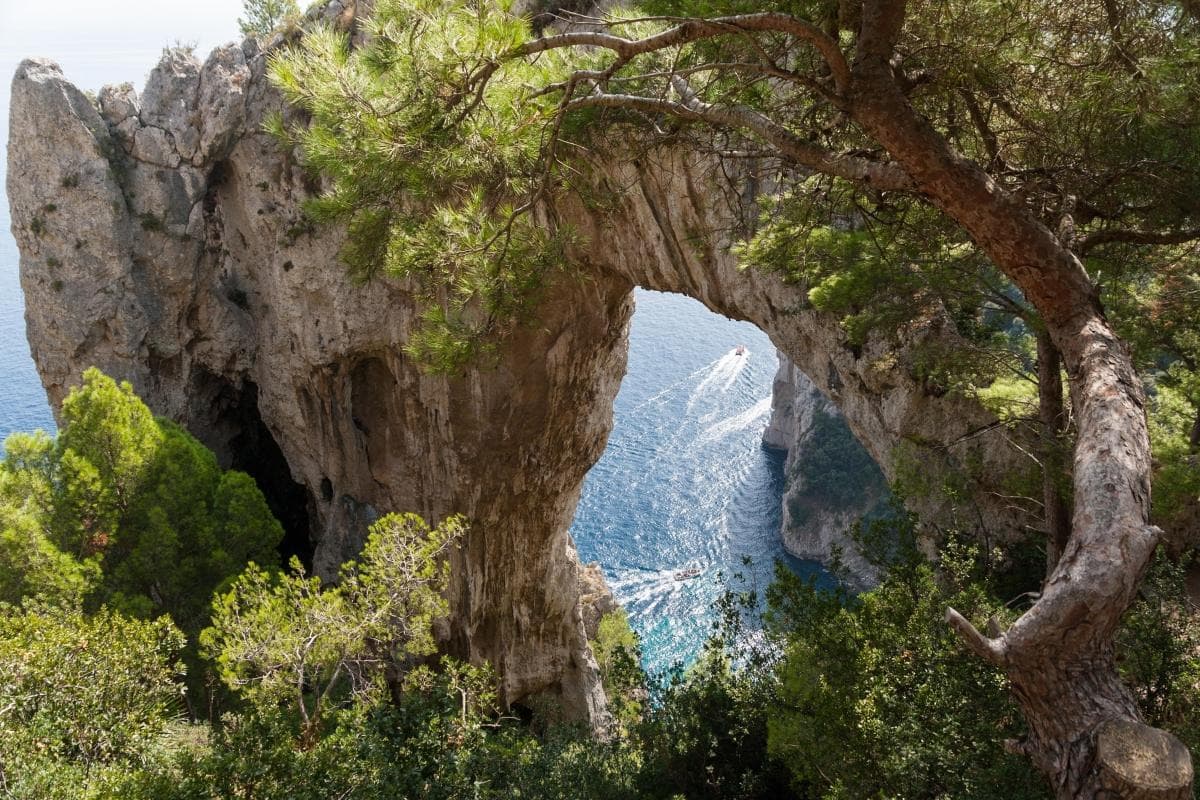
The sky above Capri that morning was the color of a borrowed shirt — pale, clean, studded with gulls. You reach the Arco Naturale the way most people do: with a little effort and a lot of reward. From the piazza the route bends and narrows, stone steps cut long before tourism, the limestone warm underfoot. Then the island opens up, and the arch appears like an old door left ajar to the sea. Waves court the rock below, bubbling and clicking as if in conversation. The arch frames the distant Faraglioni like a photograph hung in a museum but alive with traffic: skiffs, yachts, and the occasional stubborn fisherman refusing to let the day's calm go to waste.
Capri’s Natural Arch — Arco Naturale — is more than a postcard prop. It's geology written in negative space: the remnant of a collapsed sea cave, carved by a thousand small tides and the patient insistence of the Mediterranean. Up close you can see the striations in the limestone, whispers of its marine past where shells and fossilized fragments lend texture to cliffs now full of wild rosemary and the odd tenacious fig tree. From the top of the arch the sea is a bowl of shifting blues; from beneath it, the world is a vault of sound, surf and wind harmonizing into something you feel more than hear.
History sits lightly here. Romans favored Capri as a retreat — the ruins of villas and ancient grottos are scattered along the coast — and the arch itself has been a landmark for sailors and writers for centuries. Local stories braid myth and fact: the sea caves were once landing points for secretive arrivals; the Faraglioni reappear in tales about sirens and exile. More recently, Capri's reputation as a playground for artists and aristocrats in the 20th century added another layer: photographers and painters used the arch and surrounding cliffs as shorthand for the island’s blend of rugged nature and cultivated leisure.
For travelers today the Arco Naturale fits into two complementary experiences. Most visitors pair a short cliff walk or a modest hike from Capri’s small towns with boat time. From the sea the arch reads like architecture — a doorway — while from the path above it becomes a natural belvedere. Boat tours described in local listings — everything from hour-long private wooden-boat cruises to full-day circumnavigations — repeatedly highlight the arch on their itineraries. Tours like the “Guided day by boat to the Secrets of the Island of Capri,” sunrise breakfast launches that let the early light gild the rocks, and 3-hour private tours out of Capri or Positano all promise views and swims around the arch and nearby grottoes.
Why choose one approach over the other? On land you trade intimate geological detail for a quieter perspective and a chance to feel the arch’s scale; by sea you get cinematic sweeps and the privilege of dropping anchor for a swim in water that is often startlingly clear. Most boat skippers will steer close enough for photography, but remember: the Blue Grotto and some other caves require timing and sometimes an additional ticket; tides and wind can dictate what’s possible on any given day.
Practical ground truth: getting to the Arco Naturale is straightforward but not hyper-accessible. From Capri town or nearby Anacapri the walk takes about 20–40 minutes depending on your pace and starting point. The path includes uneven limestone, short stair sections, and patches of loose rock; expect an elevation gain of roughly 50–100 meters for the most direct routes and plan about 1–1.5 hours for a relaxed return trip with time to linger. If you prefer the water route, nearly every private or small-group boat tour includes a pass by the arch — the half-day and full-day options give you time to swim and explore other grottoes like the White or Green grotto nearby.
Essentials for planning: go early or late in the day to avoid mid-day crowds and to catch the light at its most flattering for photography. Wear shoes with good traction for the walk; the limestone can be slippery, especially after brief showers. Bring a light wind layer — the sea breeze sharpens once you crest the cliffs — and a reusable water bottle: Capri’s cafés are charming but pricey and sometimes crowded. If you plan to swim from a boat, bring a quick-dry towel, reef-safe sunscreen, and a mask and snorkel; many private boats supply snorkeling gear but sizes vary.
Safety notes are simple: don’t clamber on the arch itself — stable-looking rock can be deceptive — and respect signage that closes off fragile cliff-top edges. On water, obey your skipper’s instructions: currents near caves and undercut cliffs can pull unsuspecting swimmers.
Locals will tell you that the best moments happen off-schedule: a morning row before the ferries, an evening when the town’s lights blink on and the island breathes a little quieter. Pair your visit with a slow lunch in Capri’s Piazzetta — try a simple insalata caprese and a glass of local white — or take a short hike to nearby viewpoints like Belvedere di Tragara for a broader sweep of the coast. For photographers, the arch at golden hour frames the Faraglioni with an old-world symmetry; for swimmers, the buoyant Mediterranean invites exploration of the coves tucked beneath the cliffs.
In the end, the Arco Naturale is a lesson in scale and patience. It asks only that you arrive with modest curiosity and leave with an awareness of how sea, stone and human history have edited one another here. Whether you choose to approach it on foot or from a boat, it rewards those who slow down and look closely.
Trail wisdom
Small choices, better day.
Wear grippy shoes
Limestone steps and switchbacks can be slick—sturdy trail shoes or grippy sneakers protect ankles and traction.
Combine land and sea
See the arch from the trail for detail, then book a short private boat tour to swim and photograph it from the water.
Mind the light
Plan visits at sunrise or late afternoon for softer light and fewer crowds — Blue Grotto access is often calmer in the morning.
Bring water & shade
Limited shade on the approach; carry at least 1L water per person and a hat during warmer months.
Local knowledge
Read the place, not just the route.
Watch for native species including Mediterranean shearwaters, lizards and island-endemic insects among the rocks.
Keep an eye out for wildlife during the transition between areas and habitats. Respect distance guidelines.
Erosion and rising visitor numbers stress fragile cliff ecosystems — stick to trails, avoid trampling plants, and choose small, eco-conscious boat operators.
Follow the guide's instructions on size limits, ethical handling, and leave-no-trace practices.
Belvedere della Migliera — a quieter viewpoint with a sweeping panorama. Small coves east of the arch accessible by kayak or private boat for secluded swims
Locally recommended viewpoints and quiet spots known best to local operators.
Capri has been favored since Roman times as a retreat; the island’s geological features, including the arch, were shaped by sea-level changes and millennia of wave action.
Maritime roots and regional tradition shape the waterways and working coasts.
Seasonal guide
Four versions of the same landscape.
Spring
Best forwildflowers & fewer crowds · comfortable hiking temperatures · ideal boat conditions
Challengesoccasional rain · cool mornings
Spring offers mild temperatures, blooming cliff-side herbs, and fewer visitors — excellent for combining a walk and a boat trip.
Summer
Best forswimming & snorkeling · long daylight hours
Challengeshigh heat & crowds · higher boat traffic
Summer is peak season: perfect water for swimming but busiest on trails and in piazzas — book early.
Fall
Best forcalmer seas for boat tours · warm water after summer · lower accommodation prices
Challengesshortening days · sporadic autumn storms
Fall balances warm sea temperatures with thinner crowds; afternoons still feel summery but plan for cooler evenings.
Winter
Best forquiet island walks · cheaper lodging
Challengesreduced boat services · windier sea conditions
Winter is the quietest time to visit; expect limited boat tours and cooler, windier weather — the arch is dramatic but less accessible by water.
Pack with intention
What to bring.
Good to know
Common questions.
From Capri or Anacapri, walk 20–40 minutes along marked trails and stone steps; alternatively, most boat tours circumnavigating Capri pass the arch.
Plan the edges
The details that make the day easier.
The Arco Naturale is the remnant of a collapsed sea cave — its formation is the result of wave erosion against limestone over thousands of years, a common process shaping Capri’s coastline.
Capri blends rugged coastal landscape with refined island culture: sample limoncello made from local Sfusato lemons, savor a simple caprese paired with local white wine, and watch fishermen mend nets in Marina Grande for a sense of daily island life.
- Nearest ferry ports
- Marina Grande (Capri) or Sorrento
Choose small-group or private boats with responsible waste policies, avoid single-use plastics, keep to marked trails to protect endemic plants, and support local businesses that invest in sustainable tourism.
Explore by topic
Follow the threads.
Keep exploring
Make the story part of the trip.
Set out from Bass Harbor for a private, customizable day on Blue Hill Bay — lighthouses, puffins, seals, and the chance to feel Acadia from the water. Small groups, local captains, unforgettable views.
In four hours you can move from shaded canyon ferns to wind-scoured coastal ridgelines, guided by someone who knows where the light—and the hidden views—live. This private half-day hike on the Monterey Peninsula or Big Sur is compact, curated, and perfect for travelers who want depth without a multiday commitment.
 Related story
Beneath a sky of shifting light, Skaftafell’s ice reads like a map of time. This three-hour guided glacier hike mixes technical instruction with geology and culture: compact, safe, and unforgettable.