
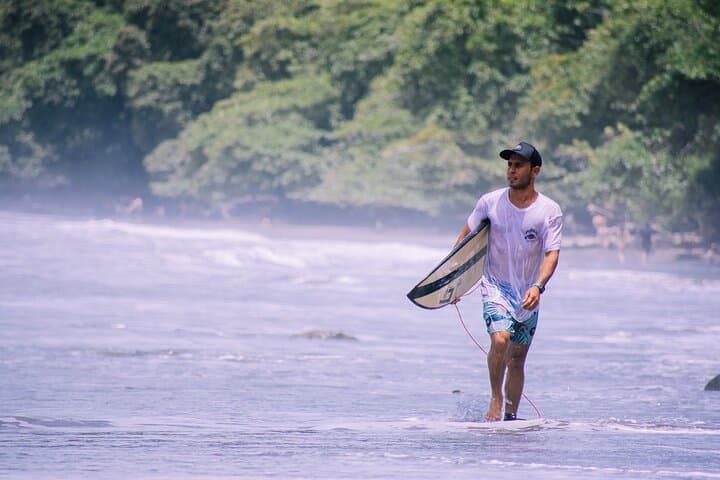
What the day feels like
The morning wind off the Pacific in Puntarenas is a soft punctuation, not yet strong enough to ruffle the surface where the surf gathers into clean, rolling sets. You push past the tide line with a borrowed soft-top and a careful instructor at your shoulder, and the ocean seems to take the measure of you—testing balance, breath, and attention. Two hours later, when you pop to your feet for the first time and ride a patch of green water toward the sand, that quiet Pacific has changed shape: what felt distant becomes immediate, personal, and a little addictive. That is the promise of a private surf lesson at Playa Hermosa near Dominical, where a two-hour, tailored session with a dedicated coach distills years of local knowledge into a few decisive cues.
Playa Hermosa in the Dominical area is quieter than the more famous breaks north and south, a sand-bottom entry favored by instructors for its predictable whitewater and forgiving shore. Surf culture arrived on Costa Rica’s southern Pacific in the 1970s and 1980s with a mix of ex-pats and visiting surfers, and towns like Dominical grew up around tides and swells. The geology here—long, sediment-rich beaches carved by river runoff and reshaped by the seasonal swell—creates both gentle beginner zones and steeper, more powerful peaks when the south swells roll in. Local instructors read that geology like a book: where the sandbars will form, when the current will sweep, which set will offer a forgiving green face for a first pop-up.
There’s a cultural beat to a lesson that’s worth noting. Local surf schools in the Dominical region tend to be small and personal. Many are family-run and tied to the rhythms of place—tidal schedules, day laborers hauling nets, and restaurants opening at sunrise to feed early surfers. A private lesson here isn’t just technique; it’s an introduction to etiquette—how to share waves, how to respect the line-up, and how to leave the beach as you found it. That ethos is why small operators often advertise private or group lessons with free cancellation and carefully matched instructor-to-student ratios: they want you learning the sport without feeling threatened by crowds.
For travelers, the practical upside is obvious: a two-hour class (this one runs about 120 minutes) is long enough to make measurable progress but short enough to fit between travel plans. Instructors bring soft-top boards and leashes, guide you through water safety and the pop-up sequence on sand before you attempt it in the whitewater, and keep lessons focused on repetition and encouragement. The typical beginner session emphasizes paddle technique, timing, pop-up mechanics, and reading a breaking wave—skills that translate to confidence the moment you untether that leash.
If you’re planning a lesson, timing is everything. Early mornings are generally best—light winds, cleaner faces, and the beach still mostly quiet. During Costa Rica’s dry season (December through April), the Pacific delivers more consistent offshore conditions that favor clean, rideable waves; the green season (May–November) brings larger, less predictable swells and afternoon winds that can make learning harder. That said, Playa Hermosa’s sand-bottom entry makes it one of the more forgiving options for year-round instruction.
Safety and comfort matter. Bring reef-safe sunscreen and a rashguard, hydrate well before you paddle out, and tell your instructor if you have any neck, shoulder, or back issues—surfing can be deceptively physical. Expect to get salty, tired, and at least a little bruised at first; by the end of the session you’ll have a feel for the ocean’s cadence and an honest sense of the next skill to practice.
Beyond the lesson, Dominical rewards slow exploration. Nearby attractions include the Marino Ballena National Park with its famous Whale’s Tail sandbar and the Nauyaca Waterfalls inland—both excellent places to cool down after a surf. Wildlife punctuates the landscape: howler monkeys and toucans are common in the trees, and humpback whales pass the coast seasonally. Local eateries range from small 'sodas' serving casado plates to beachside spots pouring cold local beer; surf culture here favors simple seafood, rice, beans, and plantain—food that refuels.
For anyone tempted by the idea of standing on a board for the first time, a private surf lesson at Playa Hermosa is a low-barrier, high-reward entry point. It’s practical—two hours, professional coaching, and gear provided—and soulful: you leave with more than a skill; you leave with a better sense of how this part of the Pacific moves and why surfers keep coming back. To book a tailored session with local instructors who prioritize safety and progression, check out this private surf lesson option at Playa Hermosa, Dominical: <a href="https://app.advcollective.com/local-experts/private-surf-lesson-at-playa-hermosa-dominical-learn-to-ride-costa-rica-waves">private surf lesson</a>.
A final note: surf learning is iterative. Two hours is enough to stand, to feel progress, and to catch a few small waves. Return for another session and that early success compounds quickly. If you leave Dominical without mastery, you’ll likely leave with a plan to come back.
Practical snapshot: lessons here typically start from USD 99 for a two-hour private session, include board and leash, and often allow free cancellation. Bring a sense of patience, a willingness to get wet, and a camera for the shore shots when you finally connect with a wave.
Trail wisdom
Small choices, better day.
Book an early slot
Schedule lessons at dawn for cleaner waves and lighter winds—conditions that make learning easier.
Use reef-safe sunscreen
Protect skin and the marine environment by choosing biodegradable, reef-safe SPF.
Hydrate and snack
Bring water and a light carbohydrate snack; paddling is deceptively taxing and energy helps progress.
Communicate injuries
Tell your instructor about past shoulder, neck, or back issues so they can adapt coaching.
Local knowledge
Read the place, not just the route.
Watch for native species including Howler monkeys, Humpback whales (seasonal).
Keep an eye out for wildlife during the transition between areas and habitats. Respect distance guidelines.
Marino Ballena and nearby coastal zones are protected; visitors should use reef-safe sunscreen, avoid stepping on corals, and pack out all trash.
Follow the guide's instructions on size limits, ethical handling, and leave-no-trace practices.
Nauyaca Waterfalls (a cooling freshwater swim inland). Marino Ballena National Park and the Whale’s Tail sandbar at low tide
Locally recommended viewpoints and quiet spots known best to local operators.
Surfing became an identifiable part of Dominical’s culture in the latter 20th century as travelers and ex-pats popularized the region’s breaks.
Maritime roots and regional tradition shape the waterways and working coasts.
Seasonal guide
Four versions of the same landscape.
Spring
Best forClean morning conditions · Consistent beginner-friendly surf
ChallengesOccasional larger south swells · Higher visitor numbers around holidays
Late dry season (Mar–Apr) offers warm water and reliable offshore mornings—excellent for learners who want cleaner faces.
Summer
Best forLess crowded beaches · Good cross-season practice
ChallengesAfternoon winds · Chance of larger swells during storms
Early summer maintains warm water but expect stronger winds later in the day; morning lessons still perform best.
Fall
Best forPowerful swells for progression · Photo-worthy lines
ChallengesHeavier rains in green season onset · Increased current risk
Transition into green season brings bigger surf; ideal for intermediate learners under instructor guidance.
Winter
Best forConsistent offshore conditions · Dry-season reliability
ChallengesPeak tourist season (Dec–Jan) · Higher prices and busier roads
Dry season is the most predictable for clean, learnable conditions—book ahead for prime slots.
Operator details
What the booking data adds.
Included
- ✓Snacks
- ✓Surfboard with wax
Good to know
- ✓Infants and small children can ride in a pram or stroller
- ✓Service animals allowed
- ✓Public transportation options are available nearby
- ✓Not recommended for travelers with spinal injuries
- ✓Not recommended for pregnant travelers
- ✓Not recommended for travelers with poor cardiovascular health
- ✓Travelers should have at least a moderate level of physical fitness
Pack with intention
What to bring.
Good to know
Common questions.
No—lessons are designed for beginners through intermediate surfers; instructors tailor drills to your level.
Plan the edges
The details that make the day easier.
Marino Ballena National Park, just south of Dominical, features a natural sandbar shaped like a whale’s tail that appears at low tide and is one of Costa Rica’s signature coastal formations.
After a lesson, head into Dominical for a casado or fresh ceviche at a local soda and finish with a cold Imperial at a beachside bar. The town’s eateries emphasize fresh seafood and hearty, local plates—perfect after a morning in the water.
- Closest international airport
- Juan Santamaría Intl. (SJO) ~3.5–4 hours drive; regional flights to Quepos (XQP) shorten travel; nearest trailhead: Playa Hermosa beach parking; driving from Dominical town is under 15 minutes; cell service: patchy in some beach coves; permits: none required for surfing lessons.
This coastline includes protected marine areas—use reef-safe sunscreen, pack out trash, avoid stepping on sensitive intertidal zones, and support local operators who practice low-impact tourism.
Explore by topic
Follow the threads.
Keep exploring
Make the story part of the trip.
Set out from Bass Harbor for a private, customizable day on Blue Hill Bay — lighthouses, puffins, seals, and the chance to feel Acadia from the water. Small groups, local captains, unforgettable views.
In four hours you can move from shaded canyon ferns to wind-scoured coastal ridgelines, guided by someone who knows where the light—and the hidden views—live. This private half-day hike on the Monterey Peninsula or Big Sur is compact, curated, and perfect for travelers who want depth without a multiday commitment.
 Related story
Beneath a sky of shifting light, Skaftafell’s ice reads like a map of time. This three-hour guided glacier hike mixes technical instruction with geology and culture: compact, safe, and unforgettable.