
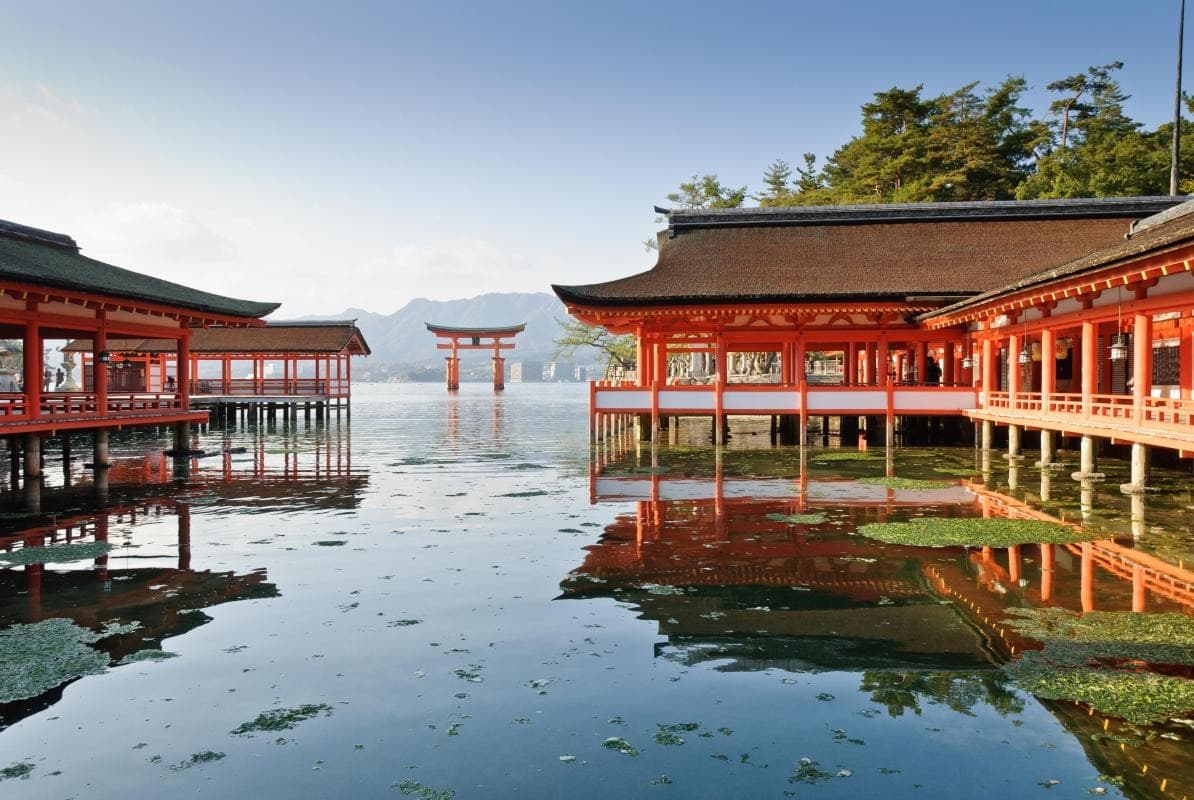
What the day feels like
The ferry cuts through a glassy Seto Inland Sea and for a few minutes the island of Miyajima feels like a stage set: roofs clustered beneath a forested slope, a five-storied pagoda standing like punctuation, and, offshore, a vermilion torii gate that appears to float when the tide is high. Stepping off the boat, the air changes—salt, pine, and the faint smoke of street-food grills—while sika deer weave through visitors with the easy entitlement of animals used to human company. Itsukushima Shrine (Itsukushima Jinja) is less a single building than a choreography of architecture and water, where Shinto platforms, boardwalks, and bridges trace the line between sea and sacred.
The shrine's current layout dates to the 12th century, after Taira no Kiyomori established Miyajima as a spiritual and political landmark. Built on stilts over the bay, the shrine was explicitly designed to blur the boundary between the human and the divine; the torii gate marks the island as a holy space. That theatrical relationship with the sea is what makes visiting here different from other temple circuits in Japan—tides change the composition of a view in minutes, and the best photographs are as much about timing as composition.
Geology and time also play their part. Miyajima is the exposed western rim of an uplifted marine terrace, and the island's slopes—cloaked in evergreen and maple—collect mist and light in ways that sculpt the season. To the island's west, Mount Misen rises to 535 meters; trails thread through mossy cedar and ancient cedars whose trunks are wrapped in the gray lichens of a maritime climate. From the summit you can watch cargo ships make pale scars through the inland sea; the horizon reads like a map of Japan’s maritime trade.
Cultural life here is compact and tactile. Daisho-in Temple offers incense-scented rooms and a quieter, contemplative counterpoint to the shrine’s ceremonial bustle. Local craftsmen sell woodcarvings and lacquerware in narrow streets; stalls grill Hiroshima oysters—plump, briny, and often served with a squeeze of lemon—and shops hand out momiji manju, a maple-leaf–shaped sweet stuffed with red-bean paste that’s become synonymous with Miyajima. The island’s small community has turned tourism into a living craft: food, souvenirs, and a network of volunteer guides who know how tide times alter both access and atmosphere.
Practicalities matter here more than in a postcard. The “floating” illusion of the torii is governed by tides: at low tide the gate becomes reachable by foot (and crowds can gather on the exposed sand), while at high tide it floats, framed by water and reflection. Ferries run from Miyajimaguchi on the mainland to the island in about 10 minutes; if you have a Japan Rail Pass you can usually use the JR ferry that serves the route. Inside the shrine complex you’ll walk wooden boardwalks that are slippery when damp, so footwear with solid tread matters. If you plan to climb Mt. Misen, expect about 4 kilometers of uphill trail with roughly 500 meters of gain from Momiji-dani Park—allow 90–120 minutes one-way on a steady pace, or take the ropeway for a 10–20 minute ascent if you prefer to save legs for the summit views.
Timing makes the difference between a crowded selfie spot and a genuine encounter. Early morning—first light—finds the bay quiet, the torii reflected in still water, and deer grazing without interruption. Late afternoon softens the island into a painterly palette, and if you can stay through sunset the gate turns into a silhouette. Avoid the midday surge when day-trippers from Hiroshima and cruise passengers swell the streets.
For planning: layer your gear for humidity and sudden weather, carry cash (some smaller shops don’t take cards), and check tide tables the day before you go—many guide apps list local tide times. Be mindful of the deer: they are beguiling but wild; don’t feed them packaged snacks (it’s bad for their digestion) and keep camera straps secured. Respect shrine etiquette: remove hats and speak quietly near prayer halls.
What travelers remember long after the photographs is the intimacy the place cultivates—a shrine designed so that sea licks its underside, a torii that can be a doorway or a silhouette depending on the tide, and an island where craft, food, and faith are all scaled to human hands. Whether you’re tracking autumn colors, chasing the perfect golden-hour silhouette of the torii, or hiking cedar-shaded trails to a summit with a far-reaching view, Itsukushima Shrine offers a compact, sensory lesson on how place, ritual, and nature can interlock. It is a destination that rewards pace: the quicker you try to swallow it, the more it slips through your fingers; the slower you are, the more layers you find.
If you go: ferry across early, follow the tide, eat fresh oysters, keep your feet on the boardwalk after rain, and leave a little time to climb. Itsukushima is a pilgrimage for the mindful traveler—an invitation to slow down and watch the sea rearrange a sacred landscape.
Trail wisdom
Small choices, better day.
Time the tide
Check local tide tables—high tide gives the classic floating torii, low tide allows a walk to the gate’s base.
Start early
Arrive at first light to avoid crowds and capture calmer water reflections around the torii.
Wear grippy shoes
Wooden boardwalks and coastal paths get slippery when wet; choose footwear with good traction.
Mind the deer
Do not feed the sika deer; keep food secured and watch for sudden approaches around narrow streets.
Local knowledge
Read the place, not just the route.
Watch for native species including sika deer (Cervus nippon), coastal sea birds (gulls and terns).
Keep an eye out for wildlife during the transition between areas and habitats. Respect distance guidelines.
Tourism pressures and feeding wildlife are ongoing concerns; visitors are asked to avoid feeding deer, carry out trash, and stick to boardwalks to protect sensitive shoreline habitats.
Follow the guide's instructions on size limits, ethical handling, and leave-no-trace practices.
Daisho-in Temple—an atmospheric temple complex with quiet nooks for contemplation. Momiji-dani Park—less crowded trails for autumn color and a quieter ascent to the ropeway
Locally recommended viewpoints and quiet spots known best to local operators.
Itsukushima Shrine in its current form traces its major reconstruction to Taira no Kiyomori in the late 12th century; the shrine is a UNESCO World Heritage Site.
Maritime roots and regional tradition shape the waterways and working coasts.
Seasonal guide
Four versions of the same landscape.
Spring
Best forcherry blossoms · milder hikes · fewer typhoon risks
Challengesoccasional rain showers · pollen season for sensitive travelers
Spring brings cherry blossoms and comfortable hiking conditions, but expect occasional rain and pollen.
Summer
Best forlush green forest · long daylight · ropeway rides
Challengeshot, humid weather · higher chance of typhoons · insect activity
Summer fills the island with green life and long days; bring sun protection and watch forecasts during typhoon season.
Fall
Best formaple leaf colors · photography · cool trails
Challengespopular with weekend crowds · shorter daylight
Autumn is peak for maple colors—expect spectacular foliage and busier streets, especially in November.
Winter
Best forquiet island atmosphere · clear views · low-season rates
Challengeschilly coastal winds · some attractions may have reduced hours
Winter offers serenity and crisp views; dress warmly for wind off the sea and shorter opening hours.
Pack with intention
What to bring.
Good to know
Common questions.
From Hiroshima Station take a local train to Miyajimaguchi (about 25 minutes), then a 10-minute ferry crossing. JR Pass holders can use the JR ferry without extra charge.
Plan the edges
The details that make the day easier.
The shrine's famous torii gate appears to float at high tide; Itsukushima Shrine was inscribed as a UNESCO World Heritage Site in 1996 and its current layout was largely shaped by Taira no Kiyomori in the 12th century.
Miyajima's small economy centers on seasonal food and crafts—try grilled Hiroshima oysters, pick up a box of momiji manju, and browse local woodcarvings for a tangible souvenir of the island's craft traditions.
- Ferry
- 10 minutes from Miyajimaguchi (JR ferry may be covered by JR Pass). Shrine: free outer areas, small fees for specific halls. Best times: sunrise and late afternoon. Accessibility: boardwalks can be slippery; some terrain uneven. Language: English signage present at main sites; small shops may be Japanese-only.
Protect fragile shorelines by staying on boardwalks, do not feed wildlife, reduce single-use plastics while on the island, and consider supporting local artisans rather than mass-produced souvenirs.
Explore by topic
Follow the threads.
Keep exploring
Make the story part of the trip.
Set out from Bass Harbor for a private, customizable day on Blue Hill Bay — lighthouses, puffins, seals, and the chance to feel Acadia from the water. Small groups, local captains, unforgettable views.
In four hours you can move from shaded canyon ferns to wind-scoured coastal ridgelines, guided by someone who knows where the light—and the hidden views—live. This private half-day hike on the Monterey Peninsula or Big Sur is compact, curated, and perfect for travelers who want depth without a multiday commitment.
 Related story
Beneath a sky of shifting light, Skaftafell’s ice reads like a map of time. This three-hour guided glacier hike mixes technical instruction with geology and culture: compact, safe, and unforgettable.