
What the day feels like
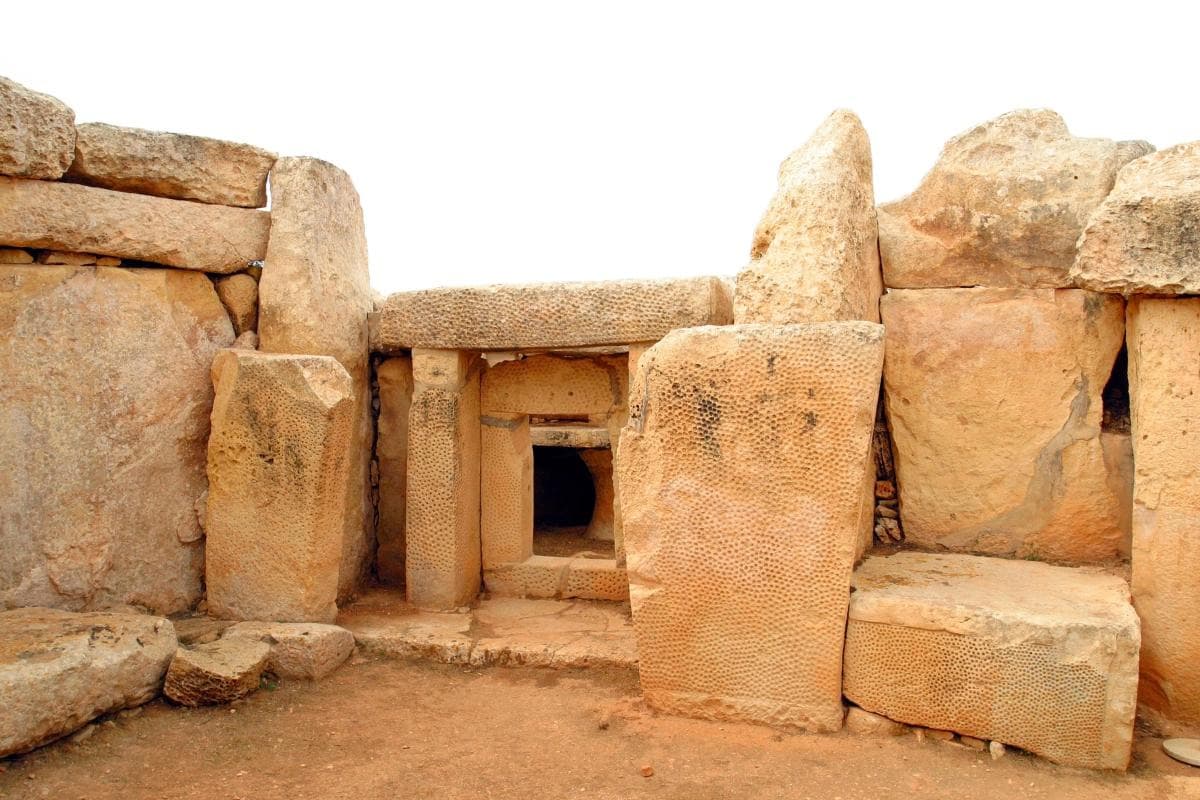
You reach the clifftop at dawn and the sea is doing what it always does here — shimmering like a dare. Salt-light spills across low limestone and, beyond it, the squat silhouette of Filfla hunkers against the horizon. The wind carries gull-cry and the faint tang of seaweed, and then you notice the stones: slabs and doorways and curving lintels so precisely set that the place reads more like a brain than a ruin. This is Hagar Qim — a megalithic temple complex that has watched the Mediterranean for more than five thousand years.
Arrive early and you’ll have the site almost to yourself. The visitor center’s glass faces the sea; the path down to the fenced platform is short but deliberate, paved with modern boardwalks that protect the archaeology while giving you close-up views. The stones are warm from a spring sun, flecked with lichen. Walk the umbrellaed circuit and the layers of time reveal themselves: rudimentary altars, doorways that frame the blue, corbels and crude pillars that once sheltered ritual hearths. The place doesn’t need explanation to impress; it needs a slowing down.
Hagar Qim’s story is geological and human. The limestone underfoot is Globigerina — the bedrock of Malta — formed from ancient sea-silt and quarried, shaped, and stacked by successive cultures. Archaeologists date the core of the complex to around 3600–3200 BCE. That puts Hagar Qim among the oldest freestanding stone structures in the world, older than the Egyptian pyramids and contemporary with the very first complex societies in Europe. It’s also a site of alignment: certain features track solar events, and many visitors come to see how light pours through lintels at solstice.
The human context is local and living. The island’s long relationship with limestone — the same rock that builds its churches and farmhouses — shows up in the nearby Limestone Heritage attraction and the centuries-old villages you’ll pass en route. Tours that pair Hagar Qim with sites like the Blue Grotto, Dingli Cliffs, Mdina and the fishing harbor of Marsaxlokk make sense: they knit the island’s geology, maritime life, and layered history into a single day. If you have time, follow the short walk from Hagar Qim to Mnajdra: its rounded chambers feel intimate and the views down toward the sea are among the island’s best.
Practicality first: a typical visit to Hagar Qim can be a focused 30–60 minutes, longer if you read the signage and linger at viewpoints. The site is compact with boardwalks and low gradients, but the surface is uneven and exposed. In summer, the Mediterranean sun is relentless; in winter, wind and drizzle can make the boardwalks slick. Most organized day tours incorporate Hagar Qim into a larger circuit—expect a full day if you’re combining it with Mdina or a Blue Grotto boat trip.
How to plan: base yourself in Valletta or the southern towns and allow a half-day for the temple plus nearby stops. The Malta Multi Pass can save money if you plan several heritage visits. For photographers, the golden hours — both sunrise and late afternoon — deliver the best light, especially for the dramatic silhouette of Filfla. If you prefer interpretation, guided tours that include the Limestone Heritage and Ghar Dalam add context to what you see at Hagar Qim: they explain the island’s stonecraft, ancient diets, and how early Maltese communities fit into the Mediterranean trade web.
Be respectful. Hagar Qim is protected: stay on the designated routes, don’t touch carvings, and consider a local guide to deepen your understanding. If you’re visiting in high season, arrive early or in late afternoon to avoid crowds; many visitors come as part of a circuit that also includes the Blue Grotto’s boat rides and the Marsaxlokk fish market.
For the active traveler who wants more than a single stop: link Hagar Qim with a coastal walk toward Dingli Cliffs for broader views, or schedule a boat at Wied iż-Żurrieq to see the Blue Grotto from the water. Food matters here: the island’s cuisine—lampuki (dolphinfish) pie, rabbit stew, gbejniet (cheese)—gives a savory edge to a day of stone and salt. Finish in Marsaxlokk, walking past the colorful luzzu fishing boats and sampling a simple seafood lunch.
Safety and comfort are straightforward: sun protection, steady shoes, water. The island’s small size makes logistics forgiving — distances are short — but the Mediterranean weather is capable of quick change. The reward is the sense that you’re walking inside a deep human story written in stone: sacred thresholds, light that matters, and a coastline that feels like it was always meant to be watched.
Hagar Qim delivers a compact but profound experience. It’s not the longest hike or the hardest climb, but it is a place where landscape, ritual, and craft meet; where every slab can feel like a line in a very old conversation. Come for the stones, stay for the sea, and leave with something that feels new: the knowledge that some places resist hurry and ask simply to be observed.
Trail wisdom
Small choices, better day.
Go early or late
Visit at first light or late afternoon to avoid crowds and get the best photo light; mid-day is hottest and busiest.
Stay on the boardwalks
The site is fragile—stick to designated paths to protect the archaeology and avoid fines.
Bring steady shoes
Surfaces are uneven limestone and can be slippery when wet—low-profile hiking shoes are ideal.
Combine with a boat trip
If weather allows, pair Hagar Qim with a Blue Grotto boat ride for complementary coastal views.
Local knowledge
Read the place, not just the route.
Watch for native species including Audouin’s gull, Mediterranean gecko.
Keep an eye out for wildlife during the transition between areas and habitats. Respect distance guidelines.
The site is managed to limit wear—boardwalks, restricted access, and interpretive signage help preserve fragile surfaces; visitors are asked to follow rules and leave no trace.
Follow the guide's instructions on size limits, ethical handling, and leave-no-trace practices.
Mnajdra Temples — the neighboring complex with rounded chambers and dramatic coastal views. A quiet lookout west of Hagar Qim that frames Filfla and makes for a low-key sunset spot
Locally recommended viewpoints and quiet spots known best to local operators.
Hagar Qim dates to roughly 3600–3200 BCE and is among Malta’s principal prehistoric temple complexes, reflecting advanced stone construction long before classical antiquity.
Maritime roots and regional tradition shape the waterways and working coasts.
Seasonal guide
Four versions of the same landscape.
Spring
Best formild walking conditions · wildflowers and clear light
Challengesvariable showers · busy weekends in April–May
Spring offers crisp air, pleasant temperatures, and clear skies—ideal for combining Hagar Qim with coastal walks and village markets.
Summer
Best forlong daylight hours · Blue Grotto boat trips · sea-swimming afterwards
Challengesintense sun and heat · larger tour groups
Summer is peak tourism and strong sunlight—visit early, carry water and shade, and expect the site to be busier.
Fall
Best forsofter light for photography · smaller crowds · pleasant temperatures
Challengesoccasional storms · shorter daylight
Autumn mirrors spring’s benefits with calmer seas making Blue Grotto trips more likely and fewer visitors at the temple.
Winter
Best forquiet visits · dramatic skies · off-season value
Challengeswind and rain · cooler temperatures
Winter is quiet and moody; the site is accessible but expect wet boardwalks and blustery winds.
Pack with intention
What to bring.
Good to know
Common questions.
Allow 30–60 minutes for the temple circuit; plan 2–4 hours if you’re combining nearby Mnajdra, the visitor center, or a Blue Grotto boat trip.
Plan the edges
The details that make the day easier.
Hagar Qim and nearby Mnajdra are over 5,000 years old—constructed around 3600–3200 BCE—and some features align with sunrise on solstices, showing early astronomical awareness.
Pair a morning at the temples with a lunch of lampuki pie and gbejniet in Marsaxlokk; local producers and small cafés around Mdina and the south coast highlight Maltese wheat breads, rabbit stews, and sea-fresh fish.
- Know-before-you-go
- short paved circuits, limited shade, combine with Mnajdra or Blue Grotto; many tours provide pick-up from Valletta and include explanatory guides—carry water and sun protection.
Respect fenced routes, avoid touching ancient stones, and support local guides and heritage sites by using official visitor facilities; small behaviors help preserve the temples for future generations.
Explore by topic
Follow the threads.
Keep exploring
Make the story part of the trip.
Set out from Bass Harbor for a private, customizable day on Blue Hill Bay — lighthouses, puffins, seals, and the chance to feel Acadia from the water. Small groups, local captains, unforgettable views.
In four hours you can move from shaded canyon ferns to wind-scoured coastal ridgelines, guided by someone who knows where the light—and the hidden views—live. This private half-day hike on the Monterey Peninsula or Big Sur is compact, curated, and perfect for travelers who want depth without a multiday commitment.
 Related story
Beneath a sky of shifting light, Skaftafell’s ice reads like a map of time. This three-hour guided glacier hike mixes technical instruction with geology and culture: compact, safe, and unforgettable.