
What the day feels like
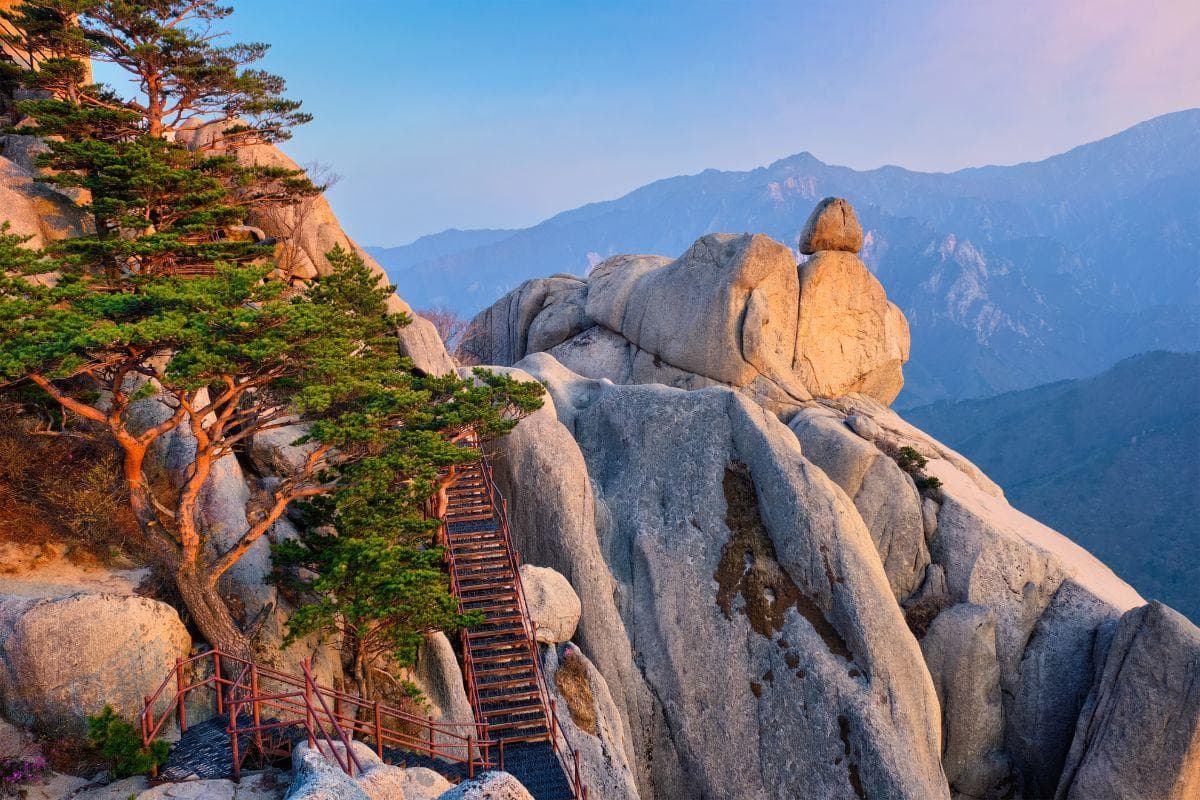
You reach the ridge and the sound of the crowd falls away. Wind slices through the granite buttresses and the world opens: a serrated skyline of sharp peaks, the dark ribs of forested slopes, and the Sea of Japan laid silver beyond the lowlands. Up close, Ulsanbawi is less a single rock than a chorus of cliffs — six blunt granite fingers that have resisted a million winters. The trail brings you here in steps and breath: wooden staircases, stair-stepped switchbacks, a narrow spine where hands meet stone. It is a hike that asks for attention, then rewards it with a view that explains why Koreans have been coming to Seoraksan for centuries.
Ulsanbawi Rock is the northwestern hinge of Seoraksan National Park, a tectonic and cultural landmark outside the tidy port town of Sokcho. The formation is hard, pale granite, shaped by glacial scouring and relentless freeze-thaw into sheer faces and stacked slabs. Local legend does as much as the geology to put the place on a map: the name Ulsanbawi literally means 'the rock from Ulsan,' a nod to a folk story about a stone that tried to wander from Ulsan to build a temple but got stranded here. Whether you come for myth or for the rock's raw angles, the trail is choreography — a measured ascension through mixed forest and exposed ledges that ends at a narrow viewpoint where you feel perched on the spine of the mountain.
Historically, Seoraksan has been a borderlands of pilgrimage and politics. Mountain hermitages punctuate the slopes, Buddhist temples clinging to sheltered niches where stone and spirit meet. The park's trails were formalized in the early 20th century, and the Ulsanbawi route developed into one of the most popular day hikes because it delivers dramatic exposure with relatively compact mileage. The rock's six peaks are a geological signature: a huge block of granite uplifted, fractured, and smoothed by ancient glaciers, not volcanic in origin as some might assume. That pale granite makes a clean contrast to the dark conifers and the coastal plain below, especially in autumn when the larch and maple flush orange and gold.
What makes this hike special — and practical for travelers — is its accessible drama. The approach is steady but not technical: expect 1,500 to 2,000 steps depending on where you begin, a mix of carved stone and wooden staircases, and a final scramble-like section where chains and railings help you negotiate narrow ledges. The round-trip time for a typical party is 2 to 4 hours, with about 400 to 500 meters of elevation gain. It is short enough to pair with a morning in Sokcho's fish market and an afternoon at a beach, but steep enough to leave you pleasantly exhausted.
Timing matters. Go early to avoid the mid-day crowds and to catch the light on the granite face; late afternoon brings dramatic side-light too, but the trail can be busier. In winter the steps become a different sport: a world of ice and crisp air, best left to experienced hikers with traction. Spring and summer are lush and green; autumn is the marquee season — crisp air and a quilt of color below the ridge.
Practicalities are simple but essential. Wear sturdy, broken-in trail shoes with good grip; the stairs can be hard on the ankles and the final ledges demand sure footing. Water is non-negotiable — bring at least 1.5 liters and more in summer — and a light windproof layer because the ridge can be startlingly cold even when the valley is warm. There is no need for ropes or technical climbing gear on the standard route, but those with a poor head for exposure should plan around the narrow viewpoints.
Local culture is part of the experience. Sokcho is the natural base: a working port known for spicy seafood stews, fresh sashimi, and kalguksu noodle shops. After a hike, nothing settles the legs like a bowl of clear, hand-cut noodles or grilled fish at the market. Respect for the mountain runs deep here; you'll see small shrines and prayer tapes, and trail etiquette is conservative: yield to descending hikers, keep voices low near temple sites, and take all trash with you.
For travelers who want to expand a day at Ulsanbawi into a short itinerary, combine the hike with a visit to nearby Biryong Falls or a cable car ride on the eastern side of Seoraksan to broaden the panorama without more footwork. Photographers will find endless compositions: the granite fingers against morning mist, climbers small against a vast horizon, and the boats of Sokcho like pins in the sea below.
Safety and sustainability are simple: stay on designated trails, do not carve or remove stone, and follow park regulations. Seoraksan is a protected area with active conservation programs; your small choices — pack out what you pack in, stick to paths, and avoid feeding wildlife — matter in preserving the fragile alpine flora and resident species.
If you go, plan for an efficient morning: shuttle or local bus to the park entrance, arrive before 9 a.m., and give yourself time at the summit to drink in the view. The effort is straightforward; the reward is panoramic and honest. Standing there you can feel the slow geology of the peninsula, the tug between sea and mountain, and why Koreans have long threaded this landscape with footpaths and stories. Ulsanbawi is not the highest rock in Korea, nor the easiest to reach, but it is one of the purest ways to feel the spine of Seoraksan under your boots.
Trail wisdom
Small choices, better day.
Start early to beat crowds
Arrive at the park entrance before 9 a.m. for quieter trails and softer morning light on the granite faces.
Bring traction in cold months
If hiking between late autumn and early spring, carry microspikes — exposed granite and stairs ice over quickly.
Respect narrow sections
Yield to descending hikers on the single-track ridgelines and use railings where provided; avoid stopping in chokepoints.
Portable water and snacks
There are no reliable water stations on the ascent; pack 1.5–2 liters and compact fuel for the climb and return.
Local knowledge
Read the place, not just the route.
Watch for native species including Korean goral (mountain goat-like antelope), Eurasian magpie and other woodland birds.
Keep an eye out for wildlife during the transition between areas and habitats. Respect distance guidelines.
Seoraksan is a national park with active trail maintenance and visitor education; stay on paths, pack out trash, and respect wildlife to minimize impact.
Follow the guide's instructions on size limits, ethical handling, and leave-no-trace practices.
Early-morning view from the lower ridge near Biryong Falls for quieter scenes. Sokcho's Jungang Market for post-hike seafood and kalguksu noodles
Locally recommended viewpoints and quiet spots known best to local operators.
Ulsanbawi’s name references a folk legend about a stone from Ulsan; the rock has long been a cultural landmark in Seoraksan’s mountain pilgrimage tradition.
Maritime roots and regional tradition shape the waterways and working coasts.
Seasonal guide
Four versions of the same landscape.
Spring
Best forwildflower displays · cool trail conditions
Challengesmuddy sections from thaw · daytime variability
Spring brings fresh greens and melting snow; trails can be muddy but the air is crisp and the rock warms quickly in sun.
Summer
Best forlush forests · early-morning hikes to avoid heat
Challengeshumid weather · thunderstorms possible afternoons
Summer is verdant and humid; start early to avoid heat and afternoon storms that can make exposed ledges slippery.
Fall
Best forpeak foliage · crisp visibility
Challengeshigher visitor numbers · cooler mornings and evenings
Autumn is prime time — clear views and brilliant colors — but expect more hikers and bring warm layers for ridge winds.
Winter
Best fordramatic, frosted granite · quiet trails
Challengesice and cold temperatures · possible trail closures
Winter creates a stark, beautiful landscape but requires traction, warm gear, and experience with icy conditions.
Pack with intention
What to bring.
Good to know
Common questions.
Most hikers complete the round trip in 2–4 hours, depending on pace and time spent at viewpoints; expect roughly 400–500 meters of elevation gain.
Plan the edges
The details that make the day easier.
Ulsanbawi consists of a cluster of six distinctive granite peaks formed by ancient glacial erosion and is one of Seoraksan’s most recognizable geological features.
After the hike, explore Sokcho’s Jungang Market for live seafood, spicy dakgangjeong and a piping bowl of kalguksu; many local restaurants source fish directly from the harbor.
Follow Leave No Trace: stick to trails, dispose of waste properly, and avoid disturbing flora and fauna; support local guides and businesses that invest in conservation.
Explore by topic
Follow the threads.
Keep exploring
Make the story part of the trip.
Set out from Bass Harbor for a private, customizable day on Blue Hill Bay — lighthouses, puffins, seals, and the chance to feel Acadia from the water. Small groups, local captains, unforgettable views.
In four hours you can move from shaded canyon ferns to wind-scoured coastal ridgelines, guided by someone who knows where the light—and the hidden views—live. This private half-day hike on the Monterey Peninsula or Big Sur is compact, curated, and perfect for travelers who want depth without a multiday commitment.
 Related story
Beneath a sky of shifting light, Skaftafell’s ice reads like a map of time. This three-hour guided glacier hike mixes technical instruction with geology and culture: compact, safe, and unforgettable.