
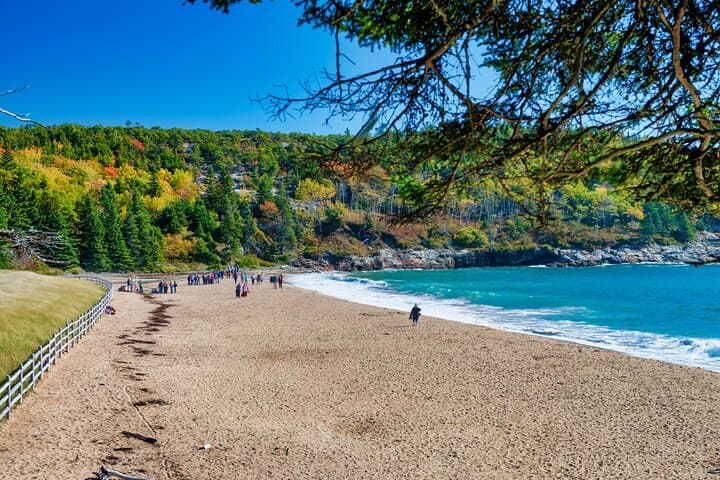
What the day feels like
The first thing you notice is the sound: a raw, open-Atlantic voice that moves through wind-tangled spruce and scrapes across bedrock. Underfoot the trail is a patchwork—fungal brown soil, salt-polished granite, and a few weathered wooden steps—and every turn opens to a different scale of sea. Lobster buoys bob like punctuation in coves. Offshore, a steady traffic of gulls and distant terns mark the invisible line between surf and horizon. This is Acadia’s Ocean Path, a coastal ribbon that threads Thunder Hole, Otter Cliff, and Otter Point Outlook into one walkable story. With the right app in your pocket, the landscape talks back.
This is a self-guided audio experience built for people who want context with their footsteps. Download the tour app before you go and you’ll get short, location-aware tracks that pop up as you move: a naturalist points to tidal pools, a local historian recounts shipwrecks, and a ranger explains how granite and ice sculpted the coastline. Booking is per car rather than per person, so couples and families can stroll together and listen at shared pace. The route is flexible—take a brisk hour-long out-and-back or stretch it into a two-hour ramble with extra stops at viewpoints and benches.
Geology here reads like an open textbook. The coastal granite—pink and stubborn—was scoured by Pleistocene ice, then wedged and lifted by sea-level changes. Waves now exploit the joints and fissures, carving broad platforms and narrow inlets; Thunder Hole is the theatrical result. At certain tides and swell angles the inlet compresses air and water, producing explosive booms and white spray that seems choreographed.
Acadia’s human story layers on top of that rock. Native Wabanaki people lived along these coasts long before European settlement. In the late 19th and early 20th centuries, wealthy summer residents bought and preserved much of this shoreline, later donating large tracts that formed the nucleus of what became Acadia National Park. The park’s history—moving from private preservation to public stewardship—gives the path a civic dimension: this coast is conserved by law and habit.
Naturally, wildlife is part of the walk. Harbor seals haul out on rocky ledges in calm bays; migratory seabirds chart invisible highways overhead. In spring and fall, shorebirds and songbirds swarm through the spruce fringe; in summer you’ll catch the glint of porpoises offshore if the water is calm. The audio tour calls out likely sightings and interprets behavior so you see more than the obvious.
Despite the cinematic scenery, the Ocean Path is approachable. The route from Sand Beach to Otter Point and back is roughly 4 miles round-trip, with minimal elevation gain—expect mostly flat coastal walking, occasional stone steps, and a few uneven rocky sections where good footing matters. Plan 60–120 minutes depending on pace and how many stops you make. The path is family-friendly and popular, so weekdays and early mornings offer a quieter experience.
Practical edge: download the audio tour while on Wi‑Fi, then use it offline. Bring layered clothing; the Atlantic breeze can slice through a summer tee. Wear sturdy shoes with good grip for wet rock and tide pools, and carry water—the path has no services.
Why choose this format over a stroll with a guide? The self-guided audio lets you control the rhythm. Pause a story and linger at a tide pool, or skip a segment and keep moving. It’s ideal if you travel on your own schedule, if you like having historical and natural context without a group, or if you’re trying to balance sightseeing with a tight itinerary in Bar Harbor.
Where to start: most people pick Sand Beach or the parking area near Thunder Hole. Follow the signs, and when a track on your phone triggers, let someone else narrate the landscape while you look closely: at lichens that grip the granite, at the layered history of coastal erosion, at the sudden hush beyond a rocky headland. Time your visit for high tide at Thunder Hole if you want dramatic surf; for reflections and still light, aim for low tide in calm weather.
Local logistics are mercifully simple. The tour covers a public park trail—no special climbing skills or permits—but Acadia charges a park entrance fee. Cell service is decent in Bar Harbor but can be patchy along exposed headlands, which is why downloading the tour beforehand is emphasized.
At the end of the route you’ll have options: return to the same parking area or continue into a longer loop that connects to other shorelines and carriage roads. Bring binoculars if you want to pick out seals and seabirds; bring a notebook if you like to collect details from the audio tracks. In all cases, tread lightly—this coastline is both spectacular and fragile.
Want a quieter, richer coastal walk that reads like a field guide and a memoir at once? Download the <a href="https://app.advcollective.com/local-experts/acadia-ocean-path-self-guided-audio-walking-tour">Acadia Ocean Path self-guided audio walking tour</a> and let the shore tell you its stories in your own time.
Trail wisdom
Small choices, better day.
Download before you arrive
Download the audio tour on Wi‑Fi—offline playback ensures narration triggers even with spotty cell service.
Wear grippy shoes
Expect wet granite and uneven rock; shoes with good tread make tide‑pooling and cliffside steps safer.
Time Thunder Hole
Visit near mid-to-high tide with a swell to experience the best booms—check tidal charts first.
Bring water and snacks
There are no services on the path; pack at least 1 liter per person for a 1–2 hour walk.
Local knowledge
Read the place, not just the route.
Watch for native species including Harbor seal, Various seabirds including terns and gulls.
Keep an eye out for wildlife during the transition between areas and habitats. Respect distance guidelines.
Stick to marked trails, carry out all trash, and avoid disturbing tidepool life—Acadia’s coastal ecosystems are fragile and visitor-driven impact is a concern.
Follow the guide's instructions on size limits, ethical handling, and leave-no-trace practices.
Otter Point Outlook for intimate, low-angle views of granite ledges. Less-crowded coves east of Thunder Hole at dawn for tidepool exploration
Locally recommended viewpoints and quiet spots known best to local operators.
Much of Acadia’s shoreline was donated by private landowners in the early 20th century, forming the core of what became Acadia National Park.
Maritime roots and regional tradition shape the waterways and working coasts.
Seasonal guide
Four versions of the same landscape.
Spring
Best forBird migration · Lush coastal flora
ChallengesUnpredictable weather · Cool winds
Spring brings migratory birds and bright mosses; dress in layers and expect wind-driven showers.
Summer
Best forSeal and marine mammal sightings · Warmer water views
ChallengesCrowds · Strong sun exposure
Summer offers long days and marine activity but arrive early to beat crowds and bring sun protection.
Fall
Best forFall foliage contrast · Crisp, clear light
ChallengesShorter daylight · Cooler nights
Fall is prime for color and dramatic skies—ideal for photographers—but pack warm layers for changing temperatures.
Winter
Best forEmpty trails · Winter coastal atmospherics
ChallengesIcy rock · Limited accessibility
Winter offers solitude and stark beauty; only attempt if prepared for icy conditions and limited park services.
Operator details
What the booking data adds.
Included
- ✓Support is available via chat, email, or phone if you need help.
- ✓Planning tools, route maps, scenic stops, and area previews included.
- ✓Just bring your phone and headphones; the app guides your walk.
- ✓Lifetime access: use the tour anytime and keep it for future trips.
- ✓Works offline with GPS route guidance and automatic audio stories.
- ✓Flexible tour: start, stop, and pause anytime during your trip.
- ✓Private walking tour experience for your family or group.
- ✓Access your tour in our separate audio tour app after booking.
- ✓Hidden gems and local stories included along the route.
Not included
- —No live guide. Entrance fees, parking, food, and car rental are separate.
Good to know
- ✓Public transportation options are available nearby
- ✓Suitable for all physical fitness levels
- ✓Easy to use: GPS-triggered audio plays automatically along the route for a hands-free experience.
- ✓Private tour: Follow the route on your phone without an in-person guide or crowded group.
- ✓At your own pace: Start anytime and pause for hikes, picnics, photos, or scenic stops.
- ✓Works offline: Once downloaded, the tour works using GPS without Wi-Fi or cellular service.
- ✓Multi-device access: Use the same password on one device for each traveler included in your booking.
- ✓More ways to save: Choose a single tour, a nearby bundle, or access to 200+ tours.
- ✓Download in advance: Download the Tour Guide app by Action and tour while connected to Wi-Fi or a strong cellular signal.
- ✓Follow the route: Begin at the suggested starting point or join anywhere along the route shown in the app.
- ✓Lifetime access: Preview the tour before your trip and revisit the stories, photos, and details afterward.
- ✓Supported devices: iPhone with iOS 15+, Android with version 9+, or a GPS-enabled iPad/tablet with cellular capability.
- ✓Savings tips: Walking tours: couples can share a tour by using separate earbuds. We recommend using headphones or earbuds for clearer audio and to avoid disturbing nearby guests.
Pack with intention
What to bring.
Good to know
Common questions.
A typical out-and-back from Sand Beach to Otter Point is about 4 miles round-trip and takes 60–120 minutes depending on stops.
Plan the edges
The details that make the day easier.
Thunder Hole can produce thunder-like booms when waves compress air in a narrow inlet—conditions depend on tide and swell; Acadia was first protected as Sieur de Monts National Monument in 1916 and later designated Acadia National Park.
After the walk, head into Bar Harbor for lobster rolls and local microbrews; Jordan Pond House in the park is famous for popovers and tea with a view—both are classic ways to extend the coastal day into a local culinary moment.
- Closest airport
- Hancock County–Bar Harbor Airport (BHB); Trailhead driving distance: 5–20 minutes from downtown Bar Harbor depending on start point; Cell service: good in town, patchy on exposed headlands; Permits
- passes
- Acadia entrance fee required; Parking: limited in peak months—arrive early.
This coastline is ecologically sensitive—stay on designated trails, pack out all trash, use reef‑safe sunscreen, and avoid collecting shells or disturbing tidepool organisms.
Explore by topic
Follow the threads.
Keep exploring
Make the story part of the trip.
Set out from Bass Harbor for a private, customizable day on Blue Hill Bay — lighthouses, puffins, seals, and the chance to feel Acadia from the water. Small groups, local captains, unforgettable views.
In four hours you can move from shaded canyon ferns to wind-scoured coastal ridgelines, guided by someone who knows where the light—and the hidden views—live. This private half-day hike on the Monterey Peninsula or Big Sur is compact, curated, and perfect for travelers who want depth without a multiday commitment.
 Related story
Beneath a sky of shifting light, Skaftafell’s ice reads like a map of time. This three-hour guided glacier hike mixes technical instruction with geology and culture: compact, safe, and unforgettable.