
What the day feels like
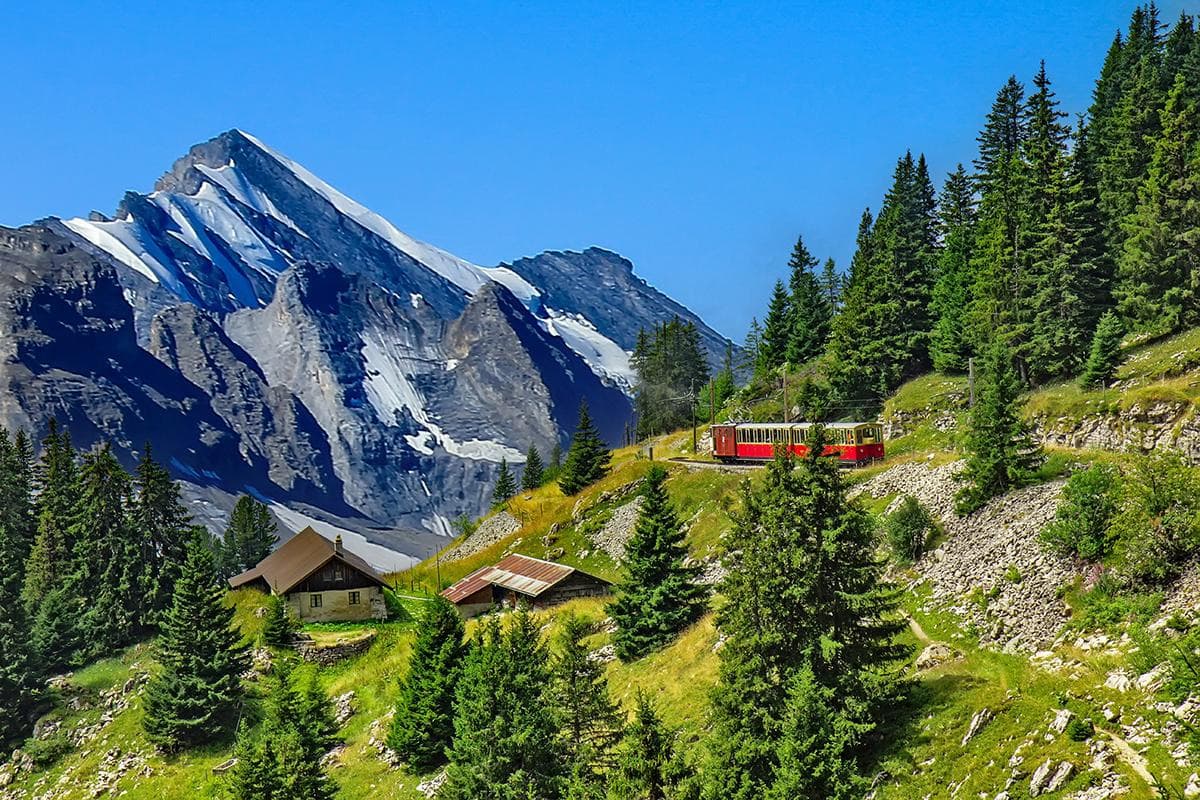
The cogwheel train exhales steam and a few tired passengers as it noses up through larch and spruce, and then the world opens. Emerging onto the Schynige Platte plateau—an alpine shelf pinned beneath the jagged crowns of the Eiger, Mönch and Jungfrau—you feel the mountains looking back at you. Wind combs the meadow grasses; the air smells like crushed herbs and distant snow. Below, the twin lakes, Thun and Brienz, hold the valley like blue mirrors. It’s the kind of place that makes you slow your breath and quicken your feet.
Schynige Platte is less a single summit than a long, walkable ridge and a collection of experiences: a turn-of-the-century cog railway that climbs from Wilderswil, an alpine botanical garden that stages the seasons in living color, and trails that ribbon along ridgelines with panoramas that demand to be earned. Geologically, the ridge is a mosaic of ancient crystalline rock and glacially carved bowls; glaciers sculpted the valleys and left the broad shoulder where sheep still graze and alpine flowers colonize crevices. Historically, the Schynige Platte Railway—opened in the late 19th century—was built to bring visitors to these views, and it still rolls with a nostalgic, low-gear dignity.
Culture here is pastoral and intentional. Chalet farms dot the slopes, their balconies stacked with drying herbs and cheese, while in Interlaken and the nearby villages the cadence of tourism meets local life: market stalls on Saturday mornings, cheese cellars where the scent of ripening raclette hangs heavy, and guides who grew up reading the mountains like maps. The alpine garden, founded in the early 20th century, collects species from across the Bernese Alps and gives you a botanical index of the landscape you’re traversing.
For travelers, Schynige Platte is accommodating to a range of appetites. There are gentle panorama walks under 3 kilometers that let you sample the ridge and its vistas without a sweat. For those who want more vertical and solitude, several longer routes extend toward peaks like Loucherhorn or link with multi-day trails that descend into Lauterbrunnen or climb toward Faulhorn—routes that demand good shoes and a prepared pack.
Practicalities matter here. The cogwheel railway from Wilderswil climbs roughly 1,000 meters in about 50 minutes; the station at Schynige Platte sits at about 1,967 meters above sea level. Trails on the plateau are a mix of wide packed-earth paths and stonier ridgelines; expect sections with loose scree and exposed edges if you push toward higher summits. Weather is changeable—morning sun can dissolve into wind and fog by afternoon—so timing matters. Morning climbs and midday ridge hikes often reward you with the clearest views; late afternoons can deliver dramatic light but also more cloud and wind.
If you're using public transport in the Bernese Oberland, the Jungfrau Travel Pass is a practical companion: it bundles boats, buses, gondolas and many railways around Interlaken, Grindelwald and Lauterbrunnen, simplifying logistics and often saving money. Book a train slot from Wilderswil on a calm morning, spend a few hours strolling the alpine garden and nearby viewpoints, then choose a hike that matches your energy—short panoramic loop, or a half-day descent to lower valleys.
Safety and comfort are straightforward. Sturdy footwear with good ankle support is non-negotiable on longer routes; layers are essential. Hydration is critical despite cool air—there are refills at the mountain restaurant when open, but always carry at least 1–2 liters. If you plan to traverse long ridgelines, bring a headlamp and a compact windproof layer—visibility can drop fast, and temperatures do, too.
Beyond the logistics, Schynige Platte is restorative. Trails thread through meadows, and marmots whistle from crevices while choughs wheel near cliffs. The alpine garden tells a seasonal story: in midsummer, the meadows are a riot of alpine gentians, edelweiss and wild thyme; in late summer, grasses turn amber and light slants low and honeyed. The place feels stitched to the rhythms of grazing, snowmelt and human visitors who come to listen to a mountain’s slow deliberation.
Plan your visit around intention. One can do Schynige Platte properly in a half-day: take the historical cog train up, walk the short Panorama Trail to the viewpoints and the alpine garden, have lunch at the mountain restaurant, then either return by train or continue on a half-day hike to a nearby valley. For multi-day link-ups—combining Schynige Platte with Lauterbrunnen, Grindelwald or the Jungfrau panorama—use the Jungfrau Travel Pass to keep transfers efficient.
Ultimately, Schynige Platte rewards the kind of travel that listens: to the groove of your boots on gravel, to marmots’ whistles, and to the way the ridge invites you to wander. It’s a place to earn a view and to feel the Alps operate by a patient logic. If you go, bring curiosity and a simple kit. The mountains will do the rest.
Why travelers want it: you get classic Bernese Oberland panoramas without an alpine-grade commitment, access by charming historic rail, and the option to scale up into a longer ridge traverse if the weather and appetite allow. It’s an elegant alpine day that trades strain for sustained, accessible spectacle.
Trail wisdom
Small choices, better day.
Catch the first cog
Morning departures on the Schynige Platte Railway often mean clearer skies and softer light on the ridge; fewer clouds and calmer winds make for better visibility.
Layer for alpine weather
Temperatures can drop quickly at ~1,967 m—pack a windproof shell and an insulating mid-layer even on warm days.
Carry water and snacks
Facilities are limited outside the mountain restaurant—bring 1–2L of water and high-energy snacks for hikes longer than 2 hours.
Stay on marked trails
The plateau supports delicate alpine flora and grazing areas—follow waymarks to avoid erosion and protect plant communities.
Local knowledge
Read the place, not just the route.
Watch for native species including alpine marmot, golden eagle (or choughs and alpine choughs).
Keep an eye out for wildlife during the transition between areas and habitats. Respect distance guidelines.
Trails pass through fragile alpine habitats—stay on marked paths, pack out waste, and support local transport to reduce car traffic in the valleys.
Follow the guide's instructions on size limits, ethical handling, and leave-no-trace practices.
The Schynige Platte Alpine Garden’s niche beds showcasing rare local saxifrages and gentians. Early-morning viewpoints where light catches the north faces of the Jungfrau and Eiger with minimal crowds
Locally recommended viewpoints and quiet spots known best to local operators.
The Schynige Platte Railway dates to the late 19th century and was built to open alpine panoramas to visitors—its historic rolling stock still runs in season.
Maritime roots and regional tradition shape the waterways and working coasts.
Seasonal guide
Four versions of the same landscape.
Spring
Best forwildflower emergence · quieter trails · birdsong and thawed streams
Challengespatchy snow · variable temperatures
Late spring reveals the first alpine blooms and quieter trails, though higher sections can still hold snow into June—check local trail reports.
Summer
Best forfull wildflower display · clear panoramas · long daylight hours
Challengescrowds on weekends · afternoon storms
Summer is peak for hiking and the alpine garden in full bloom; start early to avoid wind and convective thunderstorms in the afternoon.
Fall
Best forgolden light · fewer visitors · migratory bird watching
Challengesshorter days · sudden cold snaps
Autumn trims the crowds and offers crisp, clear views—pack warmer layers and plan shorter routes as daylight fades sooner.
Winter
Best forsnowshoeing nearby · quiet solitude · snow-covered panoramas
Challengesclosed trails/limited services · avalanche risk on steep slopes
In deep winter Schynige Platte can be snowbound and services are reduced; consider guided winter outings or nearby snowshoe options instead of unguided ridge hikes.
Pack with intention
What to bring.
Good to know
Common questions.
Take the historic Schynige Platte cogwheel railway from Wilderswil; Wilderswil is reached from Interlaken by regional train or bus. The Jungfrau Travel Pass covers many regional connections.
Plan the edges
The details that make the day easier.
The Schynige Platte Alpine Garden cultivates hundreds of native alpine plant species and was established to preserve and display the flora of the Bernese Alps.
Pair the hike with local Bernese food—order a cheese platter or raclette in a nearby chalet, and stroll Interlaken’s market for handmade wool and alpine preserves.
- Access
- Wilderswil cogwheel railway; Elevation: ~1,967 m; Best time: June–September; Passes: Jungfrau Travel Pass recommended; Services: small mountain restaurant and alpine garden in season.
Use trains and buses where possible, stay on official trails to protect delicate alpine flora, and respect grazing periods—these practices help preserve Schynige Platte’s ecosystems.
Explore by topic
Follow the threads.
Keep exploring
Make the story part of the trip.
Set out from Bass Harbor for a private, customizable day on Blue Hill Bay — lighthouses, puffins, seals, and the chance to feel Acadia from the water. Small groups, local captains, unforgettable views.
In four hours you can move from shaded canyon ferns to wind-scoured coastal ridgelines, guided by someone who knows where the light—and the hidden views—live. This private half-day hike on the Monterey Peninsula or Big Sur is compact, curated, and perfect for travelers who want depth without a multiday commitment.
 Related story
Beneath a sky of shifting light, Skaftafell’s ice reads like a map of time. This three-hour guided glacier hike mixes technical instruction with geology and culture: compact, safe, and unforgettable.