
What the day feels like
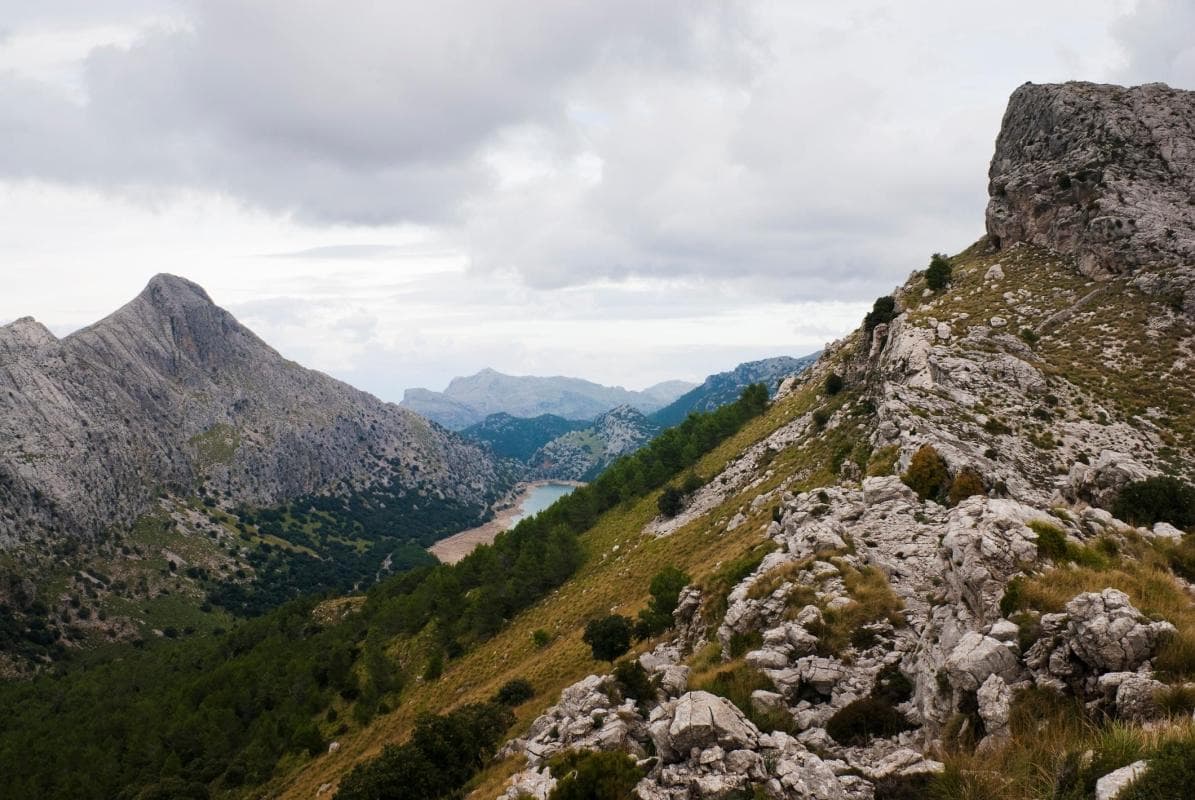
You crest a final limestone rib and the world rearranges itself. Sunlight spills across a quilt of olive terraces, the sea becomes a hard blue line, and a string of villages — Valldemossa, Deià, Sóller — cling to the mountains like bookmarks. The wind here has a voice; it scours the rock, rattles the dry stone walls, and seems determined to point you toward the next outcrop. This is Serra de Tramuntana: Mallorca’s spine, a place where geology, agriculture and human history have been arguing for attention for millennia.
The first steps on a Tramuntana trail are always revealing. Trails alternate between microclimates: shaded forests of holm oak and pine, scrubbed terraces with gnarled olive trees, sudden cliff-edge viewpoints. The limestone is old sea bed — folded, fractured and hollowed into karst that drops into deep ravines and vertical escarpments. Over that rock, centuries of smart, stubborn stewardship have layered terraces, stone stairways and agricultural plots — the famous marges — that still feed mountain villages today.
If the mountain range has a single unifying theme it’s endurance. The GR 221 ‘Dry Stone Route’ threads 160 kilometers along the ridgeline and through valleys, designed for slow travel and respectful passage. Short day hikes give you the same clarity on a smaller scale: a 10–14 km leg of GR 221 often rises 400–800 meters and takes you past shepherd shelters, abandoned farmhouses and shepherd paths that feel at once wild and civilized. For those after a summit, Puig Major — Mallorca’s highest point at 1,445 meters — is a long, steep affair across rough limestone and loose scree. For less vertical itineraries, the walk down Barranc de Biniaraix offers ancient stone stairways, citrus groves and a voice of water daring you onward.
Culture rides alongside the hikes. Villages like Deià and Valldemossa are small but storied: they hosted writers and musicians, and you can still taste their influence in intimate cafés and stone houses. The range was inscribed on the UNESCO World Heritage List in 2011 as a Cultural Landscape — a recognition of the way human agriculture, irrigation and architecture have been married to the mountain’s topography. That legacy also shows up in minuscule ways: a shepherd’s wooden gate stopping the flock, a terrace still producing olive oil, or stacked stone walls that zigzag across slopes.
Wildlife is subtle but present. Look for Bonelli’s eagles or common buzzards wheeling above gullies, hear the clack of alpine choughs, and watch for wild goats on sheer faces. In spring, the scent of lavender and rosemary swells; in summer the air grows dry and the trails bake. Water is never guaranteed on the high ridges, so planning around springs, seasonal torrents and the small village fountains is part of the local rhythm.
For travelers, Serra de Tramuntana is both invitation and honest assessment. It rewards early mornings—sunrise along the ridge cuts the heat and gives you solitude—and it rewards patience: time spent in a village café or on a terrace watching the day shift is as much part of the experience as the hike itself.
Practical guide
Best bets: Pick a stretch of the GR 221 if you want long, connected trails and mountain refuges; aim for day hikes like the Biniaraix to Sóller route (roughly 6–10 km, 200–600 m ascent depending on where you start) for a mix of cultural scenery and reasonable distance. Summit attempts of Puig Major demand 1,000+ meters of ascent from low villages and require good navigation and scrambling comfort.
Timing: Spring (April–June) and fall (September–October) are the sweet spots: temperatures are mild, flowers and scents are at their peak, and water sources are likelier to flow. If you’re in high summer, start before sunrise and carry shade and plenty of water.
Navigation & safety: Trails are generally marked, but stone paths can turn into faint goat tracks; a map, GPS route or local guide is invaluable for longer routes. Wear grippy boots for limestone and loose scree. Cell reception is spotty in valleys and non-existent on some ridges—download offline maps and tell someone your route.
Getting there & where to stay: Palma is the island’s transport hub, but many travelers choose mountain towns such as Sóller, Pollença or Valldemossa as basecamps; they’re closer to trailheads and offer food, gear and transport options. Roads are narrow and winding—take your time and watch for cyclists and buses.
Why go now
Serra de Tramuntana is both accessible and profound: a range where Mediterranean light meets rigorous geology and where centuries of farming practices still shape the land. Whether you come for a quick day hike that ends at a seaside cove or a multi-day slog along the GR 221, the Tramuntana keeps its promises: sweeping viewpoints, human-scale villages, surprising biodiversity and a kind of mountain civility that rewards thoughtful travel.
Leave no trace & local notes
Respect the terraces and gates, move livestock and crops at the right distance, carry out what you bring in, and avoid open fires in dry months. The landscape is resilient but fragile; your small efforts—sticking to trails, minimizing noise and packing out trash—help keep the Tramuntana alive for the next person.
If you want a clear memory to take home, wait for sunset on a ridge above a village. The stone houses glow, the sea softens, and the mountain breathes out; that moment is the Tramuntana distilled.
Length & format note: descriptions of distances and elevation are representative—check local trail guides or refuges for exact legs and seasonal closures before you go.
Trail wisdom
Small choices, better day.
Start early
Summer heat builds fast; begin hikes before 7am to avoid high temperatures and crowds at key viewpoints.
Carry extra water
Water sources can be scarce above 800 meters—bring at least 2–3 liters per person for day hikes and plan refills in villages.
Wear grippy footwear
Limestone shelves and loose scree require sturdy boots with good traction and ankle support.
Respect terraces and gates
Close gates, step over dry stone walls where appropriate, and avoid stepping on cultivated terraces to protect local agriculture.
Local knowledge
Read the place, not just the route.
Watch for native species including Bonelli’s eagle, Iberian ibex (wild goats).
Keep an eye out for wildlife during the transition between areas and habitats. Respect distance guidelines.
UNESCO listing recognizes the cultural and natural value; visitors should stick to paths, respect agricultural areas and avoid disturbing wildlife.
Follow the guide's instructions on size limits, ethical handling, and leave-no-trace practices.
Walk the stone stairway of Barranc de Biniaraix early morning for soft light and local life. Explore the tiny hamlet trailheads around Lluc for quiet stony paths and a monastery stop
Locally recommended viewpoints and quiet spots known best to local operators.
The Serra de Tramuntana is a cultural landscape shaped over centuries by terrace farming, irrigation and stonework; its human footprint is as significant as its geology.
Maritime roots and regional tradition shape the waterways and working coasts.
Seasonal guide
Four versions of the same landscape.
Spring
Best forwildflowers and scents · mild daytime temperatures · fuller water sources
Challengesmuddy sections after rain · variable high-elevation weather
Spring is ideal for colorful trails, active streams and comfortable hiking conditions—expect cool mornings and warmer afternoons.
Summer
Best forlong daylight hours · coastal swims after hikes
Challengeshigh heat and sun exposure · reduced water flow, wildfire risk
Hot and dry—start early, carry shade and plenty of water; avoid long exposed ridge hikes in mid-afternoon.
Fall
Best forstable weather · fewer crowds · harvest season in villages
Challengesshortening daylight · cooler nights at elevation
Fall mirrors spring’s pleasant hiking weather with warm days and crisp evenings—great for longer multi-day sections.
Winter
Best forquiet trails · dramatic light and storms
Challengesrain, possible snow on highest peaks · some refuges and services close
Milder than many mountain ranges but variable—be prepared for wet, windy conditions and check local openings.
Pack with intention
What to bring.
Good to know
Common questions.
No—many trails are accessible independently—but guides are useful for multi-day routes, obscure paths, or summit attempts where navigation is tricky.
Plan the edges
The details that make the day easier.
The Serra de Tramuntana was designated a UNESCO World Heritage Site in 2011 for its cultural landscape of terraces, irrigation systems and traditional dry-stone construction.
Mountain villages serve anchovies, sobrassada and freshly pressed olive oil; visit local markets in Sóller or Pollença for citrus and almond cakes, and sip a coffee in a stone plaza to watch mountain life unfold.
- Nearest airports
- Palma de Mallorca (PMI). Best bases: Sóller, Valldemossa, Pollença. Maps: GR 221 guides and offline GPS. Water: limited above 800m—carry supplies.
Stick to marked trails, carry out all waste, avoid lighting fires, support local producers (olive oil, honey) and use established accommodations to help maintain the cultural landscape.
Explore by topic
Follow the threads.
Keep exploring
Make the story part of the trip.
Set out from Bass Harbor for a private, customizable day on Blue Hill Bay — lighthouses, puffins, seals, and the chance to feel Acadia from the water. Small groups, local captains, unforgettable views.
In four hours you can move from shaded canyon ferns to wind-scoured coastal ridgelines, guided by someone who knows where the light—and the hidden views—live. This private half-day hike on the Monterey Peninsula or Big Sur is compact, curated, and perfect for travelers who want depth without a multiday commitment.
 Related story
Beneath a sky of shifting light, Skaftafell’s ice reads like a map of time. This three-hour guided glacier hike mixes technical instruction with geology and culture: compact, safe, and unforgettable.