
What the day feels like
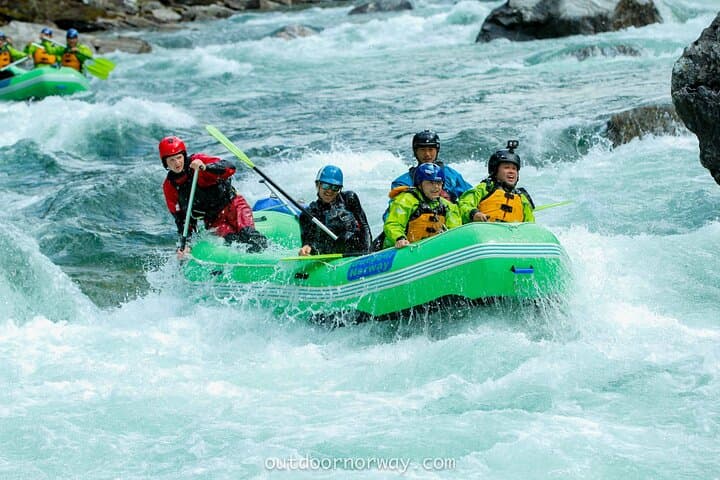
The river appears almost casual at first: a ribbon of mirror between steep, spruce-lined banks, glinting where the sun slips through a scatter of clouds. Then the current narrows and the surface tightens into the instant you recognize as power — water leaning into itself, churning with a noise like distant machinery. Guides shout, oars cut, and the raft answers, finding pockets and eddies as if the river is daring you to keep up. This is the Play Section of the Raundal river, a three-hour run that packs a series of Grade III rapids into a compact, demanding—and joyful—stretch of Norwegian whitewater.
You don’t need to be elite to feel alive here. The trip marketed as Whitewater Rafting in Raundal Valley is designed around moments: a sudden, high-shouldered drop that turns your stomach into a camera shutter; a calm eddy where the raft spins and everyone’s laughter rises; and long glides under carved cliffs that were once shaped by glaciers. It’s a sequence of contrasts — playful surf waves and technical, lined rapids — that give the section its nickname and make it a favorite for both first-time rafters who are fit and experienced paddlers seeking a concentrated dose of adrenaline.
Raundal (Raundalen) sits in Vestland county, the lush corridor between fjords and high mountains that helped define Norway’s dramatic post-glacial landscape. The valley’s bedrock is ancient gneiss and schist, and during the last Ice Age, massive ice sheets gouged the troughs and left behind steep valley walls and fast, confined rivers. Locals have long used these waterways for transport, sawmills and, more recently, tourism. Voss, the nearest adventure hub, has a reputation as Norway’s action-sports capital; it’s the staging town for rafting, paragliding and Ekstremsportveko, the country’s now-famous extreme sports festival.
Beyond the geology and thrills, there’s an understated culture to the experience. Guides are often local — part mountain guide, part river custodian — and they combine practical coaching with a conversational knowledge of the valley’s farms, trout runs and seasonal snowmelt rhythms. You’ll hear about how runoff from the mountains swells the river in late spring and early summer, why mid-summer is the sweet spot for steady flow without the full fury of snowmelt, and which bends hide smooth pools for a quick swim when conditions allow.
Practical details matter here. The official run is three hours door-to-door on the water; expect a total outing time closer to 3–4 hours including gear-up, safety briefing and the short approach to the launch. The rapids are rated predominantly Grade III — fun, pushy and technical, with clean lines and play waves rather than relentless, punchy hydraulics. The physical demands are moderate: you’ll be paddling on command, bracing during waves and occasionally scrambling over wet rocks when exiting for a portage. The trip price generally starts at about USD 177 per person and the operation averages exceptional feedback — roughly 204 reviews and an aggregate rating around 4.9, which speaks to consistent safety and guide quality.
How to prepare: choose footwear that won’t slip and will stay on in the river (neoprene booties or strapped sandals), and wear layers that dry quickly. Many operators provide wetsuits, helmets and life jackets, but check before you arrive. Hydration is key: even cold-weather paddling can dehydrate you quickly when the heart is beating in the spray and wind. Arrive ready to listen — your lead guide will give line-by-line directions for the trickier rapids. This isn’t a free-for-all; teamwork is the whole point.
Timing your visit is straightforward. Late June through August hits the sweet spot for stable flows, long daylight and manageable air temperatures. Spring can deliver higher water that ups the difficulty; fall brings crisp light and quieter runs but colder water. Winter is off-season here for rafting and best left to skiers and fjord-watchers.
Safety and stewardship are part of the trip’s DNA. Rafting in a valley carved by glaciers requires respect for shifting water levels and a willingness to follow the guide’s decisions — including the possibility of portaging a rapid if water conditions aren’t favorable. Leave no trace policies are enforced: pack out anything you bring and avoid trampling the riparian vegetation that slows erosion and feeds trout populations.
If you’re plotting this into a longer Norwegian trip, couple the run with a day in Voss for local food, thermal pools or a short hike into the valley brow for a broader view. For photographers, the point where the raft threads a narrow chute with a backdrop of mossy cliffs presents a cinematic frame, but don’t sacrifice safety for the shot — keep cameras secured with straps or leave them with a dry bag on shore.
In the end, the Raundal Play Section is a concentrated expression of what makes Norwegian adventure travel so satisfying: clean, cold water; efficient, low-friction logistics; and terrain that insists on your full attention. Whether you’re a paddler eager to line up waves or a curious traveler chasing something more immediate than a postcard of the fjords, this three-hour run delivers clarity: the river asks, you answer, and for a short, bright while, the valley belongs to motion.
Why go: it’s a compact, world-class set of rapids in a scenic glacial valley, run by pros who prioritize both play and safety. The timing is purposeful — three hours of guided water time provides enough action to satisfy but doesn’t require an entire day away from exploring the surrounding region.
Bottom line: pack a sense of teamwork, a bit of bravery and a camera in a dry bag. The Raundal Play Section will give you the clean lines, surfy rapids and post-run grin that make rafting one of the purest ways to experience Norway’s wild interior.
Trail wisdom
Small choices, better day.
Dress for immersion
Wear quick-drying layers and secured footwear; neoprene booties or river sandals with straps work best.
Hydrate before and after
Cold river spray can mask dehydration—drink water before boarding and bring a secure water bottle to sip afterward.
Listen to your guide
Commands on the raft are concise and matter—ready position and timing keep the boat stable through technical moves.
Secure valuables
Use a small dry bag for phones and cameras or leave them with staff—straps alone aren’t enough in surfy rapids.
Local knowledge
Read the place, not just the route.
Watch for native species including Atlantic salmon (seasonal runs), Eurasian otter along quieter riffles.
Keep an eye out for wildlife during the transition between areas and habitats. Respect distance guidelines.
Operators emphasize Leave No Trace: avoid trampling banks, pack out all waste, and use biodegradable sunscreen to protect aquatic life.
Follow the guide's instructions on size limits, ethical handling, and leave-no-trace practices.
A short post-run walk to a quiet side pool favored by local swimmers. Scenic viewpoint on the valley ridge that looks back over the Play Section
Locally recommended viewpoints and quiet spots known best to local operators.
The valley was heavily shaped by Pleistocene glaciers; historically, small farms in Raundal relied on the river for timber transport and water-powered mills.
Maritime roots and regional tradition shape the waterways and working coasts.
Seasonal guide
Four versions of the same landscape.
Spring
Best forHigh flows · Fewer crowds
ChallengesColder water · Variable flows
Spring snowmelt raises flows, making some rapids faster and more technical—best for experienced paddlers or guided runs that adjust lines.
Summer
Best forStable flows · Warmer air · Long daylight
ChallengesHigher visitor numbers · Occasional low flows late season
Summer is the prime season for reliable, playful water, comfortable temperatures and predictable logistics.
Fall
Best forCrisp light · Quiet runs
ChallengesColder air and water · Shorter days
Fall offers quieter rivers and vivid valley colors; dress warmer and expect chillier swims.
Winter
Best forScenic winter valley views from shore
ChallengesNot suitable for rafting · Limited services
Rafting operations are generally off-season—winter is for skiing and planning your summer return.
Operator details
What the booking data adds.
Included
- ✓Inflatable Raft
- ✓Raft Paddle
- ✓PFD (personal floatation device) - Life Jacket
- ✓Wetsuit
- ✓Professional River Guide
- ✓Footwear in neoprene and rubber for water activities
- ✓Splash Jacket
- ✓Transport to and from the river
Good to know
- ✓Service animals allowed
- ✓Public transportation options are available nearby
- ✓Suitable for all physical fitness levels
Pack with intention
What to bring.
Good to know
Common questions.
The guided experience is approximately three hours of on-water time, with total outing time closer to 3–4 hours including briefing and gearing up.
Plan the edges
The details that make the day easier.
Voss, the nearest adventure hub, hosts Ekstremsportveko (Extreme Sports Week), one of the world's largest extreme sports festivals, drawing athletes to the region each summer.
After the run, head back to Voss for locally brewed beer and brunost-topped open sandwiches at a café; for a heartier meal, try regional lamb or freshly smoked trout at a farm-to-table spot—locals favor simple, rustic flavors after a day outdoors.
- Closest airport
- Bergen Airport Flesland (BGO); Drive to Voss ~1.5 hours from Bergen; meeting point often in Voss or a short transfer from Bergen—confirm with operator; cell service: intermittent in the valley, good in towns; permits: none required for commercial runs, but follow operator rules.
This river corridor supports sensitive riparian habitats—pack out waste, avoid single-use plastics, and use biodegradable personal-care products to protect aquatic life.
Explore by topic
Follow the threads.
Keep exploring
Make the story part of the trip.
Set out from Bass Harbor for a private, customizable day on Blue Hill Bay — lighthouses, puffins, seals, and the chance to feel Acadia from the water. Small groups, local captains, unforgettable views.
In four hours you can move from shaded canyon ferns to wind-scoured coastal ridgelines, guided by someone who knows where the light—and the hidden views—live. This private half-day hike on the Monterey Peninsula or Big Sur is compact, curated, and perfect for travelers who want depth without a multiday commitment.
 Related story
Beneath a sky of shifting light, Skaftafell’s ice reads like a map of time. This three-hour guided glacier hike mixes technical instruction with geology and culture: compact, safe, and unforgettable.