
What the day feels like
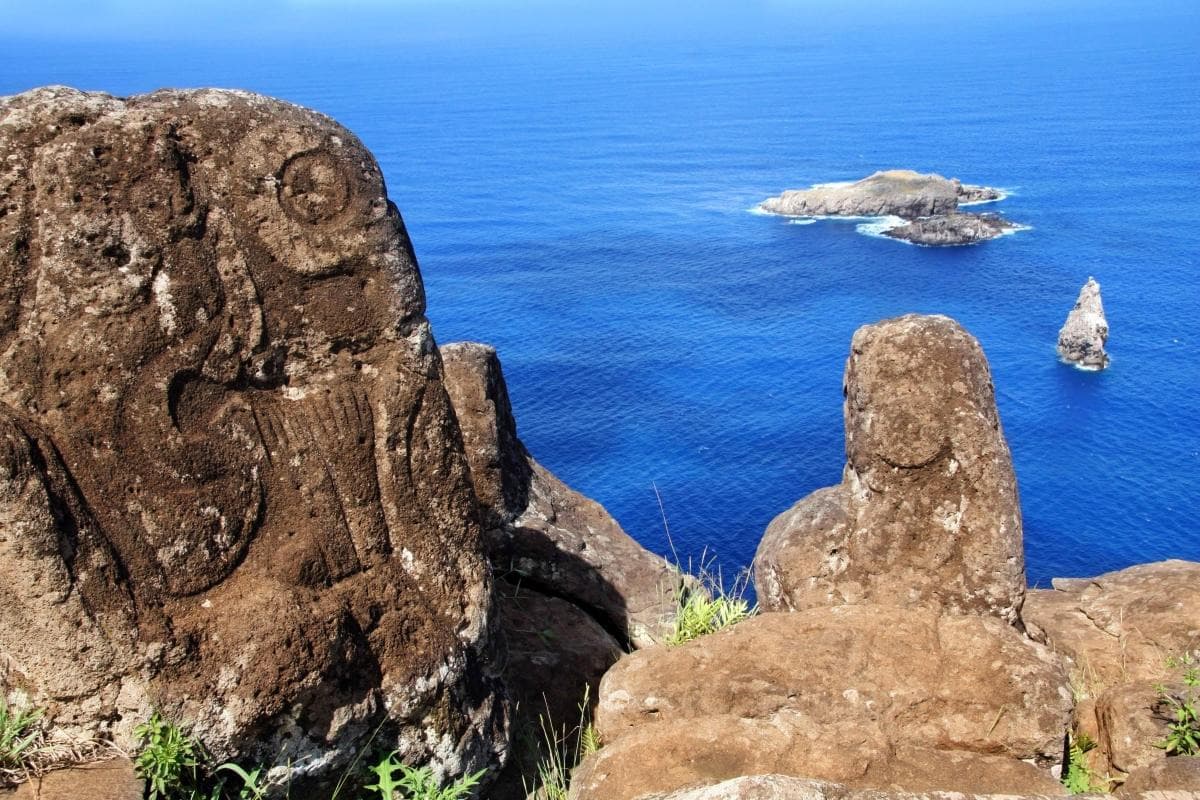
The wind on Rapa Nui is not a gentle breeze; it arrives like a verdict. It slants across the lip of Rano Kau, pushes at your jacket, and carries salt and seabird calls from the cliffs below. At Orongo, the stone foundations of circular houses hug the crater’s edge as if to stay tethered to the island’s last great rite — the Tangata Manu, or Birdman competition. One moment you’re walking among broken walls and carved petroglyphs; the next you’re looking over a raw, vertical drop to the South Pacific and three tiny motu—Motu Nui, Motu Iti and Motu Kao Kao—floating like punctuation marks on the water. It’s an abrupt, vivid kind of remoteness: human history balanced on volcanic geology and relentless ocean.
Orongo isn’t a single monument so much as a hinge between worlds. It occupies the western rim of Rano Kau, one of the three volcanoes that stitched together what became Easter Island. The village’s roughly 50 stone houses were once ceremonial dwellings, packed in on the rim like stone beehives. The Birdman competition that took place here in the 18th and 19th centuries replaced the era of moai erection and spoke to a society adapting to new religious and political realities. Pilgrims gathered at Orongo to watch competing delegates swim to Motu Nui, harvest the first sooty tern egg, and climb back with the prize; the winner’s patron enjoyed a year of prestige and privileges.
Geologically, Rano Kau is a wide, shallow caldera whose inner slopes cradle a freshwater lake. The rim at Orongo sits roughly 200–300 meters above sea level and cuts a dramatic profile against the sky. Your first look down into the crater reveals a microclimate of grasses and reeds — a soft, green counterpoint to the wind-swept stone above. Beyond, the cliffs plunge sheer to the ocean, evidence of the island’s violent volcanic birth and the slow chiseling action of waves and wind.
Walking Orongo is a study in textures. Footsteps on compacted earth shift to volcanic scoria and ancient flagstones; the low stone walls, some only knee-high now, whisper the scale and arrangement of once-busy households. Petroglyphs along the path — stylized birdmen, lines of concentric eyes — are patient and terse, carved by hands now centuries gone. Local guides, many from Hanga Roa, weave archaeology and oral history with a practical, sometimes wry sensibility. They’ll explain the archaeological consensus on the Birdman rite, discuss the moai’s toppled state and how European contact altered everything, and then point out a modern-day Rapa Nui family tending crops below the rim.
Orongo’s cultural resonance is immediate. It’s not just a set of stones; it’s a story still lived in community rituals, in language spoken by elders, and in the islanders’ stewardship. The national park that protects Rapa Nui limits access to sensitive areas, and interpretation emphasizes respect — don’t climb on ahu platforms, stay on designated paths, and follow your guide’s directions. Those rules aren’t bureaucratic curlicues; they are the thin buffer between a place that can survive for another hundred years and one that can’t.
Practically, a visit to Orongo is accessible but requires intention. Most guided circuits from Hanga Roa — the island’s only town — include Orongo as a half-day stop on a longer loop that also takes in Rano Raraku and Ahu Tongariki. On foot, the site involves modest walking over uneven terrain with ups and downs; the crater rim stroll is short — think 1–2 kilometers with panoramic viewpoints — but exposed. Expect wind and sun more than steep climbing. If you’re coming as part of a broader itinerary, set aside at least 90 minutes to two hours to move carefully, read the petroglyphs, and find a quiet place on the rim to watch light shift over Motu Nui.
The best time for photographs and solitude is early morning or late afternoon, when the sun sculpts the stone and the wind often drops a touch. Bring layers: the weather can flip from sharp sun to chilling gusts in minutes. Footwear should be sturdy—trail shoes or light hiking boots—and water is non-negotiable. Guides will add value beyond convenience; they’ll place the visible archaeology in chronological order, explain why Orongo’s stone houses are arranged the way they are, and point out details you’d miss if you moved too quickly.
Orongo is also a lesson in scale. Up close the carved birdman figures are intimate, human—small in scale but enormous in implication. From the rim, the sheer verticality of the cliffs makes you feel the raw force of the Pacific. That tension — between tiny carved hands and the ocean’s immensity — is the core of the place’s power.
For travelers, Orongo delivers an experience that mixes walking, cultural immersion, and photography with a steady dose of weathered geology. It’s not a strenuous hike so much as a place that rewards patience. Take your time on the rim, listen to your guide, and imagine the long line of swimmers who once dove from these cliffs into cold water for the sake of a scrambled bird’s egg. You’ll leave with facts — number of stone houses, the mechanics of the Birdman competition — and with a different kind of souvenir: the memory of wind on a volcanic edge and the knowledge that on this small island, human stories have always been written on a large, often unforgiving landscape.
Trail wisdom
Small choices, better day.
Dress in windproof layers
The rim is exposed; bring a windbreaker and a warm mid-layer even on sunny days.
Wear sturdy footwear
Expect uneven volcanic rock and short stair sections—trail shoes or light boots make the site far more comfortable.
Carry water and sun protection
There’s little shade; carry at least 1 liter of water, a hat and SPF for a 1–2 hour visit.
Respect designated paths
Stay off fragile ahu and follow guide directions to protect petroglyphs and archaeology.
Local knowledge
Read the place, not just the route.
Watch for native species including sooty tern, masked booby.
Keep an eye out for wildlife during the transition between areas and habitats. Respect distance guidelines.
Strict pathing and park fees help protect fragile petroglyphs and soil from erosion; local guides enforce rules and support community-led stewardship.
Follow the guide's instructions on size limits, ethical handling, and leave-no-trace practices.
Motu Nui viewpoint at dawn — fewer crowds and strong light for photos. Puna Pau red scoria quarry — lesser-visited site linked to moai eyes and hats
Locally recommended viewpoints and quiet spots known best to local operators.
Orongo became the ceremonial center for the Birdman cult after the moai era; competitors swam to Motu Nui to retrieve the first sooty tern egg and secure political power for their sponsor.
Maritime roots and regional tradition shape the waterways and working coasts.
Seasonal guide
Four versions of the same landscape.
Spring
Best formilder temperatures · fewer rains · wildflowers in the crater
Challengeswindy days · variable weather swings
Southern spring (Sept–Nov) brings pleasant days and crisp mornings — ideal for visiting Orongo when colors are fresh and crowds are moderate.
Summer
Best forlong daylight hours · calmer seas for boat views · full tour schedules
Challengesmore tourists · occasionally heavier clouds and brief showers
Summer (Dec–Feb) has the warmest daytime temperatures and busiest visitor season; book guided tours in advance.
Fall
Best forgolden light for photography · cooler afternoons · fewer crowds after peak
Challengesincreased wind frequency · shorter days
Autumn (Mar–May) offers stable light and thinner crowds; afternoons can feel brisk as winds pick up.
Winter
Best fordramatic skies · off-season quiet · budget travel
Challengescooler temps · occasional rain · short daylight
Winter (Jun–Aug) is cooler and wetter; still rewarding for those prepared with layers and flexible schedules.
Pack with intention
What to bring.
Good to know
Common questions.
Plan 1–2 hours to walk the site at a relaxed pace, photograph the cliff views, and listen to interpretation from a guide.
Plan the edges
The details that make the day easier.
Orongo contains roughly 50–53 circular stone houses and was the ceremonial center for the Birdman competition that determined political power after the moai era — a historic shift in Rapa Nui society.
Hanga Roa’s small restaurants serve fresh fish ceviche and traditional po'e (a sweet baked fruit pudding). Evenings bring live music and dance performances (ronda) where local culture and storytelling continue the island’s oral traditions.
- Location
- West rim of Rano Kau, 6–10 km from Hanga Roa; Time: 1–2 hours onsite; Difficulty: moderate; Park fee required; Best time: early morning or late afternoon for light and fewer crowds.
Stick to marked trails, hire local guides, avoid single-use plastics, and refrain from touching petroglyphs—these small actions minimize erosion and protect cultural heritage.
Explore by topic
Follow the threads.
Keep exploring
Make the story part of the trip.
Set out from Bass Harbor for a private, customizable day on Blue Hill Bay — lighthouses, puffins, seals, and the chance to feel Acadia from the water. Small groups, local captains, unforgettable views.
In four hours you can move from shaded canyon ferns to wind-scoured coastal ridgelines, guided by someone who knows where the light—and the hidden views—live. This private half-day hike on the Monterey Peninsula or Big Sur is compact, curated, and perfect for travelers who want depth without a multiday commitment.
 Related story
Beneath a sky of shifting light, Skaftafell’s ice reads like a map of time. This three-hour guided glacier hike mixes technical instruction with geology and culture: compact, safe, and unforgettable.