
What the day feels like
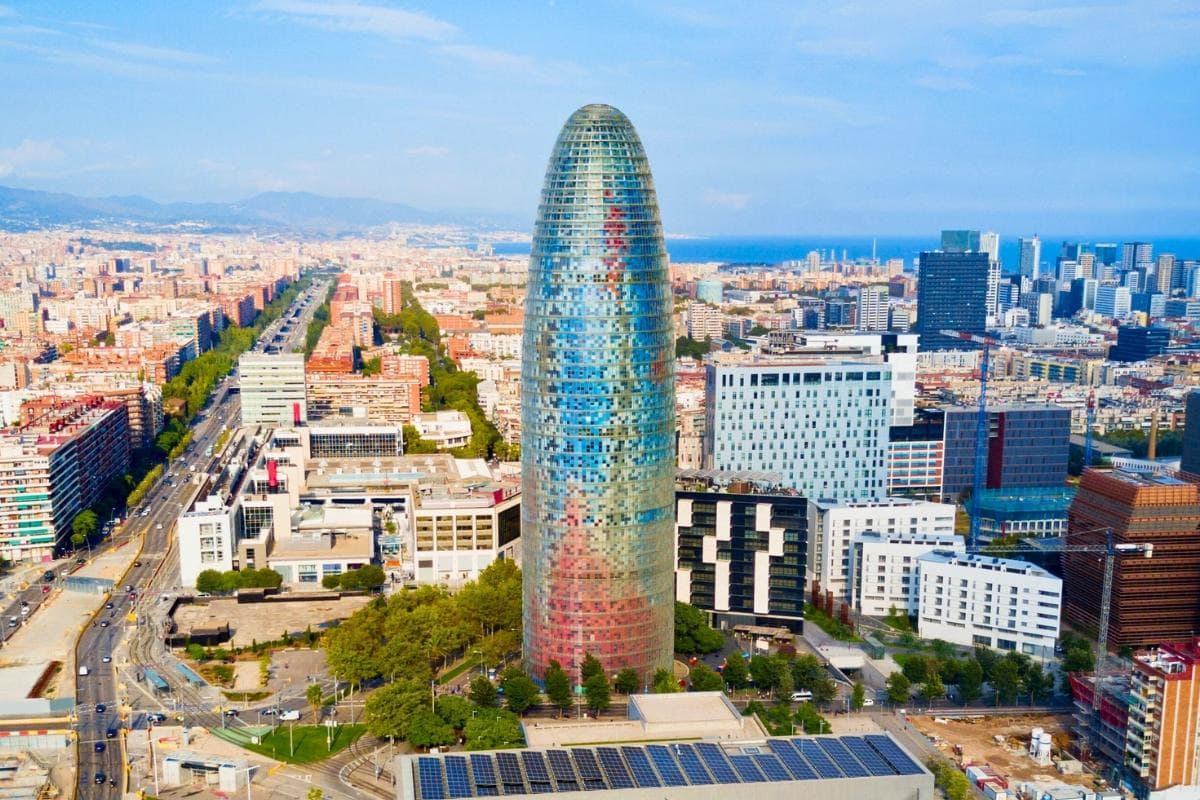
At dusk, Torre Glòries wakes with a pulse. The 144-meter bullet of glass and aluminum looks less like a building and more like a lighthouse for the city’s modern ambitions—its multicolored LED skin cycling through patterns that make the surrounding avenues feel like a stage. You can stand on Avinguda Diagonal and feel the tower’s light washing over the square, or drift along the nearby Rambla del Poblenou and watch it punctuate the skyline, a marker between old industrial blocks and sleek new developments. For travelers who come for architecture and stay for the neighborhood, Torre Glòries is both compass and destination.
Jean Nouvel’s landmark—formerly known as Torre Agbar—arrived in the early 2000s as a statement: Barcelona would not be trapped in its modernista past, it would also reinvent itself for the 21st century. The form references local geology and the serrated profile of Montserrat, while the façade’s thousands of glass louvers give the tower a skin that breathes and changes. Completed in 2005, the building sits at Plaça de les Glòries Catalanes, where the post-industrial district of Poblenou has been remade into a testing ground for urban renewal—tech offices, creative studios, and a new generation of cafés and galleries.
The best way to understand Torre Glòries is to move around it rather than stand directly beneath it. The tower reads differently from every angle. From the Barceloneta waterfront it becomes a dot of light on the spine of the city; from the quieter streets of Poblenou its reflective skin mirrors red brick warehouses and the graffiti of a neighborhood still defining itself. Local guides frame visits in context: a private modern architecture tour will place Nouvel’s work alongside the Barcelona Pavilion and contemporary interventions by Foster and Hadid, while off-the-beaten-path bike tours thread the tower into a narrative about industrial migration, Olympic-driven redevelopment and the rise of the 22@ innovation district.
There’s practical choreography to visiting. Daytime visits let you study the complex geometry of the façade and the subtle way it captures Mediterranean light; evening visits deliver the LED show—an especially good pick for photographers who want to pair a long exposure of the tower with the warm lights of nearby cafés. For a different vantage, night e-bike tours and GoCar storytelling routes put you in motion: the city’s lighting scheme changes the tower from a static object into a moving companion as you pass municipal markets, converted factories and seaside avenues. If you want even broader perspective, several private yacht and sailing options head out from Port Vell so you can see Barça’s skyline—Torre Glòries included—framed by the Mediterranean.
Beyond aesthetics, Torre Glòries is part of an urban story. Poblenou’s factories—once the beating heart of Barcelona’s industry—gave way to the 1992 Olympic overhaul and a later tech-driven makeover. The tower’s placement at the junction of Diagonal and the ring roads is deliberate; it acts as an urban fulcrum, a visual anchor that links historic Eixample geometry with a more experimental eastern shore. While the tower is primarily an office building with periodic public exhibitions rather than a conventional tourist site, the surrounding public spaces and the careful curation of tours mean you can make a full half-day—or an evening—of the visit.
Plan smart: the tower is easily reached by Metro L1 (Glòries) and a dense web of buses; cycling lanes lead into the heart of Poblenou. Timing matters. Come in the late afternoon to feel the quality of the light and linger for the tower’s lighting spectacle after sunset. If your aim is photography, blue hour plus a tripod win the day; if your aim is context, book a private architecture tour that bookmarks Nouvel’s work with regional Modernista and contemporary pieces. If you’re short on time, a four-hour bike tour of Poblenou and the 22@ district will pack in the highlights—historic cemetery, old factories, and newly planted plazas—while explaining how Torre Glòries fits into Barcelona’s ongoing reinvention.
Practicalities are straightforward but worth noting. Wear comfortable shoes—the neighborhood is flat but lively walking surfaces and tram tracks mean sensible soles are a must. Barcelona’s micro-climate on the coast is forgiving, but wind can make the area feel cooler after sunset; layer up. Respect private property: much of Torre Glòries is office space, and while there are occasional exhibitions, interior access is limited. The tower is best appreciated as an urban landmark you move around, photograph, and tie into broader explorations of Poblenou’s cafés, markets and waterfront.
Why bother? Because Torre Glòries is where Barcelona shows its future-facing face. It’s not a replacement for the Sagrada Família or Parc Güell; it’s a reminder that the city can be both rooted and restless. Pair a morning spent in modern architecture with an afternoon bike ride through Poblenou, cap it with the tower lighting at dusk, and you’ll leave with a more complete sense of how Barcelona’s skyline is changing—and what that change says about cities in the twenty-first century.
Suggested activities that pair well: a private modern architecture tour to learn the building’s design context; an off-the-beaten-track bike ride through Poblenou to taste the neighborhood’s texture; an e-bike night tour to see the tower glow while the sea breeze cools the air; or a short yacht cruise for a skyline view framed by Mediterranean light.
Torre Glòries is less monument than marker: an invitation to explore an area where light, glass and urban reinvention meet. Go with curiosity, a charged camera, and a map that lets you keep moving.
Trail wisdom
Small choices, better day.
Time it for blue hour
Arrive in late afternoon to study the façade in natural light, then stay for the LED display after sunset for the most dramatic photos.
Combine with a Poblenou bike tour
A guided bike tour connects the tower with nearby modern architecture, converted factories, and local cafés in a compact half-day.
Use public transit or a city bike
Glòries metro stop (L1) and multiple tram and bus lines serve the area—parking is limited and traffic can be heavy.
Respect access limits
Torre Glòries is primarily office space—interior visits are occasional, so plan for exterior viewing and guided tour stops.
Local knowledge
Read the place, not just the route.
Watch for native species including Mediterranean gulls along the waterfront, Urban-dwelling peregrine falcons and common city birds like house sparrows.
Keep an eye out for wildlife during the transition between areas and habitats. Respect distance guidelines.
The façade uses an energy-efficient LED system; visitors are encouraged to use public transport and respect lighting curfew initiatives to minimize light pollution and local disturbance.
Follow the guide's instructions on size limits, ethical handling, and leave-no-trace practices.
Cementiri del Poblenou – a striking neoclassical cemetery with evocative sculpture. Mercat dels Encants (Fira de Bellcaire) – one of Europe’s oldest flea markets with surprising finds and a rooftop viewpoint
Locally recommended viewpoints and quiet spots known best to local operators.
Torre Glòries was completed in 2005 and symbolized the transformation of industrial Poblenou into Barcelona’s modern 22@ innovation district following major urban renewal efforts after the 1992 Olympics.
Maritime roots and regional tradition shape the waterways and working coasts.
Seasonal guide
Four versions of the same landscape.
Spring
Best forcomfortable walking and bike tours · mild weather photography
Challengesoccasional rain showers · variable evening temperatures
Spring offers mild conditions ideal for strolling around Poblenou or joining a bike tour—bring a light rain layer and expect crisp evenings.
Summer
Best forlate-night LED viewing · combined beach and city days
Challengesheat during midday · crowds and festival-related closures
Summer gives the longest evenings for post-sunset light shows; avoid midday heat by scheduling indoor museums or a seaside swim in the afternoon.
Fall
Best forarchitecture-focused walks · less crowded streets
Challengesshorter daylight hours · sporadic rain
Fall cools the streets and sharpens the light—perfect for detailed façade study and quieter tours, though sunset comes earlier.
Winter
Best forcrisp night photography · indoor architecture exhibits
Challengeschill from the sea breeze · fewer outdoor events
Winters are mild but breezy; layer up for night shoots and prioritize indoor architectural tours when possible.
Pack with intention
What to bring.
Good to know
Common questions.
Torre Glòries is primarily an office building with occasional exhibitions; regular public access is limited—check event listings or book a guided architecture tour that includes curated indoor visits when available.
Plan the edges
The details that make the day easier.
Torre Glòries (formerly Torre Agbar) was designed by Jean Nouvel and completed in 2005; it stands approximately 144 meters tall and is a prominent example of Barcelona's 21st-century architectural expansion.
Poblenou blends old industrial canteens and modern cafés—sample a vermut at a local bar, try fresh seafood near the beach, and spot street art that frames the neighborhood’s creative pulse.
- Know-before-you-go
- Metro L1 Glòries; primary photo times—late afternoon to post-sunset; interior access limited—book a guided architecture tour; flat walking terrain; wallet-friendly cafés nearby.
Favor public transit, electric bike tours, and certified local guides; respect lighting restrictions and avoid light-intensive night shoots that can disturb residents and wildlife.
Explore by topic
Follow the threads.
Keep exploring
Make the story part of the trip.
Set out from Bass Harbor for a private, customizable day on Blue Hill Bay — lighthouses, puffins, seals, and the chance to feel Acadia from the water. Small groups, local captains, unforgettable views.
In four hours you can move from shaded canyon ferns to wind-scoured coastal ridgelines, guided by someone who knows where the light—and the hidden views—live. This private half-day hike on the Monterey Peninsula or Big Sur is compact, curated, and perfect for travelers who want depth without a multiday commitment.
 Related story
Beneath a sky of shifting light, Skaftafell’s ice reads like a map of time. This three-hour guided glacier hike mixes technical instruction with geology and culture: compact, safe, and unforgettable.