
What the day feels like
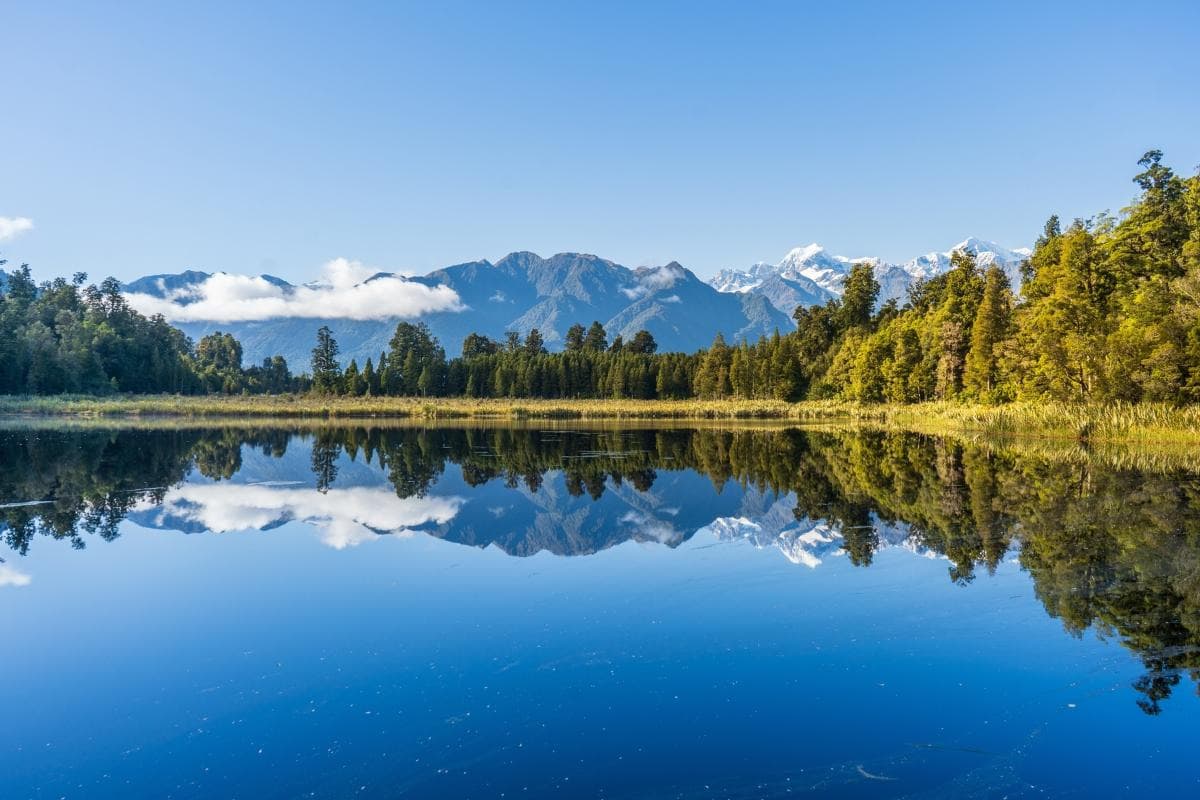
The boardwalk hums under your boots and the rainforest exhales. As you round the final curve of the Lake Matheson loop the trees part as if on cue, and the world flips itself over: Aoraki/Mount Cook and Rangitira/Mount Tasman stand inverted, razor-sharp, on the lake’s skin. Wind-wise, the surface is a sheet of glass—the mountains a second sky you can step toward. It’s the kind of quiet that lands between breaths, and the reason locals call this place New Zealand’s ‘‘mirror lake.’n Lake Matheson is compact—barely 2.6 kilometers around on the well-formed Great Short Walk—and it gives back a disproportionate amount of drama. Situated in Westland Tai Poutini National Park on the South Island’s rain-splattered West Coast, the walk threads raised boardwalks and forest tracks through podocarp and rimu, crosses small bridges over clear mountain streams, and finishes with a handful of viewing platforms perfectly positioned for reflection portraits. The path is flat, family-friendly and can be savored in under an hour, but most visitors plan for 1–2 hours to chase light and linger.
Geologically, Lake Matheson is a product of glaciers and time. Retreating ice carved valleys and left moraines that dammed meltwater, and the nearby peaks—Aoraki/Mount Cook at 3,724 meters and the slightly shorter Mount Tasman—were forged by the same tectonic theater that raised the Southern Alps. The lake’s reflective fame depends on two simple variables: calm air and clean light. When the wind dies at dawn or dusk and the rainclouds break, those towering summits catch themselves in the water like a mirror putting on makeup.
There’s cultural weight here, too. Aoraki is a sacred ancestor in local Ngāi Tahu stories, central to Māori identity and cosmology in Te Waipounamu (the South Island). The region’s communities—small settlements such as Fox Glacier (Kā Roimata o Hine Hukatere) and Franz Josef—have built livelihoods around guiding and hospitality while working to protect the fragile rainforest and river corridors that feed lakes like Matheson.
Practicalities are refreshingly simple. The Lake Matheson Walk begins at the day-use parking area off State Highway 6, just north of Fox Glacier village and roughly a 20–30 minute drive from Franz Josef township. The loop distance is roughly 2.6 km (1.6 miles); elevation gain is negligible—under 50 meters—making it accessible to most walkers. Track surfaces alternate between compacted gravel, raised boardwalk and short stair sections; sturdy walking shoes or light hikers are appropriate. Most people visit at dawn or in the hour before sunset for still water and the richest color, but midday can be rewarding after a rain when the forest feels saturated and the light is jewel-like.
If you prefer to travel with local context, Glacier Valley Eco Tours operates a dedicated Lake Matheson Nature Tour that departs from Franz Josef and picks up in Fox Glacier, delivering you to the trailhead with guided interpretation on the lake’s history and reflection conditions. Larger small-group tours traveling the West Coast—between Queenstown, Wanaka, Franz Josef and Christchurch—also stop at the lake, making it an easy add-on for people moving between regional hubs.
Timing and weather are the twin variables. The West Coast has a temperate, ocean-influenced climate and is famously wet; heavy rain will blur reflections and make tracks slippery. But light showers can bring those emerald greens to life and attract birds that seem unusually bold. On the rare windless evenings, set up on the main viewing platform, switch to a wide-angle lens, and wait—reflections evolve like performances.
Leave no trace is more than a catchphrase here: the boardwalk protects understory plants, and the lake’s clarity depends on intact forest and stable streambanks. Stick to marked tracks, carry out any waste, and consider a guided tour that contributes to local conservation fees.
How to approach the visit practically: arrive early if you want mirror conditions at the main viewpoint; bring a light rain shell even on fair forecasts; and give yourself time to explore the side platforms and the smaller lookouts that frame different compositions of mountain and forest. Families will find the route forgiving; photographers will find their patience rewarded; those after a short nature fix will find a satisfying rhythm—trees, water, reflection, repeat.
On quieter days, the soundscape changes: water drips from leatherleaf, tui and bellbird cut through the hush, and the lake’s surface takes on wind-sketched ripples that are interesting in their own right. For those on multi-day West Coast itineraries, Lake Matheson is an essential pause between the kineticism of glacier hikes and the long haul roads over Haast Pass toward Wanaka.
If you want an integrated experience, book a guided Lake Matheson Nature Tour—guides time visits for optimal light, share Taonga (stories) about local Māori connections to the mountains, and can fold the walk into a broader West Coast day including glacier viewpoints. Otherwise, the walk is self-sufficient: simple to get to, easy to complete, and impossible to forget once you’ve seen a mountaintop lay itself flat on water.
In the end, Lake Matheson is a lesson in how scale and stillness amplify each other: a modest lake with a monumental view, where weather and silence conspire to show the Southern Alps upside down. It’s small-adventure perfection for anyone willing to stand still and watch a mountain breathe.
Trail wisdom
Small choices, better day.
Time your visit for mirror conditions
Arrive at dawn or within an hour of sunset when winds are light for the best reflections of Aoraki/Mount Cook.
Wear grippy footwear
Boardwalks can be slick after rain; lightweight hiking shoes with good tread keep you sure-footed.
Stay on the track
The raised boardwalk protects fragile understory plants—remain on the marked path to help conservation efforts.
Bring a rain layer
The West Coast’s weather changes quickly—pack a waterproof shell even if skies look clear.
Local knowledge
Read the place, not just the route.
Watch for native species including Tui (New Zealand honeyeater), Fantail (pīwakawaka).
Keep an eye out for wildlife during the transition between areas and habitats. Respect distance guidelines.
The boardwalk preserves fragile understory and prevents erosion—visitors are asked to stay on paths and pack out all rubbish to protect the lake’s clarity.
Follow the guide's instructions on size limits, ethical handling, and leave-no-trace practices.
Walk the smaller side platforms for quieter compositions away from the main viewing deck. Combine with a quick visit to Lake Matheson’s western outlook for different mountain angles
Locally recommended viewpoints and quiet spots known best to local operators.
Lake Matheson formed from glacial activity; its striking reflections were noted by early European settlers and have become a must-see stop on West Coast itineraries.
Maritime roots and regional tradition shape the waterways and working coasts.
Seasonal guide
Four versions of the same landscape.
Spring
Best forwildflower moods · birdsong · fewer crowds
Challengesunpredictable showers · variable light
Spring brings fresh foliage and active birdlife; expect alternating sun and showers—reflections can be spectacular after a clearing.
Summer
Best forlong daylight hours · warmer temperatures
Challengesmore wind afternoons · higher visitor numbers
Summer offers comfortable walking conditions; aim for early morning or evening to avoid wind and mid-day crowds.
Fall
Best forautumn color · calm evenings · golden light
Challengescooler nights · increasing rainfall
Autumn often produces calm, clear evenings and warm late-afternoon light—ideal for reflective photography.
Winter
Best fordramatic snow-capped peaks · fewer tourists
Challengesshorter daylight · colder temps and occasional ice
Winter delivers snow-dusted summit silhouettes; layer up and plan for shorter windows of calm weather for reflections.
Pack with intention
What to bring.
Good to know
Common questions.
The loop is about 2.6 km and typically takes 1–2 hours depending on stops for photos and viewing.
Plan the edges
The details that make the day easier.
Lake Matheson is famous for mirroring Aoraki/Mount Cook and Mount Tasman; its calm reflections are the result of sheltered lake geometry and frequent still-air conditions at dawn and dusk.
The nearby communities of Fox Glacier and Franz Josef mix guiding culture with West Coast hospitality—sample local seafood and try whitebait fritters at seasonal stands; learn about Aoraki’s significance from regional Ngāi Tahu storytellers.
- Distance
- ~2.6 km loop • Time: 1–2 hours • Difficulty: Easy • Nearest base: Fox Glacier (10–15 minutes) or Franz Josef (25–30 minutes) • Best time: Dawn
Stay on marked tracks, take all rubbish home, and choose local-guided tours that contribute to conservation efforts to protect fragile rainforest and freshwater ecosystems.
Explore by topic
Follow the threads.
Keep exploring
Make the story part of the trip.
Set out from Bass Harbor for a private, customizable day on Blue Hill Bay — lighthouses, puffins, seals, and the chance to feel Acadia from the water. Small groups, local captains, unforgettable views.
In four hours you can move from shaded canyon ferns to wind-scoured coastal ridgelines, guided by someone who knows where the light—and the hidden views—live. This private half-day hike on the Monterey Peninsula or Big Sur is compact, curated, and perfect for travelers who want depth without a multiday commitment.
 Related story
Beneath a sky of shifting light, Skaftafell’s ice reads like a map of time. This three-hour guided glacier hike mixes technical instruction with geology and culture: compact, safe, and unforgettable.